
Reviewed · SPANISH RIDING SCHOOL TICKETS
Vienna: Spanish Riding School Training
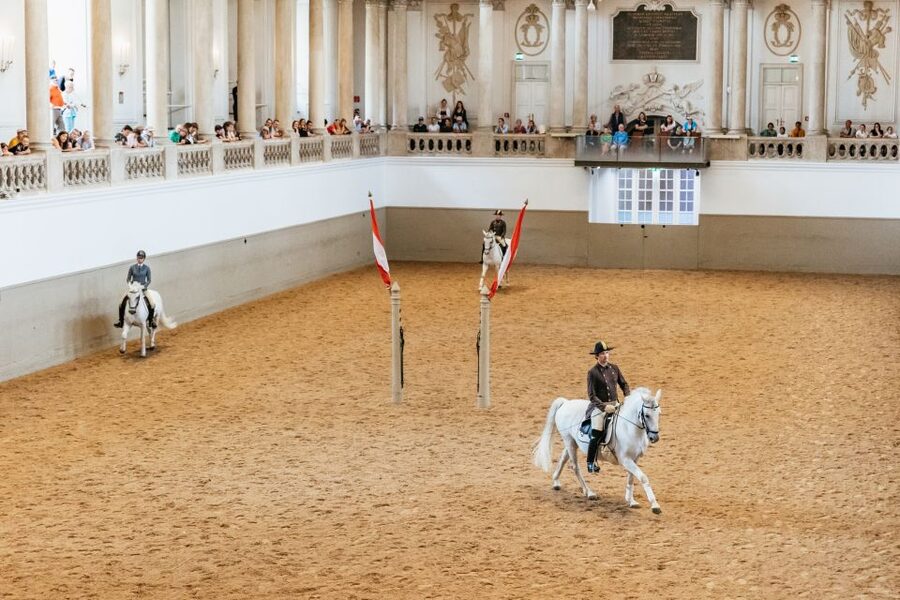
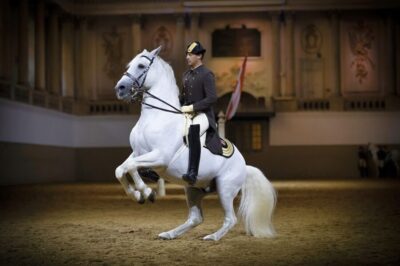
Vienna’s Spanish Riding School gives you a rare look at the work behind the famous show. In the Baroque Winter Riding Academy, white Lipizzaner stallions and their riders repeat simple movements, refine balance, and build the strength needed for haute école training. The horses work to classical Viennese music beneath chandeliers, which is about as Viennese as an hour can get.
I like the reasonable $20 price and the chance to see the horses in their everyday training rather than only in a polished performance. I also like the range of work on view, from relaxed walking and trotting to sidesteps, lead changes, and more demanding movements. The main drawback is that the spectacular school jumps, including the levade, courbette, and capriole, are not practiced every day.
Key points
- Training, not a full performance: You see the daily work that keeps the stallions fit and prepares them for the high school movements.
- One hour in a remarkable setting: The Winter Riding Academy, with its chandeliers and Baroque design, is part of the experience.
- Classical music accompanies the horses: Viennese music plays as the riders work through their exercises.
- The advanced jumps are occasional: You might see impressive movements, but the levade, courbette, and capriole are not guaranteed.
- Standing tickets can save money: They offer good value, but standing for the full hour may be tiring.
- Plan for stairs and a ticket exchange: There is no elevator, and you must exchange your voucher for a ticket at the entrance.
Inside Vienna’s Winter Riding Academy
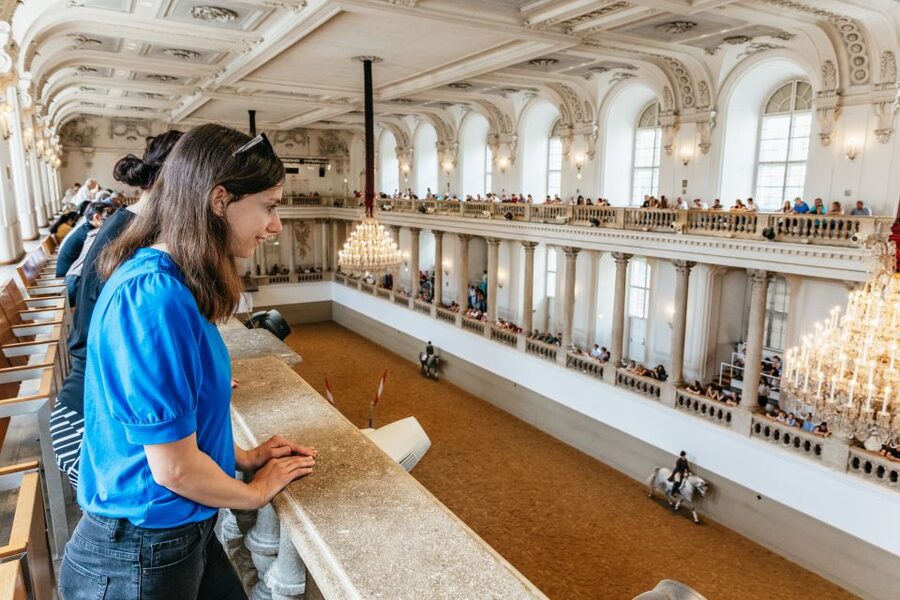
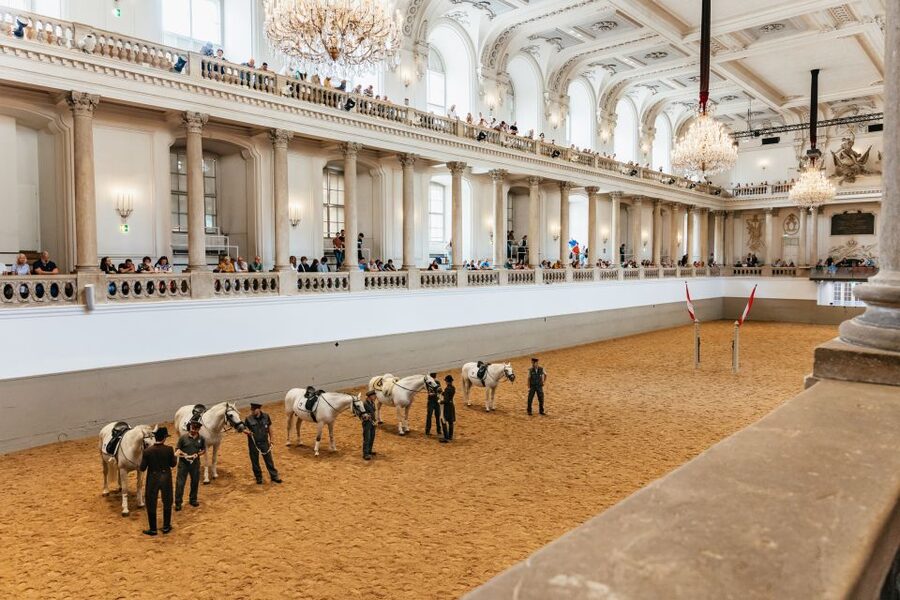
The setting is more than a place to watch horses. The Spanish Riding School’s Winter Riding Academy is a grand Baroque hall with chandeliers hanging above the riding surface. It gives the training a formal, almost theatrical feel, yet the work itself is practical and repetitive.
That contrast is what I find most interesting. You are not simply watching a display of trained animals. You are seeing a working school where horses and riders develop skills over many years. The riders guide the stallions through exercises designed to maintain athletic fitness, improve movement, and strengthen the muscle groups needed for haute école.
The hall also helps explain why this is a worthwhile stop even if you do not know much about dressage. The architecture, the music, the uniforms, and the careful rhythm of the session make the experience easy to appreciate from the first minute.
More Spanish Riding School mornings:
- Vienna Spanish Riding School Guided Tour
★ 4.7 · 6,765 reviews - Performance Of The Lipizzans At Spanish Riding School
4,190 reviews - Vienna: Spanish Riding School 45-Minute Performance Show
★ 3.9 · 731 reviews
What happens during the one-hour training
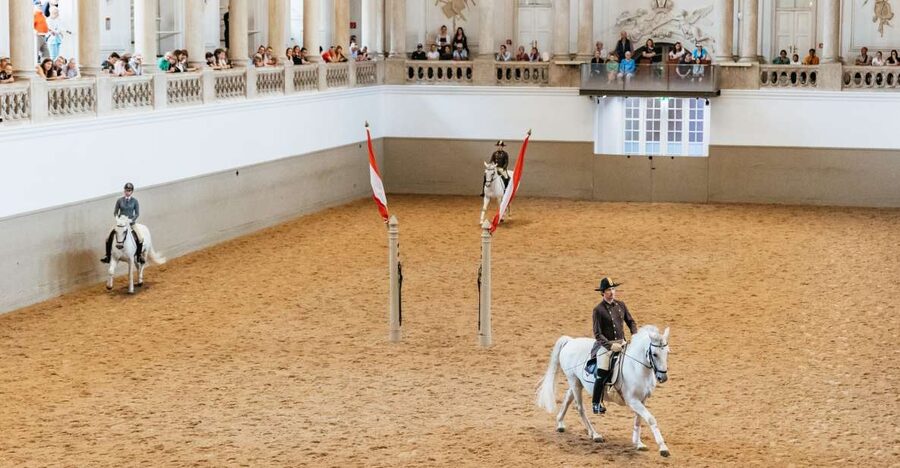
The session is called morning exercise, but it is not a single choreographed routine. Different horses and riders may be at different stages of training, so the program changes from one visit to the next.
You might first see simple, relaxed exercises. Horses walk, trot, and work through basic transitions. These movements can look modest compared with the leaps associated with the Spanish Riding School, but they are the foundation of everything that comes later.
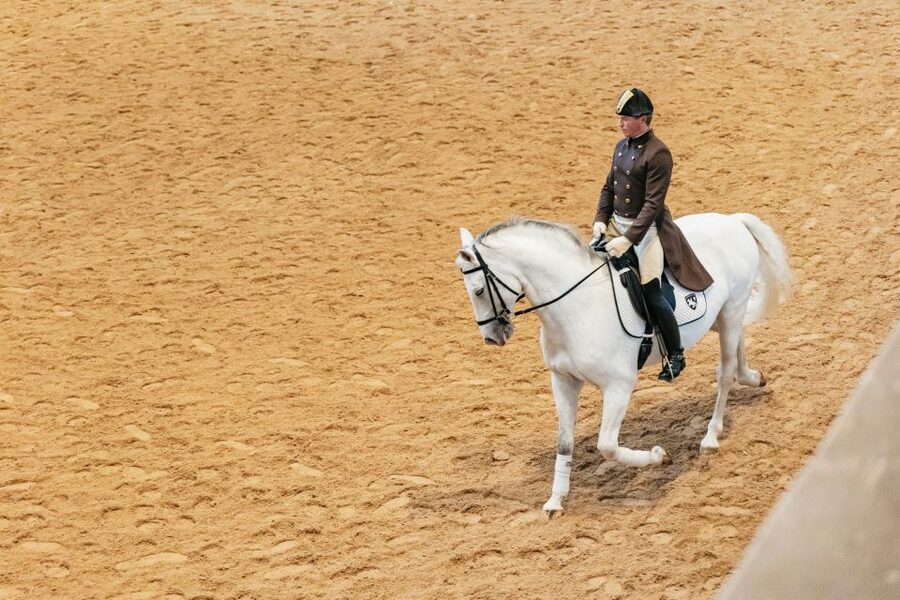
The riders also practice refining and perfecting movement. That can include changes of lead, sidesteps, lunging, and other forms of controlled dressage work. One rider may guide a seasoned horse through a familiar exercise while another receives closer instruction on a less advanced horse.
This difference in ability is one of the most useful things to watch. A rider in training may wear a different uniform and a riding hat, making it easier to identify the developing partnership. The contrast between an experienced pair and a newer pair helps you see how much patience and repetition the school requires.
You may see several horses working in the arena at once. This gives the session energy, but it also means you cannot always focus on one horse. If you want a clear understanding of a specific movement, watch the rider’s hands, posture, and leg position rather than trying to follow every horse at the same time.
Some sessions include two groups of horses during the hour, and you might see both groundwork and ridden work. The exact program can change, so think of this as an observation session, not a fixed show with guaranteed acts.
The Lipizzaners are the real focus
The white stallions are the stars, but the training is built around their long-term health. The primary purpose of the morning exercise is to maintain athleticism, strengthen particular muscles, and keep the horses prepared for advanced movements.
That makes the slower sections worth your attention. A relaxed walk or careful transition may not produce the instant thrill of a jump, but it shows the control expected from both horse and rider. The school’s famous movements are the result of this steady foundation.
I also appreciate that the training lets you see different stages of development. Some horses may work on basic movements, while others are more polished. You may see a rider repeat one exercise several times, not because the session lacks variety, but because repetition is how the horse and rider build accuracy.
The horses appear in excellent condition, and care is clearly central to the work. Still, you should not approach this as a petting experience or a chance to see the animals up close. You watch from the seating or standing areas, and photography and video are not allowed inside.
Do not book this expecting constant leaps
The most important expectation to set is simple: morning training is not the full performance.
The Spanish Riding School’s famous school jumps include the levade, in which the horse balances with its forelegs raised; the courbette, involving controlled hops; and the capriole, a demanding airborne movement. These are not part of every training session. You might see one, but you may also see a full hour devoted mainly to walking, trotting, dressage, transitions, and muscle work.
That is not a weakness if you are interested in how the horses learn. It is a limitation if you want a nonstop spectacle. Several people leave pleased by the insight into training but still wish they had seen more advanced horsemanship.
I would choose this session if the official performance is sold out, too expensive, or poorly matched with your schedule. At $20 per person, it offers a sensible way to experience the school and see the stallions without paying full performance prices. If witnessing the jumps is your main reason for coming, save room in your budget for a performance instead.
A few more Vienna days worth a look
- Vienna: Vivaldi’s Four Seasons Concert in Karlskirche
★ 4.7 · 14,951 reviews - Vienna: Skip-the-cashier-desk-line Giant Ferris Wheel Ride
★ 4.5 · 7,859 reviews - Vienna: Schönbrunn Palace & Gardens Skip-the-Line Tour
★ 4.7 · 7,739 reviews - Vienna: Light of Creation Votive Church Immersive Light Show
★ 4.8 · 6,779 reviews
Music, commentary, and what you can hear
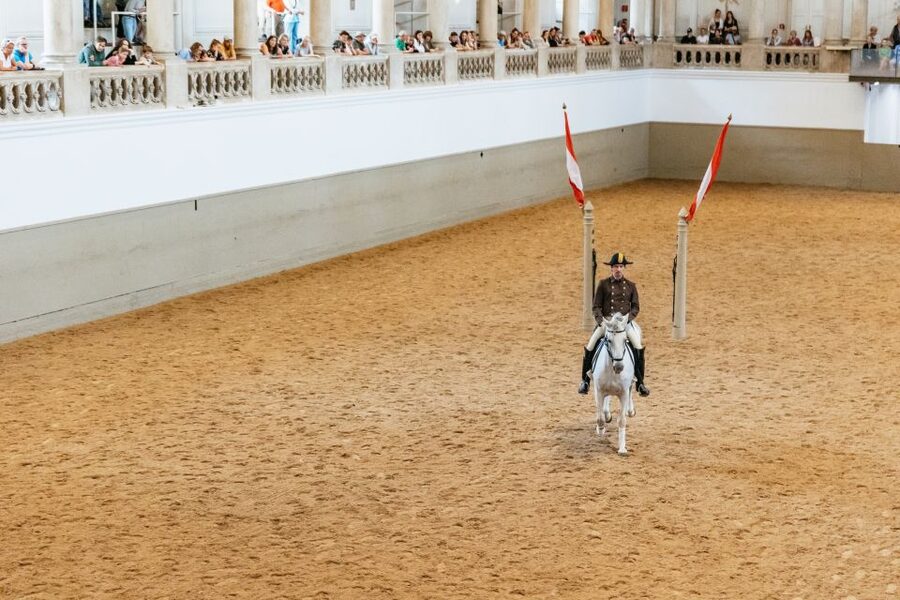
Classical Viennese music accompanies the exercise. It adds atmosphere without turning the session into a concert. The music also helps mark the changing pace of the work, especially when the horses move from relaxed exercises into more active sequences.
There is commentary about the history, the horses, and the training process. The quality of what you hear depends heavily on your position. People seated high in the upper sections sometimes find the narration muffled or difficult to follow. A seat in the middle section may be a better choice if the explanation matters to you.
You should also be ready for a fairly quick delivery. If you are relying on the commentary to understand every movement, sit where the speaker is easiest to hear and arrive with enough time to settle in. The visual experience remains worthwhile without perfect audio, but the background information adds a lot for anyone new to dressage.
Choosing between standing and seated tickets
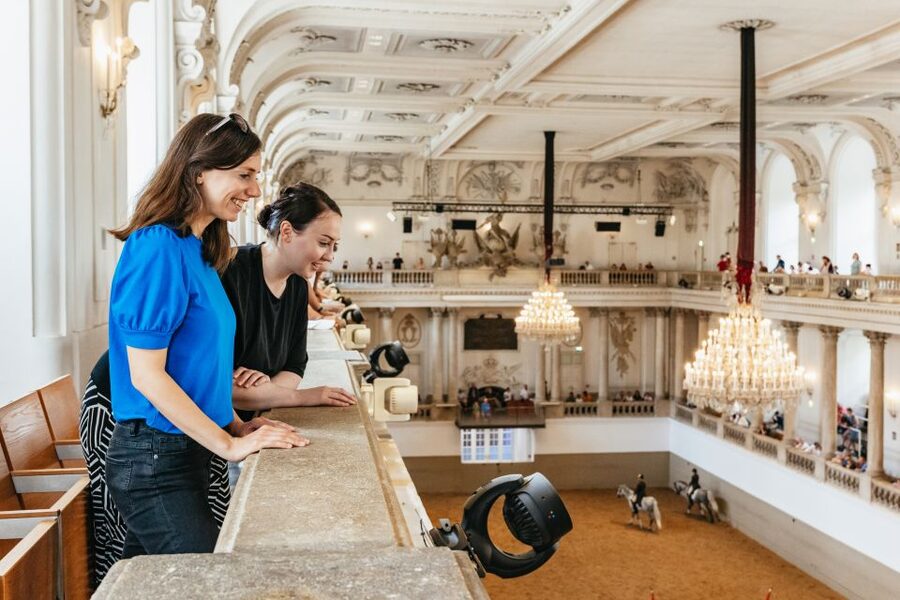
Standing tickets are the economical choice, and they can provide a good view of one side of the arena. They are especially useful if you want the lowest price or if the seated options are limited.
The tradeoff is comfort. You may be on your feet for the entire hour, and leaning forward to see over a wall can become tiring. Some people find an open stone seating area or an available seat, but you should not count on that.
Seated tickets cost more, but they make more sense for anyone with knee, back, or balance problems. Seating position matters. Upper balcony seats can require you to lean forward, and a high wall may block part of the arena. A side position can also limit your view of one end of the riding surface.
If you have a choice, I would favor a middle section with a broad view and good access to the commentary. Arrive early, since getting a better position matters more here than at a conventional theater. The best view may not be the most expensive one if the sightline is partly blocked.
Timing, entry, and ticket exchange
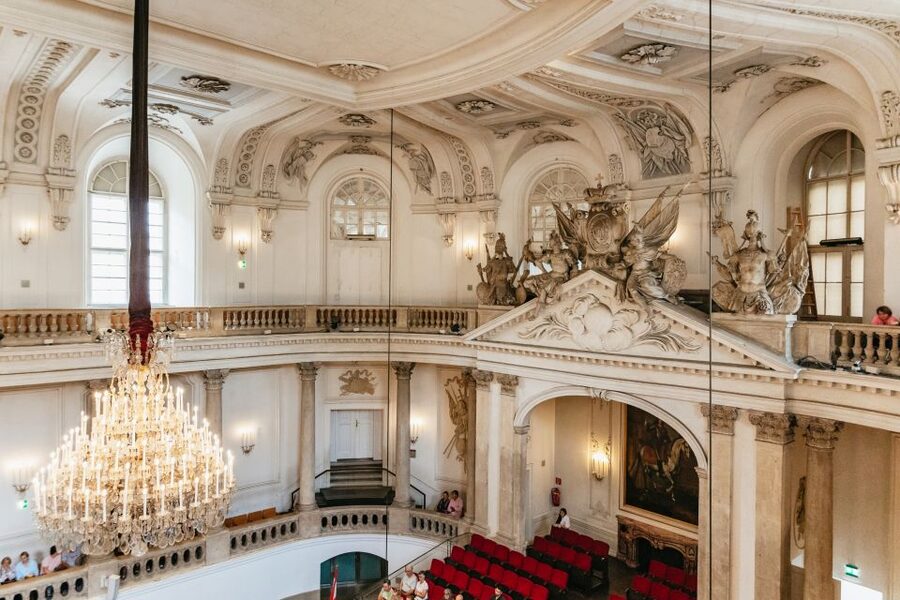
The activity lasts one hour, and starting times vary. Check availability for the day you want rather than assuming a fixed morning schedule.
Bring your voucher to the Spanish Riding School entrance and exchange it for the admission ticket. You can collect the ticket at the earliest one hour before the activity. This detail matters because arriving at the venue is not the same as completing entry. Give yourself time to find the exchange point before the session begins.
One useful practical lesson is to avoid arriving at the last minute. The building can be crowded, and the ticket exchange may require you to move around the building or queue separately. Early arrival also gives you a better chance of choosing a comfortable standing position or getting settled in your assigned seat.
The program can change. Horse training is not a mechanical stage show, and the school may adjust the work according to the horses and riders scheduled that day.
Accessibility and family considerations
There is no elevator because of the building’s monument protection. Stairs can be a serious issue for anyone with limited mobility, especially when reaching upper seating areas. If you use a wheelchair or have difficulty walking, send a request in advance rather than relying on arrangements at the door.
The experience can work well for families, but the seating choice matters. Children aged 3 to 5 enter free when sitting on an adult’s lap. Children aged 6 to 18 receive reduced admission. Children under 3 are not admitted.
A one-hour session is a manageable length for many children, and the horses moving to music can hold their attention. Standing for an hour may be harder for younger children, though, so consider seated tickets when available.
Pets are not allowed.
Photography rules are strict
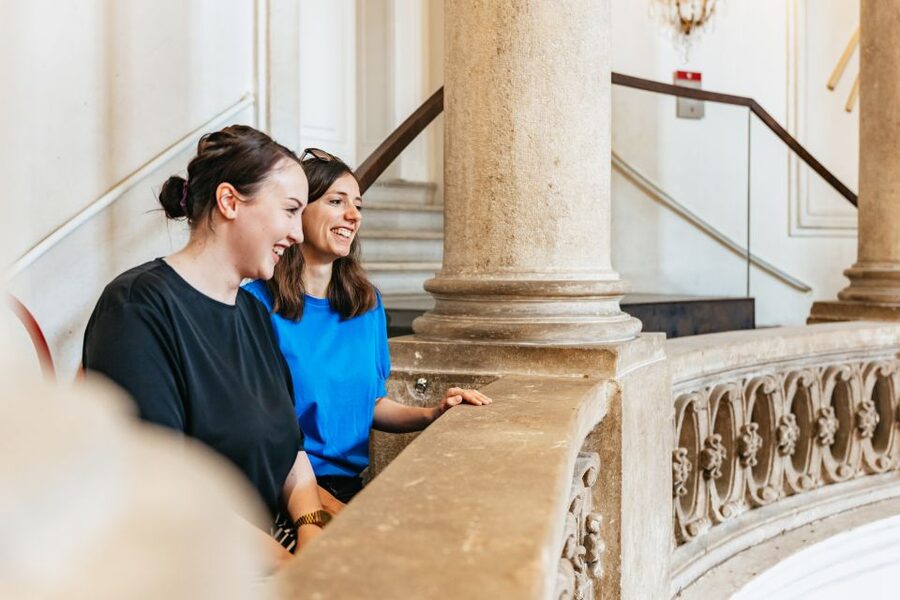
Photography and video recording are not permitted inside. Staff make repeated announcements about this, but you should follow the rule from the start. Do not plan on taking a quick phone picture once the horses enter.
This can feel disappointing, especially in such a striking building. The chandeliers, white stallions, and formal riding school setting are natural photo subjects. Still, the restriction keeps the session quieter and prevents screens from distracting the horses, riders, and people watching.
If having a photograph is essential to you, this may be a drawback. I would treat the hour as a chance to watch closely rather than as a photo stop. Pay attention to the rider’s position, the horse’s balance, and the small changes in movement that are easy to miss while holding up a phone.
Is the $20 price good value?
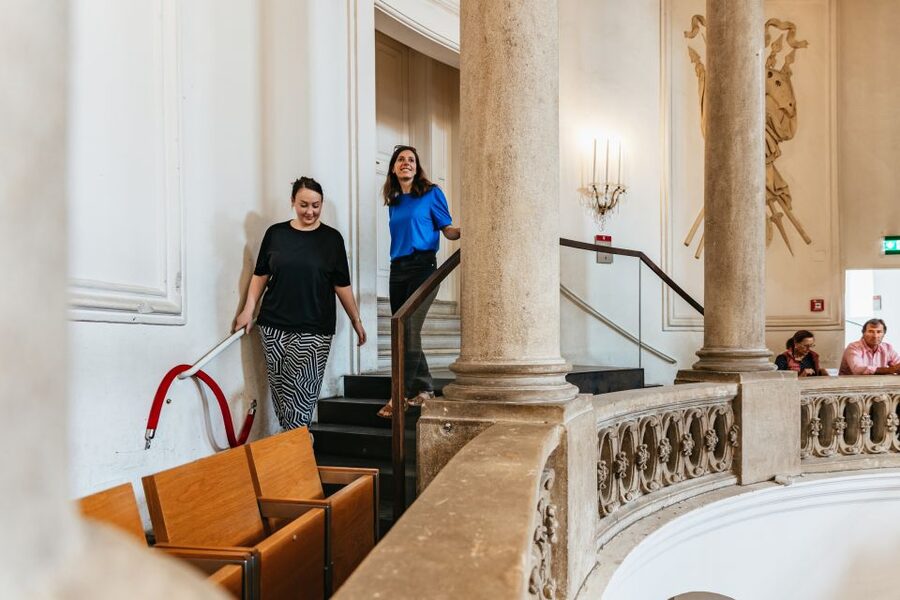
For $20, I think this is one of Vienna’s better low-cost cultural activities, particularly if you enjoy horses, architecture, or traditional performance. You get one hour in the historic academy, classical music, commentary, and access to a working training session.
The value is strongest when you understand what you are buying. This is not a cheaper version of the full show in every sense. It is quieter, less polished, and more dependent on the day’s training program. You may see remarkable dressage work, but you may not see the famous jumps.
I would compare it with the cost of a full performance and ask what you want from the visit. If your aim is to see the venue and watch the horses at work, the training session is excellent value. If you want a dramatic sequence of perfected movements, the full performance may be the better purchase.
The flexible booking terms also help. You can cancel up to 24 hours in advance for a full refund, and you can reserve now and pay later. That is useful when your Vienna schedule is still changing.
Who should book this session?
I would recommend it most strongly to:
- Horse lovers and riders who want to study training methods and horse-rider partnerships.
- First-time visitors who cannot get tickets for a full performance.
- Families looking for a one-hour activity with a manageable duration.
- Architecture fans who want to see the Winter Riding Academy.
- Budget-conscious visitors who want a taste of the Spanish Riding School for $20.
- People who enjoy watching skilled work develop through repetition rather than constant spectacle.
I would be more cautious if you need step-free access, cannot stand for an hour, or expect a guaranteed levade, courbette, or capriole. In those cases, contact the school ahead of time about access and consider the full performance if the advanced movements are your priority.
Should you book the Spanish Riding School training?
Yes, if you want an affordable and atmospheric look at the work behind Vienna’s famous equestrian tradition. I especially like it as a backup when performance tickets are gone, and I think it is a strong choice for anyone who rides or already has an interest in dressage.
Book with realistic expectations. You will see beautiful Lipizzaner stallions, dedicated riders, classical music, and a remarkable Baroque hall. You may see impressive advanced movements, but the session’s main purpose is health, practice, and steady improvement. Arrive early, choose your position carefully, respect the no-photo rule, and you will get much more from the hour.
FAQ
How long does the Spanish Riding School training last?
The training session lasts one hour.
How much does the activity cost?
The listed price is $20 per person.
What does the ticket include?
The ticket includes admission to the training at the Spanish Riding School.
Is hotel pickup included?
No. Hotel pickup and drop-off are not included.
Where do I exchange my voucher?
Present your voucher at the Spanish Riding School entrance and exchange it for an admission ticket.
When can I collect my ticket?
You can pick up your ticket at the earliest one hour before the activity.
Can I take photos or record video?
No. Photography and video recording are not allowed inside.
Are the famous school jumps guaranteed?
No. The levade, courbette, and capriole are not practiced every day, so they may not appear during your session.
Are children admitted?
Children aged 3 to 5 enter free when sitting on an adult’s lap. Children aged 6 to 18 receive discounted admission. Children under 3 are not admitted.
Is the venue accessible for wheelchair users?
The building has no elevator because of monument protection. Wheelchair users and people with walking difficulties should send a request in advance.
Just added around Vienna
- Vienna: UNESCO Schönbrunn Palace Guided Tour with Entry★ 4.5 · 94 reviews
- World War II History Vienna Old Town Private Walking Tour★ 4.8 · 9 reviews
- Vienna: Winery and Wine Tasting Tour with a Wine Expert★ 5.0 · 5 reviews
- Vienna: Wine Tasting E-Bike Tour★ 4.9 · 46 reviews
- Vienna: Wine Tasting at Schönbrunn Palace★ 4.3 · 71 reviews
- Vienna: Wine Tasting Tour★ 4.8 · 61 reviews
- Vienna: Wachau Valley Private Kayak and Wine Tour★ 5.0 · 3 reviews
- Vienna: Wiener Schnitzel and Strudel Cooking Class★ 4.9 · 126 reviews
Spanish Riding School Tickets, compared.
Spanish Riding School 45-Minute Performance Show
Read our review →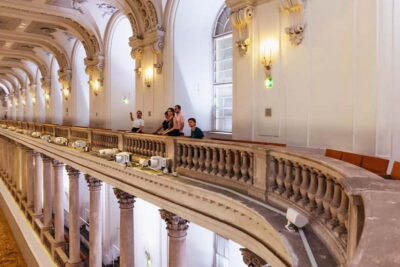
Spanish Riding School Guided Architectural Tour
Read our review →Browse the lists this tour appears in