
Reviewed · MOZART CONCERTS
Vienna: Mythos Mozart Experience
Mythos Mozart begins with a room of 1,500 candles and ends with dazzling digital art, taking you through the building where Mozart spent his final year. In between, you hear his music, see Vienna as he knew it, and play instruments from around the world.
I like the strong visual design, which makes Mozart approachable even if you cannot name a single symphony. I also like the rooftop access, with views toward St. Stephen’s Cathedral, Karlskirche, and the giant Ferris wheel. The main drawback is that the one-hour visit gives you a powerful impression of Mozart, but not a detailed account of his life or musical work.
Key points to know before you go
- Mozart’s final address: The exhibition is in the building where Mozart died in 1791 and composed The Magic Flute and The Requiem.
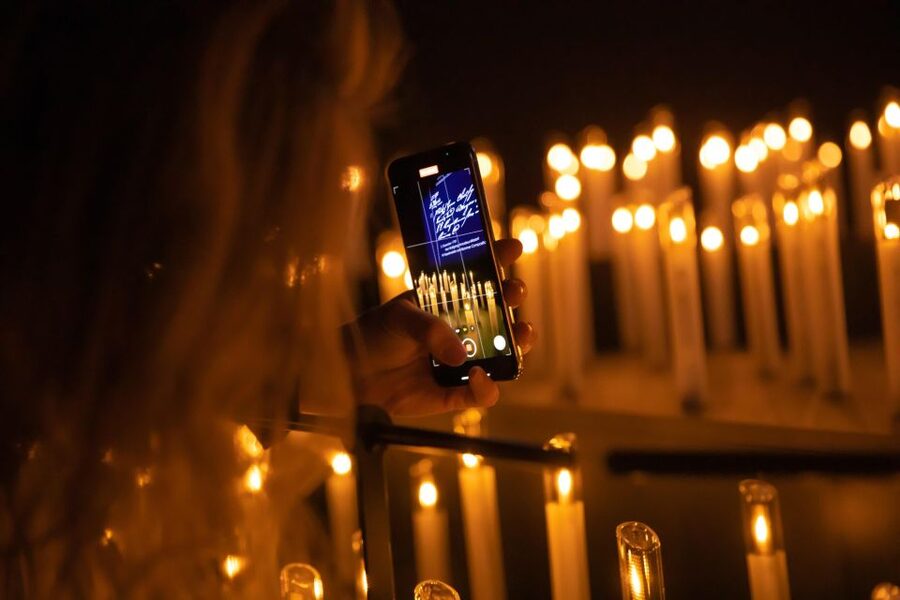
- A candlelit opening: The REQUIEM room uses 1,500 candles to create a solemn, theatrical start.
- Vienna in 360 degrees: The VIENNA 1791 room turns Mozart’s city into a moving panorama you can watch from several angles.
- Hands-on music making: The Little Night Music room lets you try instruments from different parts of the world.
- A short, weatherproof outing: Plan on about one hour, making it a useful choice for a rainy afternoon or a spare gap between sights.
- A good family introduction: You do not need musical training, though visitors wanting serious biography or detailed music analysis may find it too light.
Mozart’s final year, presented through light and sound
Mythos Mozart occupies the building where Wolfgang Amadeus Mozart spent the last year of his life. He died here in 1791, and the same setting connects the exhibition to The Magic Flute and The Requiem.
That location gives the visit a useful anchor. You are not simply entering a modern digital show in an unrelated venue. You are seeing music and images in the place tied to Mozart’s final months, even though the exhibition itself is not a traditional preserved-room museum.
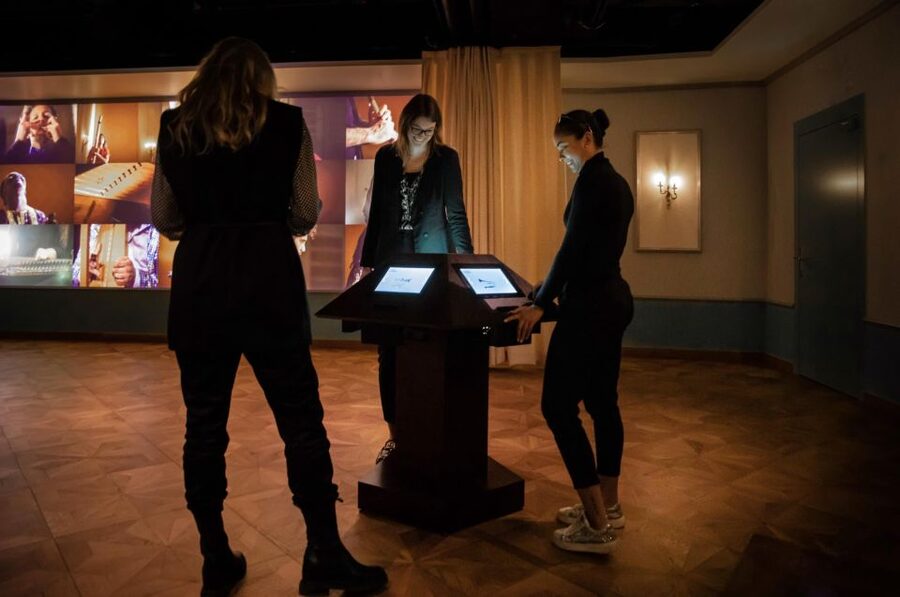
The format is closer to a sequence of art installations than a standard museum. You move from room to room, spending roughly ten minutes in each area. Music, projection, lighting, animation, and short explanatory material carry the story. The English-speaking host or greeter helps with entry, but you should expect to take the experience at your own pace rather than follow a long guided lecture.
I find this approach especially helpful for a first encounter with Mozart. You receive a sense of the man, his city, and his music without needing to arrive with a background in Classical music.
More Mozart Concerts in Vienna
- Vienna: Mozart Concert at the Golden Hall
★ 4.6 · 3,986 reviews - Vienna: Classical Concert at Mozart’s First House
2,423 reviews - Vienna: Mozart and Strauss Concert at Schönbrunn
★ 4.5 · 2,364 reviews
The REQUIEM room begins with 1,500 candles
The first major room, REQUIEM: MOZART’S DEATH, sets a serious mood. Its 1,500 candles were designed with lighting artist Moritz Waldemeyer, and the effect is far more atmospheric than a room filled with ordinary screens.
The candles create a slow, quiet opening built around The Requiem and the final period of Mozart’s life. The room can feel eerie as well as beautiful, so it is not the lighthearted beginning some people may expect from a family attraction. That is part of its purpose. It places you close to the uncertainty and sadness surrounding Mozart’s death before the exhibition moves into the city and the music.
I like this opening because it gives the visit emotional shape. You are not simply fed facts in chronological order. Instead, the room asks you to pause and listen before moving into the larger world of Vienna.
It is also the section most likely to stay with you after leaving. The candlelight, sound, and darkness work together in a way that photographs cannot fully capture. If you are sensitive to dark rooms or strong visual effects, take your time and let your eyes adjust.
Vienna in 1791 becomes a moving picture
From the Requiem room, the experience shifts to VIENNA 1791: MOZART’S CITY. Here, historical Vienna is presented through 360-degree panoramic views and animated scenes.
You can stroll through a recreation of the city, look over its rooftops, and travel through the scene in a balloon. At one point, the presentation brings you in front of the building where Mozart died. The room is less about examining individual artifacts and more about giving you a visual sense of the city around him.
This is an important part of the visit because Mozart’s work did not happen in isolation. The city supplied his audiences, churches, theaters, patrons, rivalries, and daily routines. Seeing Vienna from above gives you a basic sense of its scale and makes the connection between composer and city easier to picture.
The drawback is that the presentation does not replace a detailed city museum. You will not get an extensive timeline, a deep study of Viennese politics, or a room-by-room account of Mozart’s professional life. You get atmosphere and orientation, which is often enough for a one-hour visit but may leave serious music fans wanting more.
Little Night Music is the most playful stop
The Little Night Music room changes the tone again. Here you can interact with instruments from around the world rather than only watching projections. It is the most hands-on part of the visit and gives children, teens, and curious adults something active to do.
The point is not to perform Mozart perfectly. Instead, the room invites you to think about sound, rhythm, and the physical act of making music. That break from the darker opening and the panoramic city scene keeps the hour from feeling like a long audiovisual presentation.
I would give this room extra time if you are visiting with children. It offers a simple way to make the subject personal: you are not just hearing about a composer, you are experimenting with sound yourself.
The exhibition uses music and visual effects more than traditional objects, so this is also where you notice its limits. If you prefer original manuscripts, historic instruments, portraits, and long written explanations, you may find the material fairly light. If you prefer an active cultural stop, the hands-on design is a strong advantage.
A completely different way to spend a day here:
- Vienna: Vivaldi’s Four Seasons Concert in Karlskirche
★ 4.7 · 14,951 reviews - Vienna: Spanish Riding School Training
★ 3.9 · 9,281 reviews - Vienna: Skip-the-cashier-desk-line Giant Ferris Wheel Ride
★ 4.5 · 7,859 reviews - Vienna: Schönbrunn Palace & Gardens Skip-the-Line Tour
★ 4.7 · 7,739 reviews
The final rooms focus on Mozart’s modern side
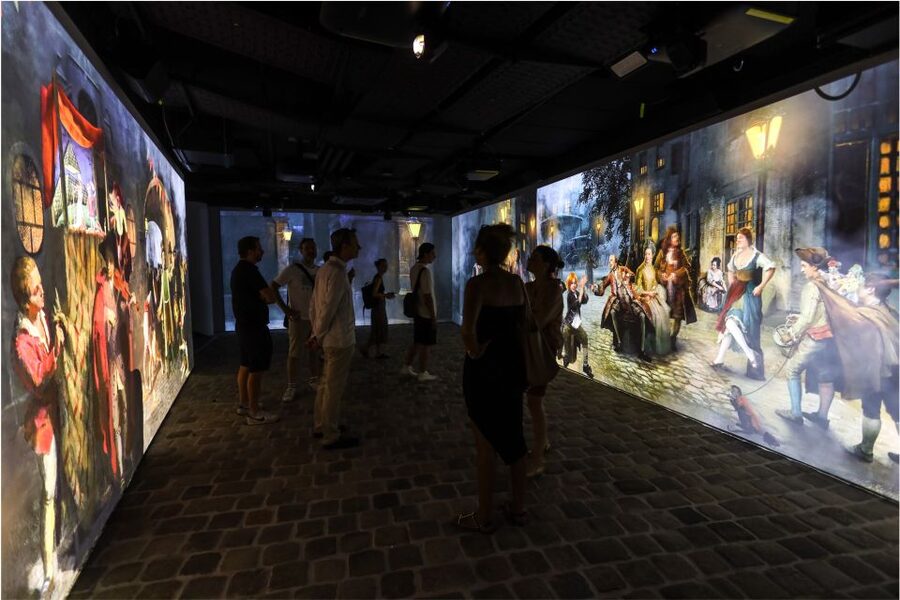
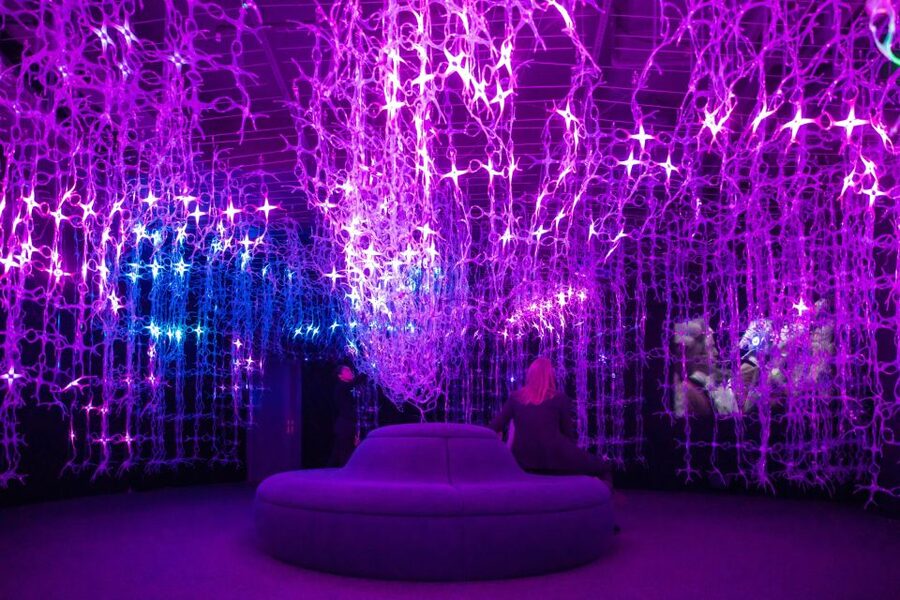
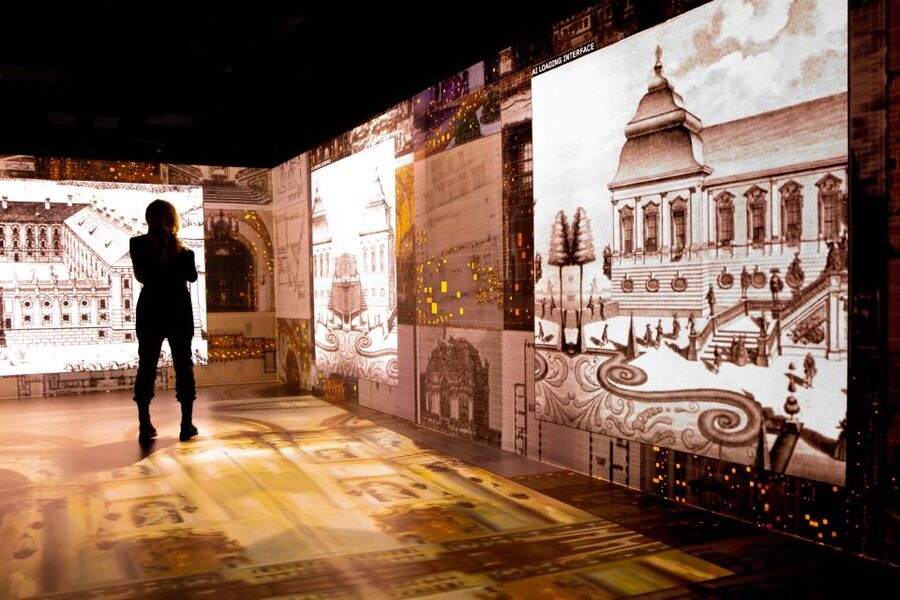
Later sections bring the music and imagery together in a more contemporary style. Digital projections, LED screens, animations, and sound create the feeling of being surrounded by Mozart’s work rather than observing it from a distance.
One final section includes artificial intelligence and modern tools. This choice will not appeal to everyone. Some people may feel that the technology pulls attention away from Mozart’s life, while others will enjoy the question it raises: what might Mozart have done with the creative tools of the 21st century?
I see this ending as a deliberate contrast with the candlelit beginning. The show starts with death and remembrance, then finishes by presenting Mozart as inventive, current, and open to fresh interpretation. That last section can feel more like a digital art installation than a history exhibit, so set your expectations accordingly.
The technology is most successful when it serves the music. When the images move with the score, the result can be striking. When you are hoping for a clear explanation of a particular composition, the visuals may feel more important than the facts.
The rooftop adds real value to a short visit
The Sky and Roofgarden is one of the practical pleasures of Mythos Mozart. After the indoor rooms, you can look across Vienna’s First District toward St. Stephen’s Cathedral, Karlskirche, and the Ferris wheel.
These views help connect the digital presentation to the real city outside. You have just seen Vienna as it appeared in 1791, and now you can look at the modern city from above. That change of scale makes the stop feel more complete.
Food and drinks are not included in the admission, but they can be purchased at the Sky Café and Restaurant. The café has a large roof terrace, so you can turn a one-hour visit into a longer break if you want a drink or a meal.
The rooftop may be less appealing in poor weather, of course, and it should not be the main reason you buy a ticket. Think of it as a useful extra, especially if you are already sightseeing in central Vienna and want a place to pause.
Is $27 a fair price for one hour?
At $27 per person, Mythos Mozart is not the cheapest short attraction in Vienna. The visit lasts about one hour, and you do not receive food, drinks, hotel transport, or a traditional private guide.
Still, the price can be fair if you value design, music, and a focused indoor stop. You are paying for several distinct rooms, extensive lighting and projection work, interactive instruments, a historical setting, and rooftop access. It is also an easy activity to fit into a busy day because it does not demand half a day.
I would compare it with a concert, a conventional Mozart museum, or a major palace visit rather than with a free church or public square. A concert gives you a longer period of live music. A traditional museum gives you more objects and factual detail. Mythos Mozart gives you a concentrated sensory presentation that is easier for children and people new to classical music.
The value is strongest for first-time visitors who want an introduction without a lecture. It is weaker for anyone seeking original documents, extensive biography, or a close study of Mozart’s compositions.
The overall rating is 4.5 from 895 reviews, and the strongest recurring praise centers on the visuals, the candle room, the friendly welcome, and the way the exhibition works for people who are not classical music specialists. That matches the sensible way to judge the ticket: this is an art and music presentation first, not a scholarly museum.
How to plan your hour
Book a time slot in advance. You should report to the Mythos Mozart Welcome Desk up to 15 minutes before your start time. Spontaneous entry can be possible, but it depends on occupancy, so I would not rely on it during a busy Vienna visit.
Allow a little extra time if you want to use the rooftop café or look at the city views. The advertised duration is one hour, but your actual visit can feel shorter or longer depending on how long you stay with the instruments and projections.
The building is wheelchair accessible. Free lockers and toilets are available, which makes the stop more comfortable if you are carrying day bags. Pets are not allowed, and you should bring a passport or other ID. A student card is also listed as useful to have with you.
The activity is available in English, and the host or greeter speaks English. The presentation itself relies heavily on music, lighting, and visual material, which means you can follow much of it without advanced language skills. If you want detailed commentary at every stage, you may find the format less satisfying.
Cancellation is flexible if your plans change: you can cancel up to 24 hours ahead for a full refund. A reserve-now-and-pay-later option is also available, which helps if you are planning several Vienna activities around weather or concert times.
Who will enjoy Mythos Mozart most?
I would recommend it to:
- Families looking for an indoor cultural activity that does not require children to read long labels.
- Adults who enjoy music, projection art, lighting, and unusual museum formats.
- First-time Mozart visitors who want a quick introduction before attending a concert.
- People with a rainy afternoon or a free hour between central Vienna sights.
- Visitors who enjoy taking photographs of dramatic interiors and rooftop views, where permitted.
I would be more cautious if you want a detailed musical education. The exhibition introduces Mozart through mood, sound, and visual storytelling, but it does not provide a full academic account of his work.
It is also worth knowing that the experience can move from solemn to playful to high-tech. That emotional shift is part of the design, but it may feel uneven if you prefer a quiet, traditional museum.
Should you book Mythos Mozart?
Book it if you want a short, polished introduction to Mozart that combines music with dramatic rooms and modern technology. The candlelit Requiem room, the 360-degree Vienna scene, the interactive instruments, and the rooftop views give you more variety than a simple audio presentation.
Skip it if your priority is a long guided explanation, original historic objects, or a close reading of Mozart’s compositions. For most visitors, I would place Mythos Mozart in the useful one-hour category: not a substitute for a concert or a serious Mozart museum, but an engaging way to meet the composer, see the place tied to his final year, and enjoy Vienna from a different angle.
FAQ
How long does the Mythos Mozart experience last?
The experience lasts about one hour. You can spend additional time at the Sky Café and Restaurant if you purchase food or drinks there.
Where does Mythos Mozart take place?
It takes place in Vienna, in the building where Mozart spent the last year of his life and died in 1791. He also composed The Magic Flute and The Requiem there.
What does the ticket include?
The ticket includes entry to the Mythos Mozart multimedia experience. Food, drinks, and hotel pickup and drop-off are not included.
Is Mythos Mozart available in English?
Yes. The listed language is English, and the host or greeter is English-speaking.
Do I need to book a time slot?
Yes. All visitors should book a time slot in advance and report to the Welcome Desk up to 15 minutes before the start. Spontaneous visits may be possible depending on occupancy.
Is the experience wheelchair accessible?
Yes, Mythos Mozart is wheelchair accessible.
Can I bring a pet?
No. Pets are not allowed.
Can I cancel my booking?
Yes. You can cancel up to 24 hours in advance for a full refund. A reserve-now-and-pay-later option is also available.
Just added around Vienna
- Vienna: UNESCO Schönbrunn Palace Guided Tour with Entry★ 4.5 · 94 reviews
- World War II History Vienna Old Town Private Walking Tour★ 4.8 · 9 reviews
- Vienna: Winery and Wine Tasting Tour with a Wine Expert★ 5.0 · 5 reviews
- Vienna: Wine Tasting E-Bike Tour★ 4.9 · 46 reviews
- Vienna: Wine Tasting at Schönbrunn Palace★ 4.3 · 71 reviews
- Vienna: Wine Tasting Tour★ 4.8 · 61 reviews
- Vienna: Concert by the Vienna Baroque Orchestra★ 4.6 · 56 reviews
- Vienna: Wachau Valley Private Kayak and Wine Tour★ 5.0 · 3 reviews
Mozart Concerts, compared.
Salzburg 2.5-Hour Walking Tour: Mozart, Old Town & More
Read our review →
Vienna Mozart Concert in Historical Costumes at the Musikverein
Read our review →
Browse the lists this tour appears in