Reviewed · TICKETS
Vienna: Tickets to Haus der Musik
Haus der Musik turns Vienna’s musical past into something you can touch, hear, and play with. You can move from Mozart and Beethoven to the science of sound, then conduct a virtual Vienna Philharmonic performance without needing musical training. I especially like the orchestra-conducting challenge and the chance to build your own waltz with dice. The main drawback is simple: the museum is packed with material, so a quick one-hour visit will feel rushed.
I also like that this is not only a classical-music museum. Families can press buttons, test instruments, and play the Namadeus game, while adults can study documents, composers, and Vienna’s musical story. Bring headphones for the smartphone guide, and remember that food and drinks are not included.
Key points before you go
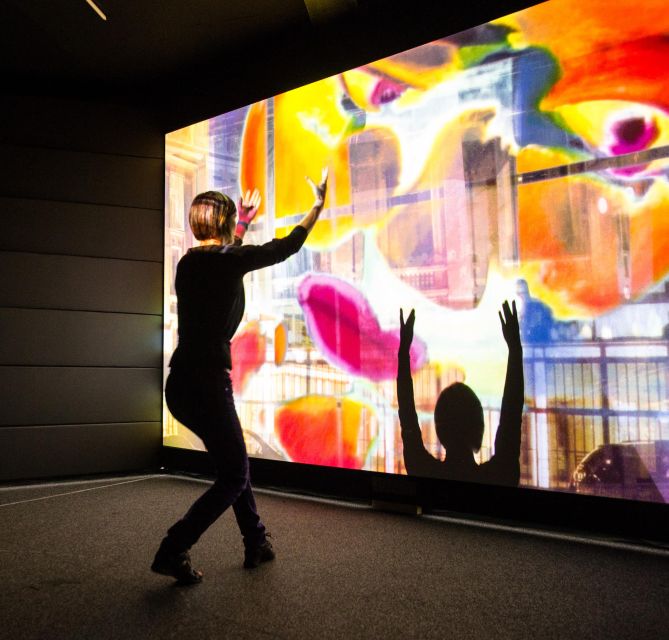
- Conduct the Vienna Philharmonic: Try to keep time with a virtual orchestra and see how the performance responds.
- Meet Vienna’s major composers: Learn about Haydn, Mozart, Beethoven, Schubert, Strauss, Mahler, and Schönberg through documents, objects, costumes, and installations.
- Test the science of sound: Explore hearing, instruments, noises, and acoustics through hands-on displays.
- Make music with games: Use dice to compose a waltz, or turn your name into a Mozart-style composition with Namadeus.
- Plan more than a quick stop: The four floors contain enough material for a few hours, especially if you read the historical and scientific displays.
- Use the free app guide: Download the guide on your own phone in one of eight languages, or use the children’s version in two languages.
What Haus der Musik does better than a standard museum
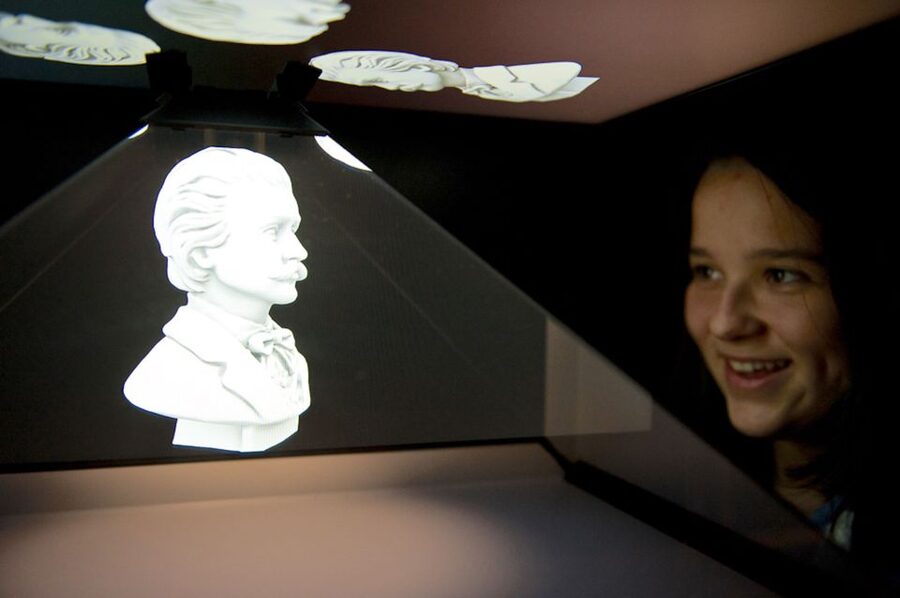
Vienna has no shortage of grand concert halls, composer memorials, and formal exhibitions. Haus der Musik takes a different route. It gives you history, but it asks you to interact with it.
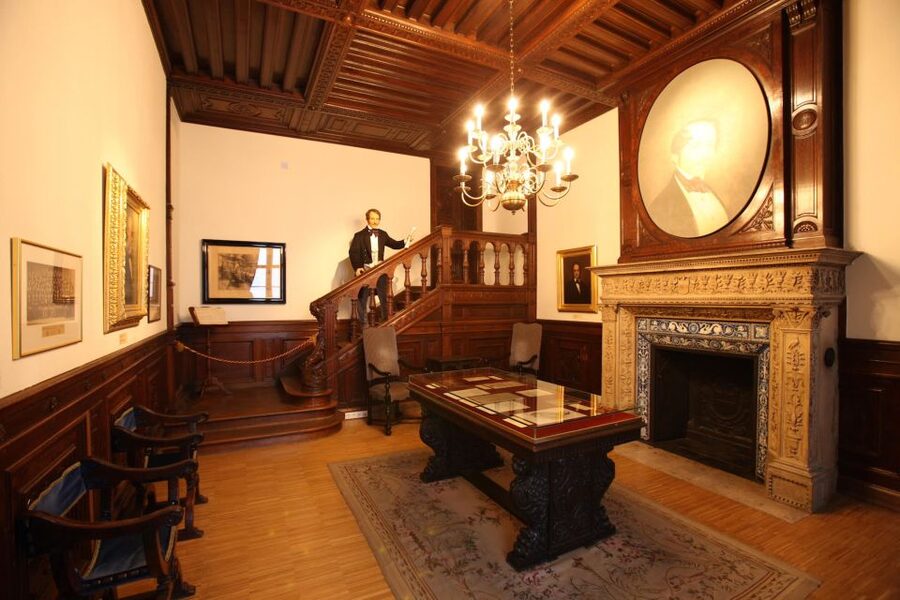
The museum occupies the former Palais of Archduke Charles, where Otto Nicolai lived when he founded the Vienna Philharmonic in 1842. That connection gives the building a useful link to the orchestra rather than making it just another old palace with display cases.
The experience works because it covers several interests at once. You can come for Mozart, stay for the physics of hearing, and finish by trying to conduct an orchestra. If you are not a classical-music fan, you still have plenty to do. If you know the music well, the historical documents and personal objects give you reasons to slow down.
I would think of the museum as a good indoor break from Vienna’s palaces and churches. It is also a smart choice for a family day, since the hands-on areas give children something to do while adults read.
A few more Vienna days worth a look
- Vienna: Vivaldi’s Four Seasons Concert in Karlskirche
★ 4.7 · 14,951 reviews - Vienna: Spanish Riding School Training
★ 3.9 · 9,281 reviews - Vienna: Skip-the-cashier-desk-line Giant Ferris Wheel Ride
★ 4.5 · 7,859 reviews
Start with the Vienna Philharmonic’s story
The Museum of the Vienna Philharmonic provides the historical anchor. Here you can see documents and keepsakes connected with the orchestra, along with the story of its beginnings in the building.
This section matters because it puts the orchestra into context before you encounter its virtual performance. The Vienna Philharmonic is not an abstract name on a concert poster. Its history is tied to the house itself, and the displays help explain that connection.
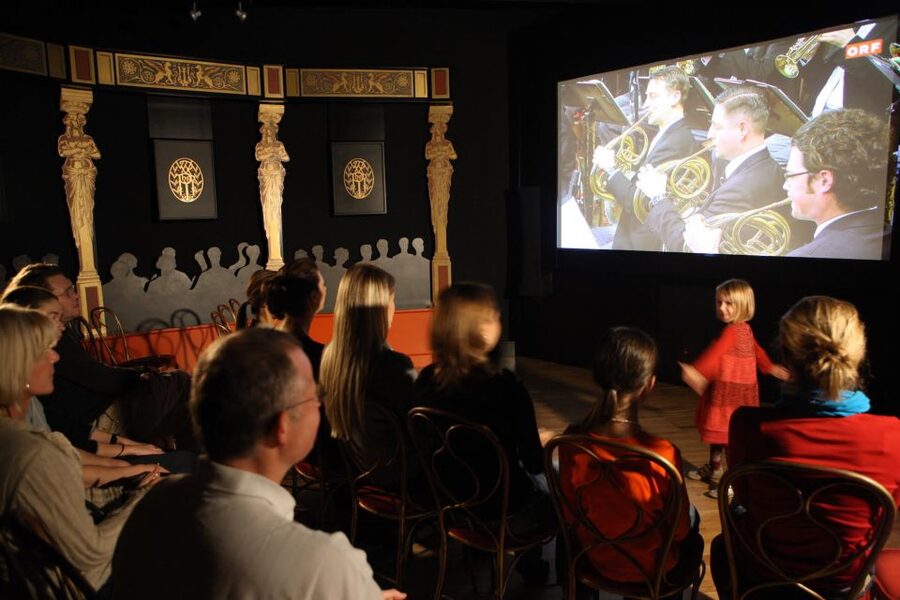
You can also listen to the orchestra’s New Year’s Concert in HD. That is a fine stop for anyone who has seen Vienna’s famous concert tradition from afar but has not managed to get a ticket. It is not a substitute for sitting in a concert hall, of course, but it gives you a clear sense of the orchestra’s public image and sound.
The limitation here is that you may be tempted to hurry past the documents in search of the interactive areas. I would not. Spend a little time getting the story of Otto Nicolai and the orchestra, then move on to the hands-on exhibits with better context.
Meet Haydn, Mozart, Beethoven, and the rest
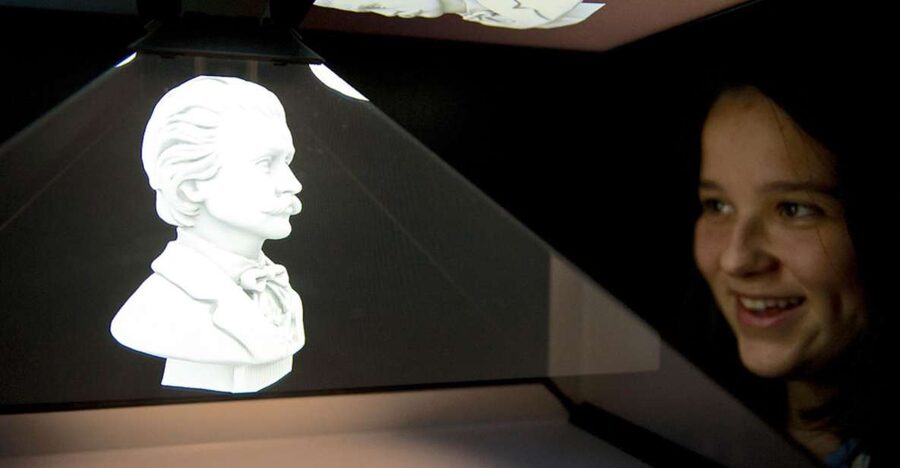
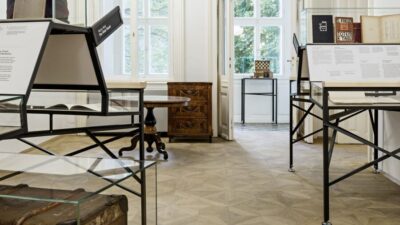
One level takes you through the lives and work of Haydn, Mozart, Beethoven, Schubert, Strauss, Mahler, and Schönberg. The displays place each composer in a period of Vienna’s story, using historic papers, models, costumes, modern installations, and personal items.
That mix keeps the rooms from feeling like a row of portraits with dates underneath. You get the people, their working world, and the music culture around them. Mozart receives special attention, including a room that many visitors find especially absorbing for its look at his life and work.
This is the strongest part for a visitor who wants actual historical substance. You can read at your own pace, pause over documents, and then move on when the information becomes too dense. The museum does not force you into a guided group, so you control the balance between reading and playing.
I would not try to absorb every label in one pass. The material is broad, and a family with younger children may prefer to choose a few composers rather than work through every panel. Adults who enjoy museum reading could easily spend a long time here.
Try the virtual orchestra conducting challenge
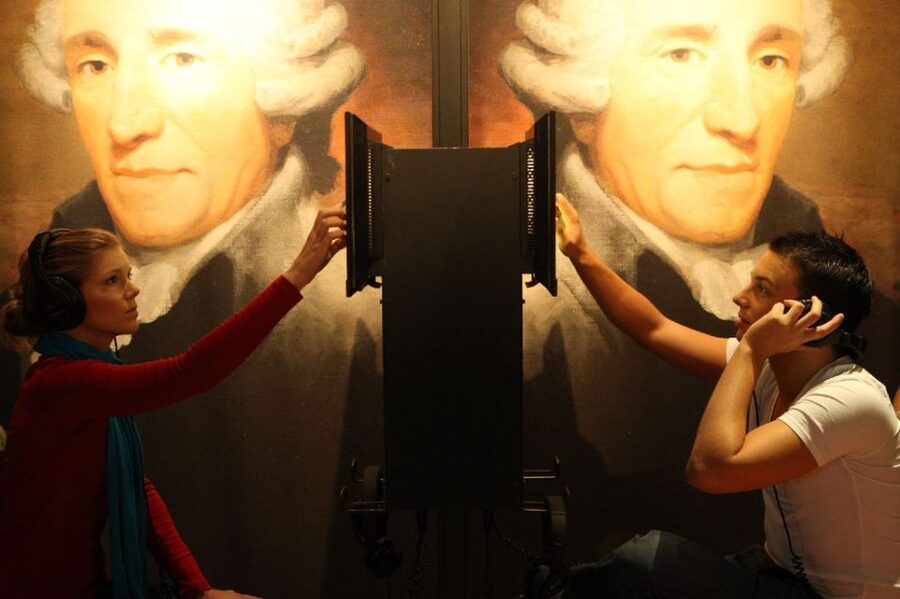
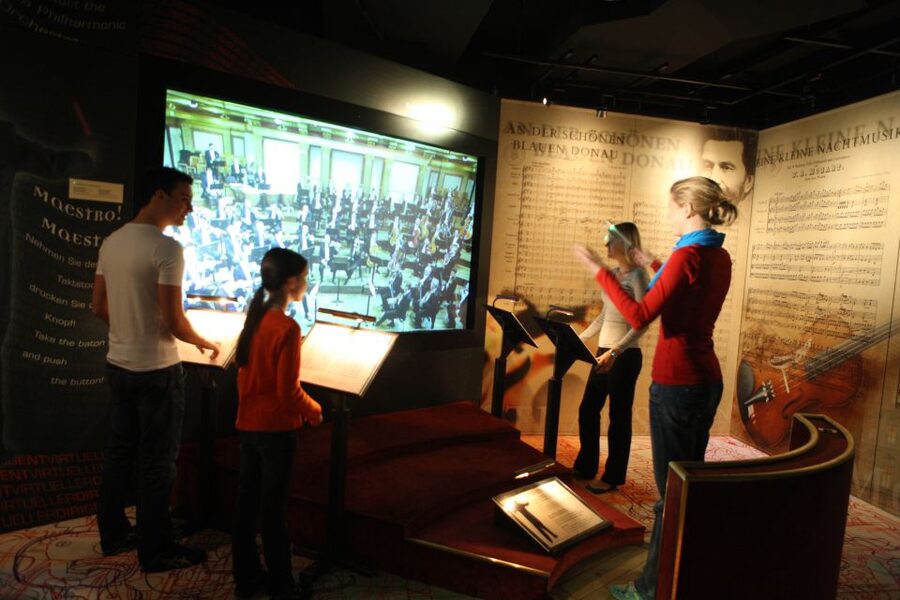
The conducting exhibit is one of the museum’s most memorable activities. You take the role of conductor and face a virtual Vienna Philharmonic performance, testing your timing and control.
You do not need formal musical study to enjoy it. The point is not to prove that you can conduct professionally. It is to give you a feel for the relationship between a conductor’s movements and an orchestra’s response.
This is a good example of why the museum suits mixed groups. A serious music lover can think about tempo and ensemble control. A child can simply enjoy taking the podium. A couple can take turns and compare results.
It is also one of the exhibits most likely to attract people, so you may need patience if several families are using it. Still, it is worth making time for. Among the museum’s many screens and buttons, this challenge gives you the clearest sense of directing a real performance.
A completely different way to spend a day here:
- Vienna: Schönbrunn Palace & Gardens Skip-the-Line Tour
★ 4.7 · 7,739 reviews - Vienna: Light of Creation Votive Church Immersive Light Show
★ 4.8 · 6,779 reviews - Vienna Spanish Riding School Guided Tour
★ 4.7 · 6,765 reviews - Vienna: Classical Concert in the World-Famous Musikverein
★ 4.6 · 6,673 reviews
Turn your name into a Mozart-style composition
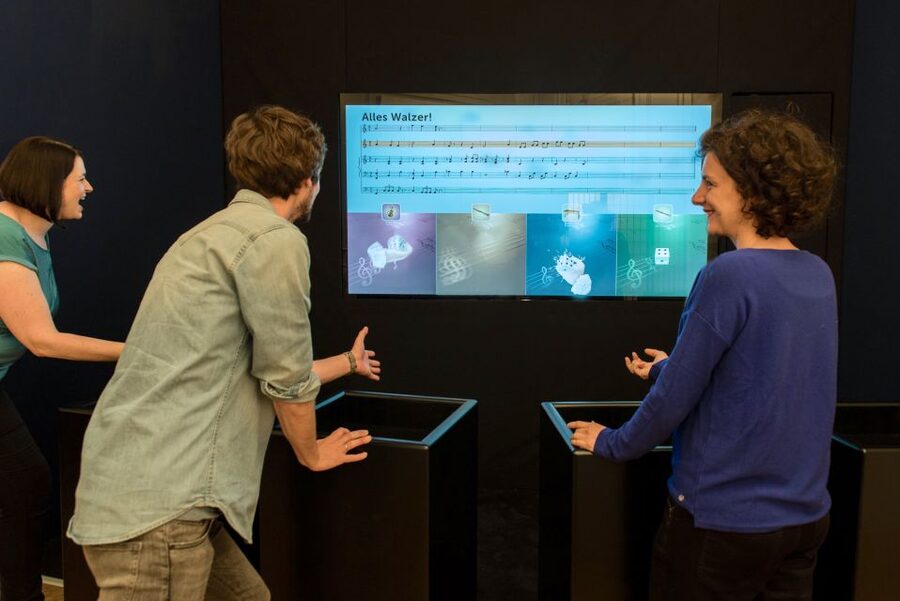
The Namadeus game offers a lighter way into Mozart’s musical world. Enter your name and hear it turned into an original Mozart-style composition.
This is playful rather than scholarly, and that is exactly its value. It gives children an easy entry point, but adults can have fun with it too. The activity makes the idea of a musical theme concrete instead of leaving Mozart’s composing skill as something distant and untouchable.
A Namadeus certificate is not included, so plan on paying extra if you want one. The sound experience itself is part of admission, but the certificate is an optional souvenir.
Compose a waltz with a roll of the dice
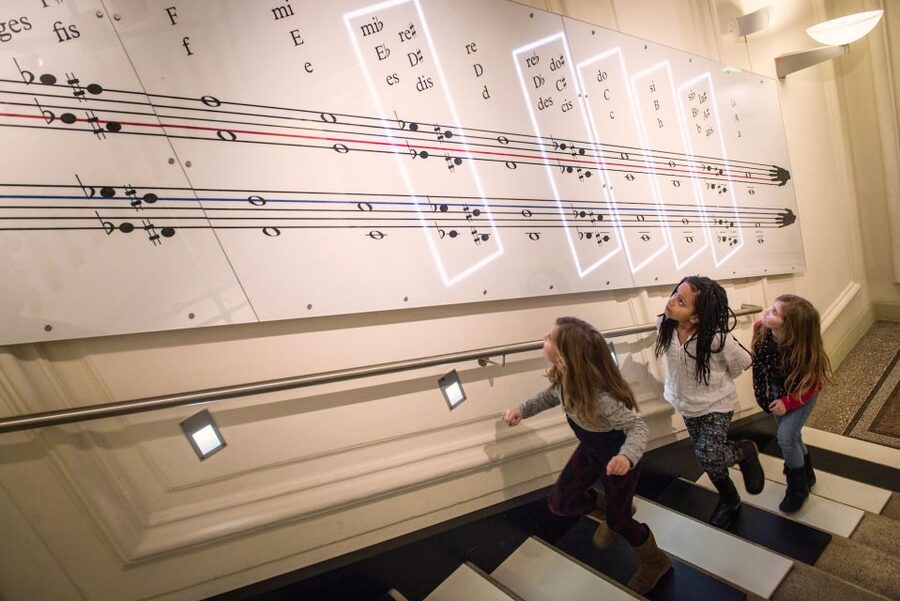
Another interactive display lets you create your own waltz by throwing dice. The game turns composition into a series of choices, showing how separate musical ideas can be combined into a finished piece.
This is a small activity, but it makes a useful point. You do not need to read music to understand that composition involves structure, selection, and variation. The dice remove the pressure to invent everything from nothing.
For children, it feels like a game. For adults, it offers a quick look at how musical patterns can be organized. I would treat it as one of several short activities rather than a reason to visit by itself.
Explore the science of sound across the upper floors
The museum’s sound and science displays are what make it broader than a composer museum. You can experiment with sound, noise, hearing, and instruments through interactive stations.
This section works especially well if your group includes someone who is more interested in physics than in symphonies. It also helps explain music in physical terms: sound is not only an artistic idea, but something produced, transmitted, heard, and shaped by instruments and spaces.
You should expect a lot of hands-on testing rather than one straight narrative. That gives you freedom, but it can also make the museum feel busy if you want a quiet, linear presentation. Use the floor plan from the ticket office to get your bearings, and use the free app guide if you want a more organized route.
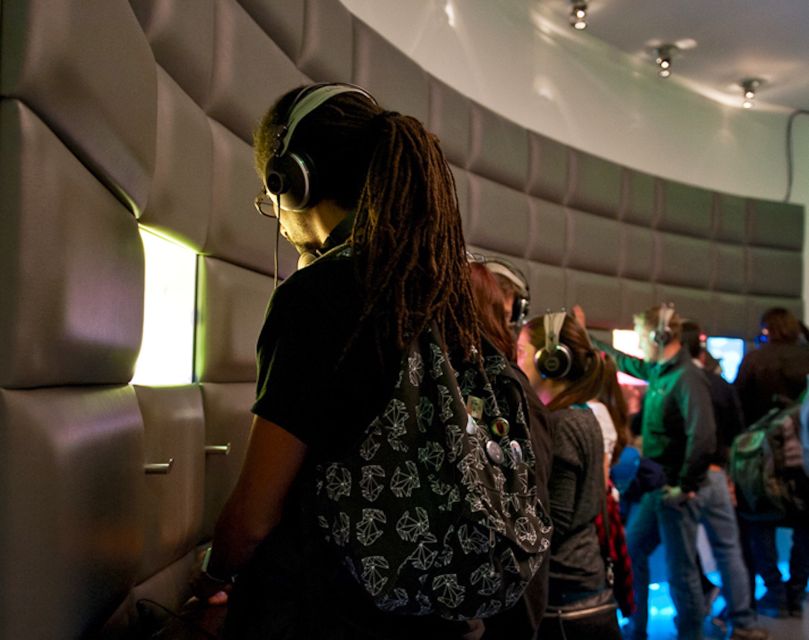
The app is available in eight languages on your own smartphone, while the children’s app is offered in two languages. Bring headphones, since they are specifically recommended for using the audio content without adding noise to the galleries.
How long should you allow?
Your ticket is valid for one day from first activation, so you do not need to race through the building. The practical question is how much attention you want to give each floor.
A quick visit can cover the main interactive highlights in roughly a couple of hours, but I would allow longer if you want to read the composer displays and try several sound experiments. One visitor spent more than four hours and still found plenty to explore. That is a useful warning for anyone planning to squeeze the museum between tightly timed appointments.
Families may spend longer than expected because children return to favorite stations. Adults who read every panel will also need extra time. If you have only a short window, prioritize the Vienna Philharmonic section, the composer level, the conducting challenge, and the sound experiments.
Temporary exhibitions in the inner courtyard may add another layer to your visit. Their themes change and can focus on famous musicians or special periods such as Viennese Modernism, so check what is showing when you arrive.
Who will get the most from the $22 ticket?
At $22 per person, this is not a bargain if you plan to stay for only 30 minutes. It becomes much better value when you use the four floors, try the interactive exhibits, and spend time with the historical displays.
For a family, the price covers several kinds of entertainment in one place. Children can play with sound and music while adults explore composers and Vienna’s cultural past. The museum also avoids the common problem of offering only child-oriented buttons and screens. Adults have enough historical and scientific material to make the visit worthwhile on their own.
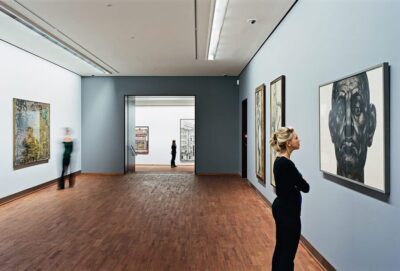
For a couple or solo visitor, the value depends on your interests. If you enjoy music, science, museums, or interactive design, you can easily justify the admission. If you want only a traditional collection of paintings and quiet display cases, this will feel too screen-based and playful.
The ticket includes admission, the museum map, the smartphone app guide, and coat check. It does not include food, drinks, or a Namadeus certificate. There are no transfers because the museum is at Seilerstätte 30 in central Vienna, so you arrange your own way there.
Access, comfort, and useful planning details
Haus der Musik is wheelchair accessible. The main and side entrances have step-free access, automatic sliding doors, and wheelchair-accessible elevators. Accessible toilets are in the inner courtyard and on the top floor.
A person accompanying a visitor with a visual impairment or a wheelchair can enter free of charge. Guide dogs are permitted. Free floor plans are available at the ticket office in the same languages used for the museum information.
Children under three enter free. These details make the museum easier to plan for families and groups with different mobility needs.
There is a coat check, which helps if you are visiting in winter. Food and drinks are not included, so plan to eat before or after your visit rather than expecting a café stop inside the ticket.
The museum allows free cancellation up to 24 hours before the visit, and you can reserve now and pay later. That is useful if your Vienna schedule depends on weather, concert plans, or changing family energy.
The best way to approach the visit
I would begin with the orchestra connection, then work through the composers before spending serious time on the interactive sound displays. That order gives you a story: Vienna’s musical institution, its major figures, and the mechanics of sound.
Next, choose the activities that suit your group. Try the conducting challenge together, let children create a Mozart-style name composition, and use the dice waltz as a short creative break from reading.
Do not feel obliged to complete every screen. The museum is strongest when you mix focused stops with free exploration. If you try to absorb every fact, you may leave tired. If you only press buttons, you will miss the reason this museum belongs in Vienna.
Should you book Haus der Musik?
Book it if you want a flexible, indoor Vienna experience that combines composers, orchestra history, science, and play. It is particularly well suited to families, mixed-age groups, curious adults, and anyone who wants more than a formal concert or a silent museum.
I would skip it only if your schedule allows a very short visit or if interactive displays are not your style. At $22, the ticket earns its keep when you stay for a few hours and use the full building. Bring headphones, leave room in your schedule, and give the conducting challenge a try. It may reveal more musical nerve than you expected.
FAQ
Where is Haus der Musik located?
Haus der Musik is at Seilerstätte 30 in Vienna’s 1010 district.
How long is the ticket valid?
The ticket is valid for one day from the time you first activate it.
What does admission include?
Admission includes entry to the museum, a museum map, coat check, and a free smartphone app guide in eight languages. A children’s app is available in two languages.
Do I need to bring anything?
Bring headphones if you plan to use the smartphone guide and audio features.
Is Haus der Musik wheelchair accessible?
Yes. The main and side entrances are step-free, automatic sliding doors are available, and wheelchair-accessible elevators connect the floors. Accessible toilets are in the inner courtyard and on the top floor.
Are children admitted free?
Children under the age of three enter free of charge.
Is the Namadeus certificate included?
No. The Namadeus activity is part of the museum experience, but the certificate costs extra.
Just added around Vienna
- Vienna: UNESCO Schönbrunn Palace Guided Tour with Entry★ 4.5 · 94 reviews
- World War II History Vienna Old Town Private Walking Tour★ 4.8 · 9 reviews
- Vienna: Winery and Wine Tasting Tour with a Wine Expert★ 5.0 · 5 reviews
- Vienna: Wine Tasting E-Bike Tour★ 4.9 · 46 reviews
- Vienna: Wine Tasting at Schönbrunn Palace★ 4.3 · 71 reviews
- Vienna: Wine Tasting Tour★ 4.8 · 61 reviews
- Vienna: Concert by the Vienna Baroque Orchestra★ 4.6 · 56 reviews
- Vienna: Wachau Valley Private Kayak and Wine Tour★ 5.0 · 3 reviews
Tickets, compared.

Classic Ensemble Vienna in St. Peter’s Church Ticket
Read our review →
Vienna Kunsthistorisches Museum Day Admission Ticket
Read our review →
Tickets for Mozarthaus Vienna with Audio Guide
Read our review →
Skip-the-Line Entrance Ticket to the Danube Tower
Read our review →