
Reviewed · CYCLING TOURS
Vienna Highlights Small-Group Bike Tour
Vienna is a big city with a compact historic core, but some of its best stops sit beyond an easy walking loop. This three-hour bike ride links the Ringstrasse, Prater, the Danube Canal, and Hundertwasserhaus, giving you a quick read on the city’s grand imperial center and its quirkier outer districts.
I like the flat route and good-quality bikes, which make the 6-mile ride manageable for most people who can cycle comfortably. I also like the way guides such as Robert, Marco, Ava, Jan, and Karl mix major sights with personal stories and small details. The main caution is group size: the advertised maximum is 15, and a large group can split at traffic lights or make road crossings feel less relaxed.
Key things to know before you book
- About 6 miles of mostly easy cycling: The route is designed to cover more ground than a walking tour without demanding athletic fitness.
- A useful first look at Vienna: You pass the Opera House, City Hall, Parliament, Hofburg, Heroes’ Square, Prater, and the Danube Canal.
- Prater and the giant Ferris wheel: This stop takes you beyond the classic center and gives the tour a wider city feel.
- Hundertwasserhaus adds a sharp change of style: Its colorful, irregular design is a welcome break from Vienna’s formal imperial buildings.
- English-speaking guides set the tone: Robert, Marco, Ava, Jan, Karl, Clemens, and Horst are among the guides praised for humor, patience, and clear storytelling.
- Weather matters: The tour operates in all weather conditions, so check the forecast and dress for rain, wind, or heat.
Why a bike is a smart way to see Vienna
Vienna is often introduced through palaces, concert halls, and grand avenues. That is only part of the city. On foot, you can cover the central sights well, but Prater, the Danube Canal, and Hundertwasserhaus take more time and planning. A bike lets you connect these areas in one outing.
This is not a race. The route uses bike paths and streets with little traffic where possible, and the pace is generally easy. One rider who did not consider herself very fit found the distance manageable, though she was tired near the end. That sounds about right: you do not need to train for this, but you should be comfortable sitting on a bike and riding for several hours with stops.
The appeal is partly practical. You do not have to work out a rental, study Vienna’s bike routes, or decide how to get from one sight to the next. You follow the guide and let the city unfold. You also get a running explanation of what you are seeing, rather than stopping at each building with only a name and a photograph.
The tradeoff is that a guided group ride cannot pause everywhere. You will see many buildings from the saddle, with longer stops at selected points. If you want to tour the Opera House, Hofburg interiors, or museums, plan a separate visit.
More bike days around Vienna:
- Classic Vienna: 3-Hour Guided Bike Tour
★ 4.7 · 1,846 reviews - Wachau Valley Wine Tasting Bike Tour from Vienna
★ 5.0 · 829 reviews - Vienna City Bike Tour
★ 4.5 · 599 reviews
Starting on the Ringstrasse
The meeting point is Vienna Explorer at Franz-Josefs-Kai 45 in the first district. After meeting your guide, you receive the bicycle and a short safety overview before setting off. Helmets are provided, and the tour ends back at the same place.
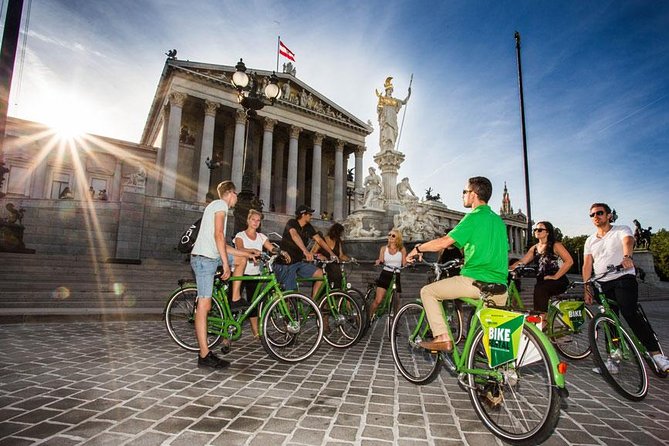
The first major section follows the Ringstrasse, Vienna’s famous ceremonial boulevard. This broad route circles the old city and gathers the grand public buildings built during the Habsburg era. You pass Vienna City Hall, the University of Vienna, the Houses of Parliament, the Hofburg Palace, and the Vienna State Opera.
This stretch is where the tour gives you its clearest sense of Vienna’s scale. The architecture is formal and theatrical, designed to project imperial confidence. From a bike, you can take in long facades and changing views without spending half the morning crossing streets on foot.
The Vienna State Opera receives a longer stop of about 20 minutes. Its Neo-Classical design makes it an easy first photo stop, and the pause gives you a chance to hear how music and court culture shaped the city. Admission to the building is not included, but there is no entry charge for the outdoor stop.
You may also pass the Hofburg, the former imperial residence associated with the Habsburg family. The tour description refers to Marie Antoinette in connection with the palace, but remember that this is an exterior-focused city ride, not a palace tour. If the Hofburg interests you, return later for its museums and historic rooms.
Heroes’ Square and Vienna’s difficult past
The ride continues through Heroes’ Square, or Heldenplatz, a broad ceremonial space beside the Hofburg. It is one of Vienna’s most impressive open areas, framed by monumental buildings and linked to the city’s imperial story.
It also carries a darker political memory. Adolf Hitler delivered his 1938 annexation speech here after Nazi Germany absorbed Austria. A good guide will place the event in context rather than treating the square as just another grand photo stop.
This is one reason guide quality matters on this tour. The strongest comments focus on guides who made history understandable and kept the ride lively. Robert, Marco, Ava, and Jan receive particular praise for clear English, humor, and personal enthusiasm. You will get more from Heroes’ Square if your guide tells the story with care and connects the setting to Vienna’s later history.
One point deserves attention: the tour does not focus on every major sight in the pedestrian center. One rider was disappointed not to see the city center more directly, and the company explains that the central pedestrian streets are not suited to a group bike ride. You should think of this as a Ringstrasse and wider-city tour, not a complete tour of every lane around Stephansplatz.
Hundertwasserhaus brings a jolt of color
The route then turns toward the Landstrasse district and Hundertwasserhaus. This apartment building was designed by Friedensreich Hundertwasser, a Viennese artist and architect known for rejecting straight lines and strict architectural order.
The building feels like a deliberate interruption to Vienna’s imperial formality. Its bright colors, uneven surfaces, and playful details make it easy to photograph, and the stop lasts about 20 minutes. You will not spend the time touring private apartments, but you can look closely at the exterior and hear about the ideas behind its design.
I like this stop because it gives the ride contrast. Without it, the route could become a parade of grand nineteenth-century facades. Hundertwasserhaus reminds you that Vienna is not only about emperors, opera, and polished stone. It also has a modern, eccentric side.
The ride through the surrounding neighborhood adds value as well. You move away from the most formal central avenues and get a quick look at a different part of Vienna. Do not expect a long neighborhood walk or a full architecture lesson, but the change of setting helps the city feel larger and more varied.
A few more Vienna days worth a look
- Vienna: Vivaldi’s Four Seasons Concert in Karlskirche
★ 4.7 · 14,951 reviews - Vienna: Spanish Riding School Training
★ 3.9 · 9,281 reviews - Vienna: Skip-the-cashier-desk-line Giant Ferris Wheel Ride
★ 4.5 · 7,859 reviews - Vienna: Schönbrunn Palace & Gardens Skip-the-Line Tour
★ 4.7 · 7,739 reviews
Prater and the giant Ferris wheel
Prater is one of the tour’s strongest reasons to choose a bike. This large park and amusement area lies farther from the old center, and reaching it on foot would take a sizeable chunk of your day. The bike gets you there without turning the visit into a transport project.
The key photo stop is the Riesenrad, Vienna’s giant Ferris wheel. It is one of the city’s best-known skyline features and an enduring symbol of Prater. The tour stops here for photographs rather than including a ride on the wheel, so you should not expect admission to the attraction.
Prater changes the mood again. After the ceremonial Ringstrasse and the design focus at Hundertwasserhaus, the amusement park feels more relaxed and open. You get a sense of how Vienna spends its free time, not just how it presents itself to the world.
Several people specifically appreciated reaching Prater and the Danube because these areas might otherwise have been skipped. That is the practical strength of this route. It does not simply replace a walking tour with wheels. It adds places that sit outside the usual first-day circuit.
Along the Danube Canal
Another section follows the Danube Canal, where you can enjoy a calmer ride and see street art along the water. This part offers a welcome change from traffic, formal buildings, and constant architectural commentary.
The Danube Canal is not the same as the broad main river, but it is a useful urban corridor and an enjoyable cycling route. The water, open views, and murals give you a different picture of Vienna. You can also see why cycling works well here: the ride becomes less about checking off monuments and more about moving through the city.
The tour description also refers to cycling along the blue waters of the Danube before returning to the starting point. Exact conditions can depend on the day’s route and pace, but you should expect a riverside section rather than a long countryside excursion. This remains a city tour, with the canal and river serving as refreshing parts of the urban route.
How hard is the ride?
The route covers approximately 10 kilometers, or about 6 miles, over roughly three hours. That total includes stops, explanations, photographs, and regrouping, so you are not pedaling continuously for three hours.
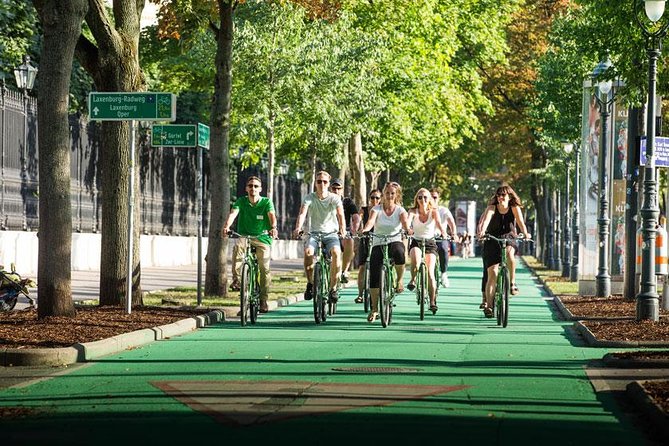
Vienna is notably flat, and several riders found the pace comfortable. The bikes are described as good quality, and helmets are supplied. The tour is intended for people with a moderate level of physical fitness, but it is not presented as a demanding athletic outing.
Still, a few practical points matter. You may encounter cobbled surfaces, which can be uncomfortable even when the route is not steep. One person found the ride longer and tougher than expected, especially over cobblestones. If you dislike cycling on uneven streets or have not ridden for a long time, this is worth considering.
The group must also manage traffic lights and crossings. One rider noted that larger groups could separate, although the guide waited and regrouped. Another felt that information was missed when the rear of the group became detached. The maximum is listed as 15 people, but the experience can still feel large on city streets.
For the smoothest ride, stay alert at intersections, keep the rider ahead in view, and tell the guide early if you are struggling. The tour is meant to be accessible, but it works best when everyone maintains a steady pace.
The guide makes the difference
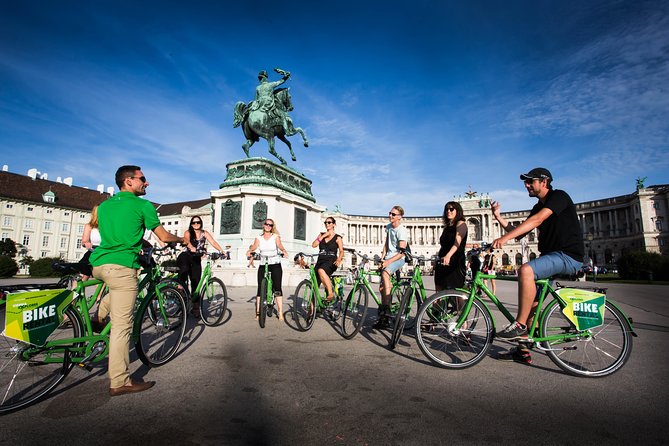
The route itself is solid, but the guide determines how much you get from it. The best guides on this experience are described as funny, patient, enthusiastic, and well informed.
Robert appears often in the positive comments, especially for his passion for Austrian history and his ability to explain places clearly. Marco is praised for bringing history to life, while Ava is noted for her excellent English and enthusiasm for Vienna. Jan, Karl, Clemens, and Horst are also singled out for making the ride engaging and comfortable.
That does not mean every guide will have the same style. One person found the commentary less engaging, and another wanted more stories about historically important sites. You should book this with realistic expectations: the tour offers a broad introduction, not a specialist seminar in Viennese history.
The strongest guides seem to understand the balance. They give you enough context to make the buildings and squares meaningful, but they also keep the group moving. For a first day in Vienna, that balance is useful.
What the $56.86 price gets you
At $56.86 per person, this is not the cheapest way to move around Vienna. Public transport costs less, and you can walk the central sights for free. But the price includes the bicycle, helmet, guide, route planning, and three hours of structured sightseeing.
The value is best if you are short on time. In one outing, you can see major Ringstrasse buildings, Heroes’ Square, Hundertwasserhaus, Prater, the Ferris wheel, and the Danube Canal. Recreating that route alone would take extra research and might involve a mix of walking, public transport, and bike rental.
It is also a good early-trip purchase. You can use the ride to mark places you want to revisit. The Opera House, Hofburg, and Hundertwasserhaus may deserve more time later, while Prater and the canal give you a feel for areas you might not otherwise reach.
Food, drinks, and hotel pickup are not included. You return to the original meeting point, so you should allow time to reach Franz-Josefs-Kai on your own. The tour is offered in English and uses a mobile ticket.
Weather and cancellation details
The tour operates in all weather conditions, so dress for the forecast. Raincoats may be available in poor weather, but you should not assume that bad conditions will automatically cancel the ride.
This policy matters because one booking party chose not to ride during severe rain, hail, and thunder and was not given a refund. The operator states that cancellation occurs only when an official government warning requires it. If you are visiting during unsettled weather, consider this before booking.
You can cancel for a full refund up to 24 hours before the start time. Changes or cancellations made inside that window are not refunded. If the minimum number of participants is not reached and the operator cancels, you are offered another date or experience, or a full refund.
Who should book this bike tour?
I would choose this tour if you have one to three days in Vienna and want a fast orientation. It suits adults, couples, and families with older children who enjoy cycling and can handle a few hours on a bike.
It is also a good fit if you want more than the usual palace circuit. Prater, the canal, and Hundertwasserhaus broaden the picture, while the Ringstrasse covers the classic sights.
I would be more cautious if you want a very small, quiet group or detailed access to interiors. The group can feel larger than the phrase small-group suggests, and some riders found that road crossings made the group spread out. Children under 10 may not enjoy the ride if they are not keen cyclists or have little interest in history.
Book it early if it fits your plans. The experience is commonly reserved about 18 days ahead, which suggests that popular dates can fill. Bring comfortable clothing, prepare for changing weather, and treat the tour as an introduction rather than the final word on Vienna.
Should you book it?
Yes, if you want to see a broad slice of Vienna in three hours and prefer an easy guided ride to renting a bike alone. The flat route, useful stops, and access to Prater and the Danube give you more range than a standard walking tour.
Book with some caution if safety briefings and small groups are your top priorities. The tour includes a brief safety overview, but group separation at crossings has been a concern for some riders. If you stay near the guide and communicate clearly, the ride should work well, but it is not a private cycling experience.
For a first look at Vienna, the value is strong. You finish with a map in your head, a list of places worth returning to, and a better sense of how the imperial center connects to the city beyond it.
FAQ
How long is the Vienna Highlights Small-Group Bike Tour?
The tour lasts approximately three hours and covers about 6 miles, or 10 kilometers, including sightseeing stops.
What sights are included on the route?
You ride along the Ringstrasse and pass the Vienna State Opera, City Hall, Vienna University, the Houses of Parliament, and the Hofburg. The route also includes Heroes’ Square, Hundertwasserhaus, Prater and its giant Ferris wheel, the Danube Canal, and sections along the Danube.
Is the tour suitable for beginners?
The route is mostly flat and generally follows bike paths and streets with little traffic. A moderate level of physical fitness is recommended, and you should be comfortable riding for several hours with stops.
Are bicycles and helmets provided?
Yes. Use of a bicycle and a professional guide are included, and helmets are provided according to the supplied tour information.
Where does the tour start and finish?
The tour starts at Vienna Explorer, Franz-Josefs-Kai 45, 1010 Vienna. It finishes back at the same meeting point.
What happens if the weather is bad?
The tour operates in all weather conditions, so you should dress appropriately. You can cancel for a full refund up to 24 hours before the scheduled start, but cancellations made less than 24 hours in advance are not refunded.
Just added around Vienna
- Vienna: UNESCO Schönbrunn Palace Guided Tour with Entry★ 4.5 · 94 reviews
- World War II History Vienna Old Town Private Walking Tour★ 4.8 · 9 reviews
- Vienna: Winery and Wine Tasting Tour with a Wine Expert★ 5.0 · 5 reviews
- Vienna: Wine Tasting Tour★ 4.8 · 61 reviews
- Vienna: Wine Tasting E-Bike Tour★ 4.9 · 46 reviews
- Vienna: Wine Tasting at Schönbrunn Palace★ 4.3 · 71 reviews
- Vienna: Concert by the Vienna Baroque Orchestra★ 4.6 · 56 reviews
- Vienna: Wachau Valley Private Kayak and Wine Tour★ 5.0 · 3 reviews
Cycling Tours, compared.
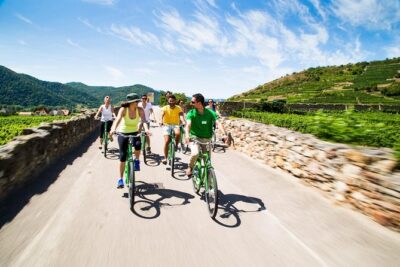
Wachau Valley Wine Tasting Bike Tour from Vienna
Read our review →
Grape Grazing: Wachau Valley Winery Biking Tour
Read our review →
Vienna by Bike 3-Hour All-In-One City Bike Tour in English
Read our review →
Browse the lists this tour appears in