
Reviewed · WALKING TOURS
Salzburg Private Walking Tour
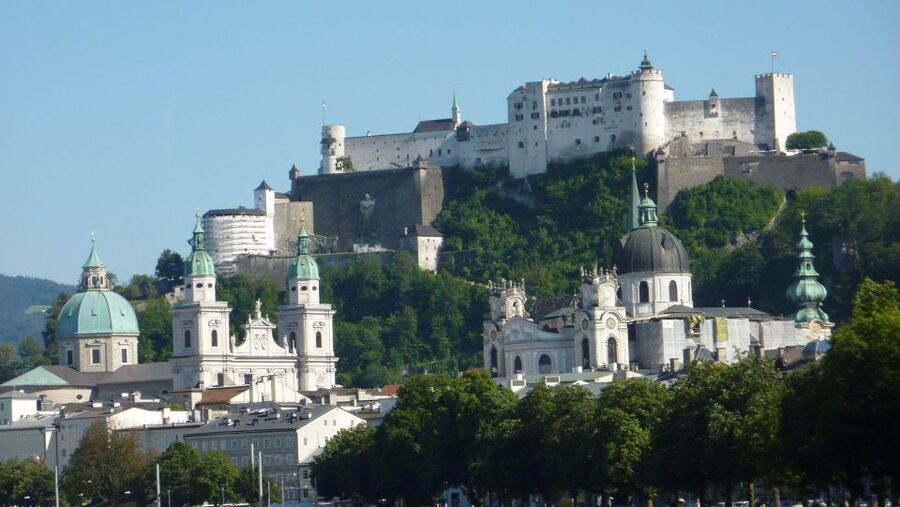
Salzburg’s story begins with salt and power. This two-hour private walk links the city’s salt wealth, prince-archbishops, Mozart, and The Sound of Music into one readable tour, so you get more than a parade of handsome buildings. I like the personal format and the way the route brings together music, religion, politics, and architecture. I also like that your guide can speak English or German and that your group can include up to 15 people.
The main tradeoff is time. Two hours goes quickly, and entrance fees are not included, so this works best as an introduction rather than a full museum visit. You’ll see Salzburg’s major sights and learn how they fit together, but you may need a separate visit for the interiors and collections that catch your eye.
Key points at a glance
- Salt explains Salzburg’s early wealth: Learn why the mineral that gave the city its name helped fund its growth.
- Mozart’s story has a real address: Getreidegasse leads you to the house where Wolfgang Amadeus Mozart was born on January 27, 1756.
- Mirabell Palace mixes romance and power: See the palace built by Prince-Archbishop Wolf Dietrich for Salome Alt.
- The Residenz reveals church rule: Understand how Salzburg’s prince-archbishops governed the city-state.
- The Cathedral connects history with Mozart: See the monumental Early Baroque church and its baptismal font, where Mozart was christened.
- Private guiding keeps the walk focused: Your guide is with your group only, with English and German offered.
Why Salzburg makes a good walking-tour city
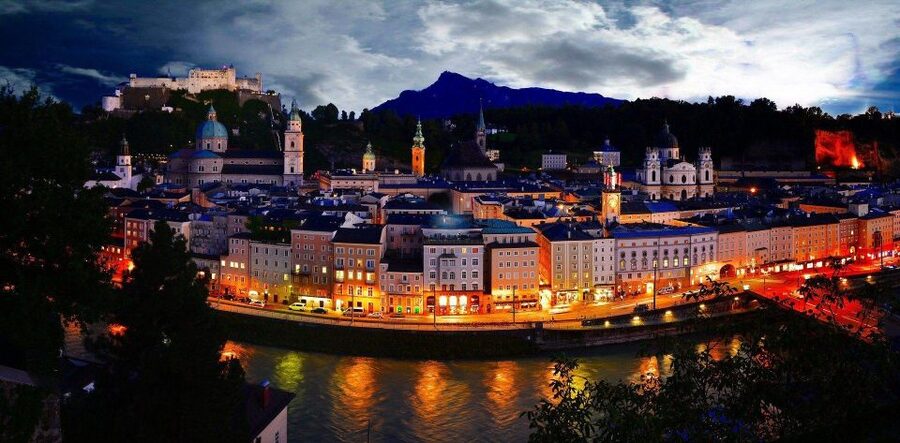
Salzburg is compact, handsome, and packed with stories. A short walk can take you from a palace garden to a narrow shopping street, then into the political and religious center of the old city. I find that a guide helps here because the buildings can look simply elegant until you learn what they were built to do.
This is a city shaped by several forces at once. Salt brought money. Catholic churchmen controlled the government. Music gave Salzburg its lasting fame. The Sound of Music added another layer, turning familiar streets and views into part of a modern film legend.
The tour’s strength is this connection between subjects. Instead of treating Mozart as an isolated genius or The Sound of Music as a separate attraction, you can see how both belong to Salzburg’s broader identity. The guide also covers architecture and local culture, which gives the walk more substance than a quick list of photo stops.
Because the tour is private, you are not folded into a large public group. That matters if you want to ask about Mozart, church architecture, or the city’s political past without waiting for a dozen other questions. It is also useful for families or mixed-interest groups, since the guide can give more attention to the subjects that hold your group’s interest.
More Walking Tours in Salzburg
- Salzburg 2.5-Hour Walking Tour: Mozart, Old Town & More
★ 4.2 · 987 reviews - Salzburg: Old Town, Mozart, & Mirabell Gardens Walking Tour
★ 4.8 · 461 reviews - Salzburg Oldtown: Sightseeing Walking Tour with Licensed Local Guide
★ 5.0 · 392 reviews
Mirabell Palace and the city’s polished face
Mirabell Palace is one of the tour’s first major points of interest. Prince-Archbishop Wolf Dietrich built it for Salome Alt, his beloved courtesan, a detail that immediately gives the palace a more human story than its formal name suggests.
I like beginning with a place that combines private feeling and public authority. Salzburg’s rulers were churchmen, but they also lived as political leaders with grand residences and elaborate tastes. Mirabell helps you see that tension before the tour moves deeper into the old city.
The palace also connects naturally to The Sound of Music. The film helped make Salzburg’s musical identity familiar around the world, and the city still carries that association. The tour does not treat the film as the whole story. Instead, it uses the Von Trapp family and the musical as one way to understand how Salzburg’s real setting became part of popular culture.
You should expect to see the palace as part of a walking route rather than assume that an interior visit is included. Admission fees are separate, and the activity information does not promise entry to each site. If a palace room or museum matters to you, ask your guide about the stop and plan any paid admission separately.
Getreidegasse and Mozart’s Birthplace
Getreidegasse is the old town’s busy central street and one of Salzburg’s most recognizable addresses. Its historic buildings, shop signs, and narrow urban setting make it a natural place to discuss how the city works as both a living center and a historic one.
The key stop here is Mozart’s Birthplace. Wolfgang Amadeus Mozart was born in this house on January 27, 1756. That fact can sound familiar, but the address gives his story a useful sense of place. You are not just hearing about a famous composer in the abstract. You are standing at the starting point of the life that made Salzburg one of Europe’s best-known music cities.
I appreciate that the tour focuses on Mozart’s life and genius rather than simply pointing out a museum façade. A guide can explain why his name carries such weight in Salzburg and how his story fits the city’s culture. The supplied feedback specifically praises the guides for adding architectural details and interesting features, not just dates and names.
Thomas L. is one guide praised for combining city history with architecture and a lively manner. Frau Eisl is another named guide, described as bringing strong enthusiasm and extensive information to the walk. Guide assignments can vary, so you should not book on the assumption that one particular person will lead your group. Still, those comments indicate the kind of guiding style you can expect: factual, engaged, and not overly stiff.
Getreidegasse can be active, so this is a place where the guide’s voice and positioning matter. The route is short enough to cover the key story, but you should not expect long museum time within a two-hour walk. If Mozart is your main reason for visiting Salzburg, consider using the tour to get oriented, then return to the Birthplace on your own if you want a slower look.
The Residenz and the politics of a church-ruled city
The Residenz explains the political side of Salzburg. This was where the prince-archbishops held court while they ruled the city-state. Their authority was religious, but it was also civic and political, and the building helps make that arrangement easier to understand.
I find this part especially useful because Salzburg can otherwise seem like a city of music, churches, and pretty streets without a clear explanation of who paid for them. The answer is tied to control of resources, including salt, and to the power held by the prince-archbishops.
The tour follows the city’s political story toward the later change in government, when Salzburg became part of the Habsburg Empire in the 19th century. That transition gives you a wider frame for the buildings around you. Salzburg was not only a local religious center. It was also a small state with rulers, court life, and changing political ties.
As with the other major sights, entrance fees are not included. The walk can introduce you to the Residenz and explain its role, but you should not count on a full interior tour unless your booking or guide confirms it. This distinction matters if you are comparing the activity with a museum ticket or a longer palace visit.
A completely different way to spend a day here:
- The Original Sound of Music Tour in Salzburg
★ 4.5 · 6,129 reviews - Salzburg: Original Sound of Music Tour
★ 4.8 · 5,059 reviews - From Salzburg: Half-Day Tour to Hallstatt
★ 4.6 · 3,596 reviews - Salzburg: Mozart Concert at Mirabell Palace
★ 4.8 · 3,498 reviews
Salzburg Cathedral and Mozart’s baptism
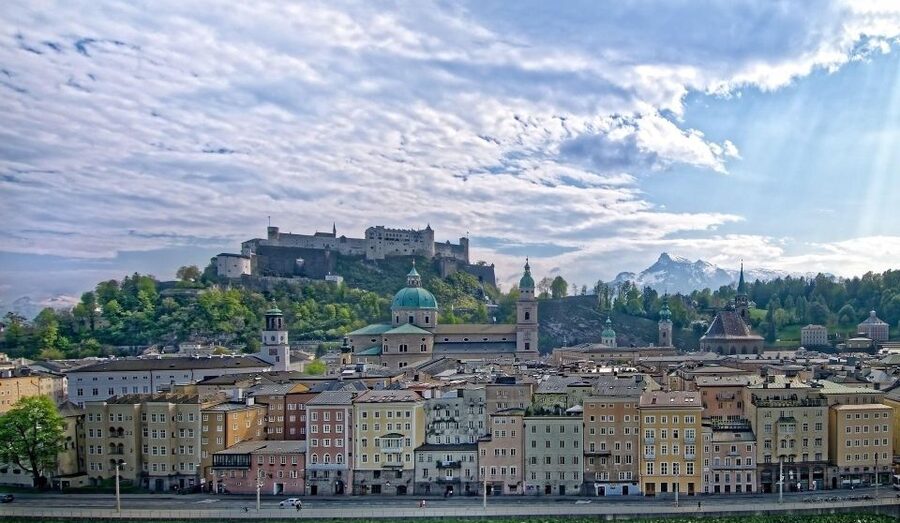
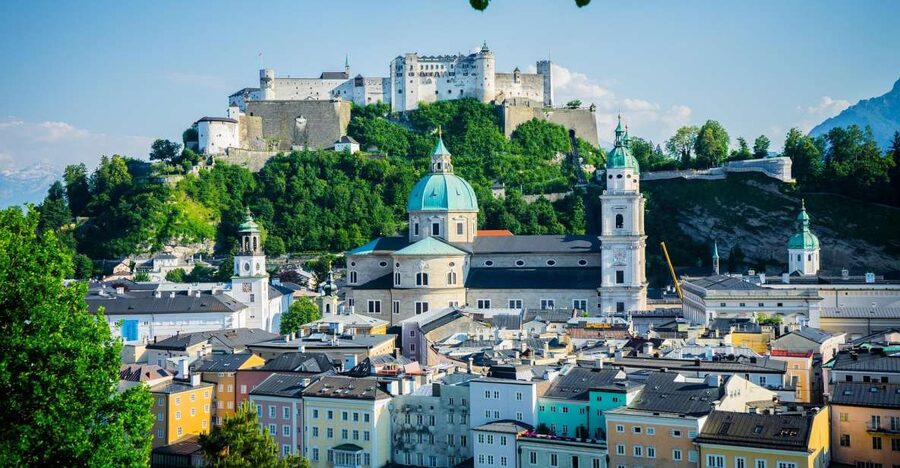
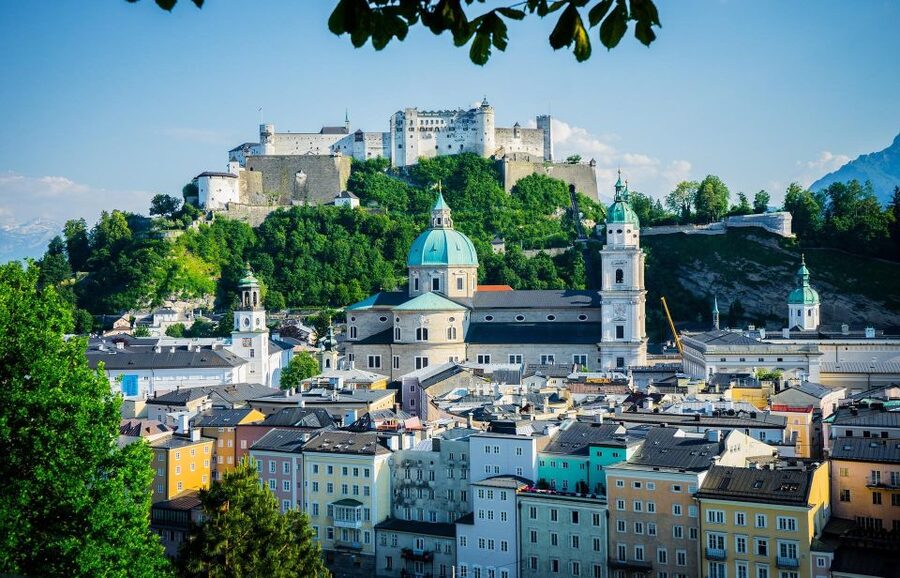
Salzburg Cathedral, or Salzburger Dom, brings together many of the tour’s main themes: religion, architecture, music, and local power. Its monumental Early Baroque design reflects the ambition of the churchmen who shaped Salzburg’s public face.
The cathedral is also tied directly to Mozart. Its bronze baptismal font, decorated with lions at the base, is identified as the font where Wolfgang Amadeus Mozart was christened. That detail gives the building a personal connection to the composer rather than leaving it as a grand but distant monument.
I like this stop because it makes Mozart part of the city’s religious setting. His story did not begin only with concerts and composition. It began in a Salzburg shaped by Catholic institutions, princely church rulers, and elaborate public architecture.
The cathedral can be impressive even if you are not an architecture specialist. Your guide can help you notice why Early Baroque buildings feel so forceful and ceremonial, and why a city of Salzburg’s size has such imposing landmarks. The experience remains a walking introduction, not a promise of extended time inside every church or collection, so keep your expectations realistic.
Salt, money, and Salzburg’s growth
Salt may be the least obvious subject on the route, but it is one of the most useful. The tour explains salt’s role in Salzburg’s growth, giving you an economic reason for the city’s prominence.
When you look at Salzburg’s palaces, churches, and court buildings, it helps to ask where the money came from. Salt was not merely a local product. It was a valuable resource that supported the city’s development and helped its rulers maintain influence.
This subject also ties the route together. The palace reflects elite life. The Residenz reflects government. The Cathedral reflects religious authority. Salt helps explain the financial foundation beneath those institutions.
I value this kind of context because it changes how you read the city. Without it, you may see one beautiful building after another. With it, you begin to understand why so much architectural effort and political power collected in one place.
The activity description does not give a detailed salt-production stop or promise a visit to a mine. Treat salt as a theme explained during the city walk, not as a separate industrial excursion. If salt history is your main interest, you will want to ask how much time your guide plans to spend on it.
The Sound of Music and the Von Trapp connection
The Sound of Music is part of Salzburg’s modern identity, and this tour includes the story of the Von Trapp family on which the musical was based. That gives you a chance to connect the city you see with the film and stage version known around the world.
I like the subject when it is handled alongside real history. Salzburg is not only a movie set, and this walk does not replace the city’s religious, political, or musical story with film references. Instead, the Sound of Music thread adds a familiar entry point for people who may first have noticed Salzburg through the movie.
You should also keep the scope clear. This is a city walking tour, not a dedicated Sound of Music excursion. The supplied details do not promise filming locations outside the central route, transportation to distant sites, singing, or a special film performance. You will learn about the Von Trapp story and the city’s connection to the musical while seeing Salzburg’s main central sights.
For families and first-time visitors, that balance can work well. One person may care about Mozart, another about church architecture, and another about the Von Trapp family. The guide can connect those interests within the same walk.
What two hours can realistically cover
Two hours is enough for a strong first look at Salzburg’s central identity. You can expect a focused route that brings together Mirabell Palace, Getreidegasse, Mozart’s Birthplace, the Residenz, Salzburg Cathedral, and the themes of salt, religion, politics, Mozart, and The Sound of Music.
It is not enough for a slow examination of every interior. The duration also leaves little room for long stops at paid museums, extended shopping, or detailed architectural study. I would use this tour to get your bearings and understand the city, then decide which places deserve more of your time.
The private format helps make the short schedule useful. Your guide is with your group only, so the pace and discussion can be more focused than on a large shared tour. Still, a group of 15 is not the same as a tour for two people. If your party is large, some questions may take time and the walk may feel less personal than it would for a small group.
The tour is offered in English or German. Recent feedback includes strong praise for the guides’ friendliness, enthusiasm, historical explanations, and attention to architecture. One German-language comment also noted that the city was quiet during that visit, though conditions will vary by date and season. That makes the exact atmosphere impossible to promise, but early or quieter periods may offer a calmer walk.
Is $289 good value for your group?
The price is $289 per private group of up to 15 people. That is an important distinction. For a full group, the cost works out to roughly $19 per person. For two people, it is about $144.50 per person, before any entrance fees.
I see the strongest value for families, reunions, or groups of friends who want a private guide and can share the flat group price. You receive a local professional guide dedicated to your party, which can be worthwhile when several people want different parts of Salzburg explained.
For a couple or solo visitor, the price is harder to justify unless privacy is a priority. A shared walking tour may cost less, though the provided information does not give a comparison price. I would choose this option when you value flexibility, a private conversation, and a compact overview more than the lowest possible cost.
Remember to budget separately for entrance fees. The tour price covers the guide, not admission to the sights. Since the activity lasts two hours, you may decide to pay for only the one or two interiors that matter most to you.
Who should book this Salzburg walk?
I would recommend it to first-time visitors who want the city’s main stories connected quickly. It suits people who like history but do not want a lecture, families who need a manageable introduction, and fans of Mozart or The Sound of Music who also want politics and architecture in the mix.
It is also a practical choice for a larger private group. The up-to-15-person limit lets you divide the cost, and the English or German language choice makes the tour usable for many groups.
I would hesitate if you want a full museum program, a dedicated Sound of Music outing, or a detailed salt-industry visit. This is a central walking overview. Its job is to show you how Salzburg fits together, not to cover every collection and attraction in depth.
Booking remains flexible, with free cancellation up to 24 hours before the start and a reserve-now, pay-later option. Starting times depend on availability, so check the schedule before building the rest of your day around it.
Should you book the Salzburg Private Walking Tour?
Book it if you want a private, story-led introduction to Salzburg and your group can make good use of the $289 flat price. The best parts are the connections: salt explains the money, the Residenz explains the rulers, the Cathedral explains the religious setting, and Mozart and The Sound of Music explain the city’s global fame.
Skip it if you mainly want interior visits or a specialist tour devoted to one subject. For everyone else, especially first-time visitors, this two-hour walk offers a sensible way to get oriented before choosing where to spend the rest of your time.
FAQ
Where does the Salzburg Private Walking Tour take place?
The tour takes place in Salzburg, Austria, and covers the main highlights of the city through a walking route.
How long does the tour last?
The tour lasts two hours.
What languages are available?
A live guide is available in English or German.
Is this a private tour?
Yes. The experience is for a private group, with a local professional guide who is with your group only.
How many people can join one group?
The price covers a group of up to 15 people.
What sights are included in the walking route?
The route includes Mirabell Palace, Getreidegasse, Mozart’s Birthplace, the Residenz, and Salzburg Cathedral. It also covers Salzburg’s salt history, Mozart, religious and political history, and The Sound of Music connection.
Are entrance fees included?
No. Entrance fees are not included in the tour price.
What is the cancellation policy?
You can cancel up to 24 hours in advance for a full refund. You can also reserve now and pay later.
Just added around Salzburg
- Zell am See: Schmittenhöhe Tandem Paragliding Flight★ 4.9 · 82 reviews
- Zell am See: Paragliding Tandem Flight★ 5.0 · 31 reviews
- Werfen: Hohenwerfen Castle Entrance Ticket★ 4.5 · 84 reviews
- Viator Exclusive: ‘The Sound of Music’ Private Tour★ 5.0 · 28 reviews
- Zell am See Alpine Village Private Day Trip from Salzburg★ 5.0 · 3 reviews
- Private Austrian Food Tasting Tour in Salzburg’s Old Town★ 4.5 · 3 reviews
- Private transfer from Salzburg to Vienna, 2 hours for sightseeing★ 4.5 · 7 reviews
- Private Transfer from Salzburg to Munich with 2 hours for sightseeing★ 5.0 · 8 reviews
Walking Tours, compared.
Guided Walking Tour of City Center Highlights
Read our review →
Guided Walking Tour of City Highlights & Hidden Gems
Read our review →
Vienna Historic Center Small Group Walking Tour
Read our review →
Browse the lists this tour appears in