Reviewed · TOURS
Alternative Tour in Vienna Off the tourist track
Vienna’s grand palaces and coffeehouses tell only part of the city’s story. This unusual walking tour follows Martin, who once lived on Vienna’s streets, as he explains homelessness, addiction, squatting, and punk life through places tied to his own past. I like the personal, first-hand storytelling and the chance to see central Vienna through a social lens rather than a postcard view.
I also like the small-group limit of 20 people, which gives you a fair chance to hear Martin and ask questions. The main consideration is its subject matter: stories about drug addiction, sleeping rough, and forced evictions can be painful. This is not a light sightseeing stroll, though Martin’s humor helps keep the two-hour walk human and approachable.
Key points at a glance
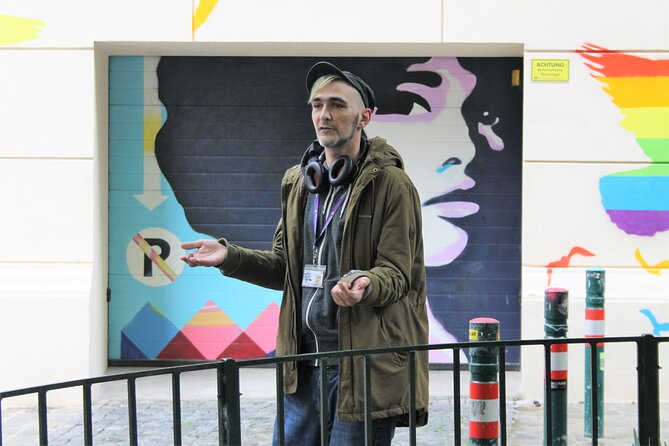
- Martin’s own story: Hear directly from a former street resident and former drug addict about life in Vienna outside the usual tourist picture.
- A central but different route: Start at Karlsplatz, pass through the subway passage and by the Secession, then continue to parks, stairs, and residential areas.
- Alfred-Grünwald-Park: Learn why Martin used this park as a sleeping place and why choosing the wrong spot on the grass could cause problems.
- Squats and punk history: At Ilse-Pisk-Stiege, hear about squatting and the evacuation of the Pizzeria Anarchia.
- Short and focused: The walk lasts about two hours, with stops where you can sit or catch your breath.
- Practical booking: The price is about $46, mobile tickets are accepted, groups can receive discounts, and cancellation is free up to 24 hours before departure.
A different way to read Vienna
This tour is not designed to show you another palace, church, or grand boulevard. It asks you to look at familiar central Vienna from the viewpoint of people who sleep, work, organize, and survive outside the city’s polished visitor image.
Martin is the key to the experience. His personal history gives the walk a directness that a standard social-history lecture cannot match. He talks about his own time on the streets, his experience with addiction, and the practical realities of finding somewhere to sleep. The point is not to turn hardship into entertainment. The value is in hearing how complicated these situations can be from someone who has lived through them.
I especially appreciate the tone described by the tour itself and its strong response from customers: serious subjects are mixed with humor, local stories, and room for questions. That balance matters. A two-hour account of homelessness and drug use could become grim or preachy. Martin’s open manner and occasional jokes make it easier to listen without making the subject seem less serious.
The walk also connects personal experience to Vienna’s recent political and social history. The sections on squats and punk culture show that the tour is not only about one man’s past. It also looks at alternative communities, property disputes, police action, and the way a city decides who has a right to occupy a building or public place.
A few more Vienna days worth a look
- Vienna: Vivaldi’s Four Seasons Concert in Karlskirche
★ 4.7 · 14,951 reviews - Vienna: Spanish Riding School Training
★ 3.9 · 9,281 reviews - Vienna: Skip-the-cashier-desk-line Giant Ferris Wheel Ride
★ 4.5 · 7,859 reviews
Starting at Karlsplatz and the Secession
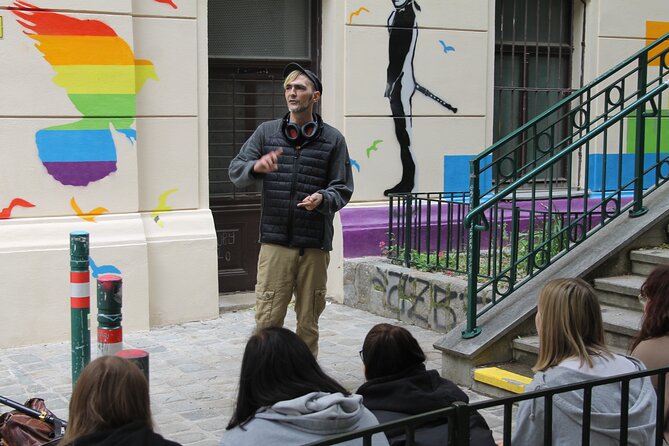
You meet at the Police Inspectorate Vienna in the Kärntnertorpassage at Karlsplatz. This is a practical central starting point, close to public transportation and easy to reach from the inner city.
The first part of the route goes through the subway passage at Karlsplatz. You then leave at the exit beside the Secession, Vienna’s famous white exhibition building crowned by its golden-leaf dome. The building itself is not the focus of the tour, but passing it creates a useful contrast: within a few minutes, you move from one of Vienna’s best-known art landmarks into stories about people who often remain unseen.
That contrast is part of what makes the route effective. You are not sent to an isolated district far from the center. The tour shows how different lives exist close to the same streets, stations, parks, and cultural buildings that you may already be visiting.
Because the route begins underground and continues on foot, wear comfortable shoes and be ready for ordinary city walking. The supplied details identify two main stops, but also mention a second station and a penultimate stop, so the walk includes movement between several points rather than two stationary talks.
Alfred-Grünwald-Park and the practical details of sleeping outside
The stop at Alfred-Grünwald-Park gives the tour its most direct look at street homelessness. The park has seating for the group, so you can settle in while Martin explains why it became a place where he slept.
The important detail here is that sleeping outside is not simply a matter of finding an empty patch of grass. Martin explains why sleeping on the meadow could be a poor choice and what made one part of the park more suitable than another. Those practical details help replace vague assumptions with a clearer picture of the decisions a person must make when they have no secure home.
This is where the tour’s small scale helps. With no more than 20 people, the group should be manageable at a park stop, and the seating gives you a break during the walk. The stop lasts about 20 minutes, long enough for a substantial story without turning the entire experience into a lecture.
You should also expect the conversation to move beyond Martin’s own sleeping arrangements. His story includes addiction and the way a person can become caught in problems that outsiders often judge too quickly. Several comments supplied for the tour describe the experience as thought-provoking and useful for young people, students, and adults. That makes sense: the park stop deals with a subject that is often visible in a city but rarely explained by someone who has lived it.
The drawback is that some details may be emotionally heavy. If you want a cheerful introduction to Vienna, this is the wrong choice. If you are willing to listen carefully and accept a serious subject, the stop can change how you notice public spaces for the rest of your visit.
Ilse-Pisk-Stiege and the story of Pizzeria Anarchia
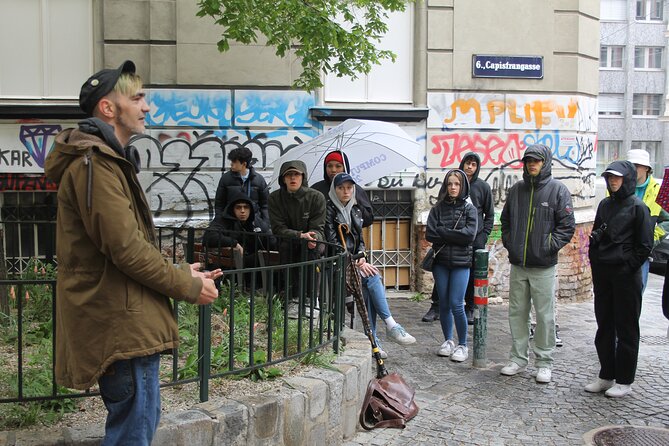
The penultimate station is Ilse-Pisk-Stiege, also called the Capistran Ascent. You can take a final breather on the stairs while Martin talks about squats and punk communities.
This section adds a wider local story to the personal account. Martin explains how squats worked, what life in punk circles could involve, and how people built an alternative way of living outside conventional housing and social structures. You are not just hearing about a subculture in the abstract. The setting helps connect those ideas to actual places in Vienna.
The most striking episode is the evacuation of Pizzeria Anarchia. According to the tour details, a house occupied by 19 people was eventually cleared by about 1,700 police officers. That imbalance gives you a sense of why the incident remains memorable and controversial. Martin presents the story through the people and events connected to it, with the kind of local context that is difficult to get from a general guidebook.
The subject also explains why the tour appeals to people interested in more than architecture. Vienna’s social history includes housing struggles, political movements, police operations, and communities that challenged normal ideas about property and authority. This stop brings those themes together without requiring you to visit a museum or read a long background text before you arrive.
The stairs are useful as a resting point, but they may not suit every participant. The activity information says most people can take part, yet the route includes subway passages, city streets, a park, and stairs. If you have mobility concerns, ask the operator before booking rather than assuming every section will be easy.
A completely different way to spend a day here:
- Vienna: Schönbrunn Palace & Gardens Skip-the-Line Tour
★ 4.7 · 7,739 reviews - Vienna: Light of Creation Votive Church Immersive Light Show
★ 4.8 · 6,779 reviews - Vienna Spanish Riding School Guided Tour
★ 4.7 · 6,765 reviews - Vienna: Classical Concert in the World-Famous Musikverein
★ 4.6 · 6,673 reviews
Ending beside Haus des Meeres
The walk ends at Esterhazypark, next to Haus des Meeres. This is a convenient finish because you can continue with another Vienna activity, visit the aquarium and zoo in the former flak tower, or use nearby public transportation.
The ending also keeps the tour connected to ordinary city life. You do not finish at a staged attraction built for the walk. You return to a public park and a well-known central destination, carrying a different understanding of the streets you have just crossed.
No entrance ticket is included for Haus des Meeres, and the tour does not appear to enter the attraction. Treat the end point as a useful landmark, not as part of the paid experience.
What the $46 price really covers
At about $46, this is more expensive than a basic group walk focused on buildings and landmarks. You are not paying for admission to a museum, a meal, or a long list of monuments. The value lies in Martin’s personal account, the access to places connected to his past, and the opportunity to ask questions during a small, focused group walk.
That makes the price easier to justify if you want a human story rather than more sightseeing. A standard city tour can explain when a building was constructed. This one explains how public spaces can function as shelter, how alternative communities form, and how a city responds when people occupy property outside the law.
The tour offers group discounts, though the exact amount is not given. For schools, youth groups, cultural associations, and other organized parties, this could make the cost more manageable. The activity has also been used with school classes, and the two-hour format is short enough to fit into a day of sightseeing without taking over the whole schedule.
I would not choose it only because it is different. The price is fair when you are genuinely interested in the topic and prepared to give Martin your attention. It is less suitable if you want constant movement, scenic views, or a conventional list of attractions.
Who will get the most from this walk
This tour suits adults and teenagers who can engage with difficult social subjects. It can work particularly well for school classes because the format is compact, the guide welcomes questions, and the discussion connects personal experience with larger issues such as addiction, housing, policing, and social judgment.
It also suits repeat visitors to Vienna. If you have already seen Schönbrunn Palace, the Hofburg, and St. Stephen’s Cathedral, this gives you another way to understand the city. You will still pass central landmarks, but they become background to a more personal account.
I would also recommend it to anyone who wants to examine their own assumptions. Several supplied comments focus on tolerance and the danger of judging too quickly. That is a fair description of the tour’s purpose. Martin’s story encourages you to see homelessness as a series of human and social problems, not as a simple personal failure.
The walk may not suit young children, since the subjects include drug use, addiction, sleeping rough, and police eviction. The information specifically supports teenagers and school groups, but parents and teachers should decide based on the maturity of the people attending.
Dogs are allowed, and service animals are allowed. The tour is near public transportation, accepts mobile tickets, and has a maximum group size of 20. Those are small details, but they make a difference when you are planning a busy day in Vienna.
Tone, language, and the role of questions
Martin’s open style is one of the strongest reasons to book. He shares personal experiences directly and leaves room for questions and extra explanations. The available comments also note that he can conduct the tour in good English, which is useful for international visitors.
The tone is not formal. You might hear a serious account followed by a joke, or a difficult point explained in plain language rather than academic terms. That informality is part of the appeal, though it means the experience may feel less structured than a museum tour.
Come ready to listen, not to demand a neat answer to every social problem. Martin can explain what happened to him and what he observed, but a two-hour walk cannot cover every aspect of Vienna’s housing system, drug policy, or social services. The strength is the personal perspective, not a complete policy lecture.
Practical planning for the two-hour route
Book with enough time to reach the Karlsplatz meeting point. Your mobile ticket is accepted, and confirmation is provided when you book. The group can include up to 20 people, with group discounts available.
The walk ends at Esterhazypark, next to Haus des Meeres, so plan your afternoon from that side of central Vienna rather than expecting to return to Karlsplatz. The route includes a subway passage, city streets, a park stop, and stairs at Ilse-Pisk-Stiege. Comfortable shoes are sensible, and you should be prepared to stand or walk between the seated stops.
The tour requires a minimum number of participants. If that minimum is not reached and the activity is canceled, you will be offered another date or experience, or receive a full refund.
You can cancel for a full refund up to 24 hours before the start time. Cancellations or changes made within 24 hours are not refunded or accepted. The cutoff uses Vienna local time, so check the clock carefully if you are booking from another time zone.
Should you book Wiener Nimmerland’s tour?
Book it if you want a candid, personal look at Vienna’s social history and are willing to spend two hours with difficult subjects. Martin’s experience, the stop at Alfred-Grünwald-Park, and the story of Pizzeria Anarchia give the walk a focus you will not get from a standard city tour.
Skip it if your ideal Vienna activity is all palaces, art, and easy entertainment. This tour asks you to listen, think, and accept some discomfort. At $46, it is good value for students, repeat visitors, and curious adults who want a human perspective on the city. For a first-time visitor with limited time, I would schedule the classic sights first, then choose this walk when you want Vienna to feel more complicated and real.
FAQ
How long does the tour last?
The tour lasts approximately two hours.
Where does the tour begin?
It begins at the Police Inspectorate Vienna in the Kärntnertorpassage at Karlsplatz, 1010 Vienna.
Where does the tour end?
It ends at Esterhazypark, next to Haus des Meeres.
Who leads the tour?
The tour is led by Martin, who previously lived on the streets of Vienna and shares personal experiences of homelessness, addiction, and life in alternative communities.
What subjects are discussed?
The tour covers homelessness, drug addiction, sleeping outside, squats, punk culture, and the evacuation of Pizzeria Anarchia.
How large is the group?
The tour has a maximum of 20 participants.
Can I cancel for a refund?
Yes. You can cancel for a full refund at least 24 hours before the experience begins. Cancellations or changes made less than 24 hours before the start time are not refunded or accepted.
Just added around Vienna
- Vienna: UNESCO Schönbrunn Palace Guided Tour with Entry★ 4.5 · 94 reviews
- World War II History Vienna Old Town Private Walking Tour★ 4.8 · 9 reviews
- Vienna: Winery and Wine Tasting Tour with a Wine Expert★ 5.0 · 5 reviews
- Vienna: Wine Tasting Tour★ 4.8 · 61 reviews
- Vienna: Wine Tasting E-Bike Tour★ 4.9 · 46 reviews
- Vienna: Wine Tasting at Schönbrunn Palace★ 4.3 · 71 reviews
- Vienna: Concert by the Vienna Baroque Orchestra★ 4.6 · 56 reviews
- Vienna: Wachau Valley Private Kayak and Wine Tour★ 5.0 · 3 reviews
Tours, compared.
Schönbrunn Palace & Gardens Skip-the-Line Tour
Read our review →

Skip-the-Line Sisi Museum, Hofburg and Gardens Tour
Read our review →
Skip-the-Line Schönbrunn Palace & Gardens Tour
Read our review →
Guided Walking Tour of City Center Highlights
Read our review →