
Reviewed · JEWISH HERITAGE TOURS
Jewish Vienna Walking Tour
Vienna’s Jewish story is written into places you could easily miss: a synagogue hidden behind plain street walls, four white columns marking a destroyed temple, and a memorial that forces you to face the scale of Nazi murder. This small-group walking tour connects those places with the wider story of Jewish life in Vienna, from the Middle Ages to the present.
I like the historian-led storytelling and the thoughtful route from the City Temple through Leopoldstadt to Judenplatz. I also like the small maximum of eight people, which gives guides such as Peter, Jan, and Annelie Pichler room to answer questions and adjust the discussion to your interests.
The main drawback is that the City Temple interior is not part of the tour, and the price is high at $179.74 per person. You’ll also need to pay your own metro fare, though the guide helps you buy a ticket if needed.
Key points to know before you book
- The City Temple is viewed from outside: You learn why Vienna’s main synagogue was designed to be barely visible from the street, but interior admission is not included.
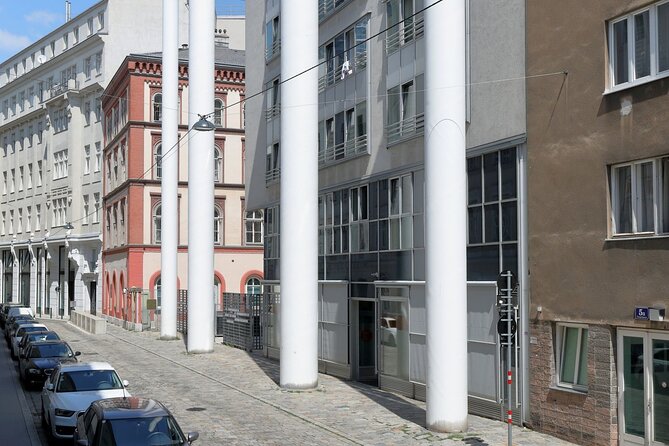
- Leopoldstadt adds physical evidence: Four tall white columns mark the site of the destroyed Leopoldstädter Temple.
- Judenplatz brings the Holocaust into focus: The tour ends at Vienna’s Holocaust Memorial, alongside the site of destroyed Ashkenazi and Sephardic synagogues.
- Guides come from academic and cultural fields: You may be led by a historian, professor, doctoral student, journalist, art critic, or published author.
- The group is capped at eight: This is a more personal format than a large city walk.
- Plan on 2.5 hours and some transit: The route includes a metro ride, and the tour finishes only a few minutes from where it begins.
Why Jewish Vienna deserves a dedicated walk
Vienna can seem polished and imperial at first glance. Palaces, grand avenues, concert halls, and coffeehouses dominate the usual sightseeing plan. This tour asks you to look again, especially at the spaces between the famous sights.
Jewish residents helped shape Vienna’s commerce, arts, theater, scholarship, and civic life over many centuries. Their place in the city was never simple. Settlement grew despite expulsions and restrictions, and Jewish communities helped build Vienna while facing repeated hostility.
That tension is central to the walk. You are not being shown a few isolated memorials. You are following a story of arrival, contribution, persecution, destruction, survival, and present-day Jewish life.
I find that approach useful because it keeps the Holocaust from swallowing the whole subject. The Nazi genocide is treated with the seriousness it demands, but you also learn about Jewish culture and daily life before 1938. That wider frame gives the memorials more meaning.
The tour is led in English and lasts about two and a half hours. A guide with a background in history, journalism, art criticism, or university teaching can explain not only what happened, but why a building looks the way it does and what its location tells you about Vienna.
More Walking Tours in Vienna
- Vienna: Guided Walking Tour of City Center Highlights
★ 4.7 · 4,989 reviews - Vienna: Vienna Central Cemetery Guided Walking Tour
★ 4.8 · 3,307 reviews - Vienna: Guided Walking Tour of City Highlights & Hidden Gems
★ 4.9 · 2,180 reviews
Starting at the City Temple on Seitenstettengasse
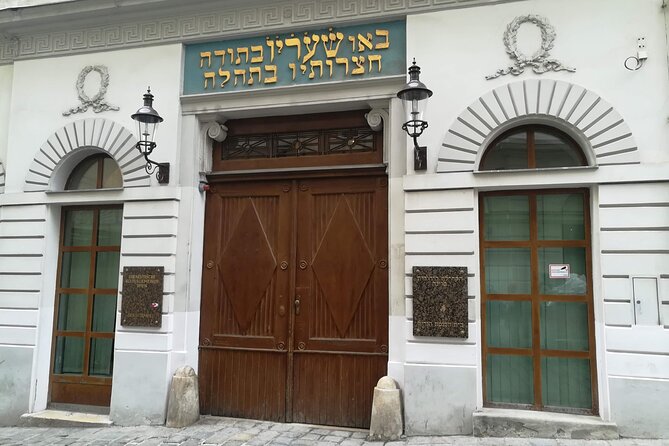
The meeting point is outside the Stadttempel, or Jewish City Temple, at Seitenstettengasse 4 in Vienna’s first district. This is a useful starting place because the building immediately raises a question: why is such an important synagogue so hard to recognize from the street?
The answer leads into the legal and social limits placed on Jewish residents in Vienna. The synagogue’s interior is much grander than its exterior suggests, but this walk stays outside. From the street, your guide explains how Jewish communities could be influential in Vienna’s development while still being forced to keep their houses of worship discreet.
That contrast makes the first stop more than a quick architectural look. You begin with the physical evidence of unequal status, then move backward into medieval Jewish settlement and the expulsions that interrupted it.
The City Temple is not simply a place to photograph before moving on. It gives your guide a chance to explain how Jewish life continued, changed, and rebuilt itself through difficult periods. The opening section also sets up a key theme for the day: visibility could be dangerous, yet Jewish identity and community life persisted.
You do not enter the synagogue during this tour. If you want to see the inside, the synagogue offers its own guided visits from April through October, Monday through Thursday. Those visits require separate planning and are not included in the $179.74 tour price.
The scheduling can work well. An 11:30 a.m. Monday synagogue visit followed by lunch fits before a 2 p.m. Jewish Vienna tour. On Tuesday and Thursday, a 2 p.m. synagogue visit can follow a 9:30 a.m. Jewish Vienna tour, with lunch between the two.
Nestroyhof Theater and Vienna’s Jewish cultural life
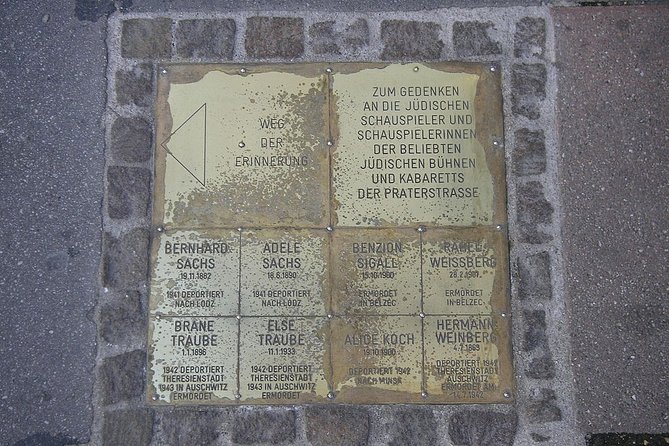
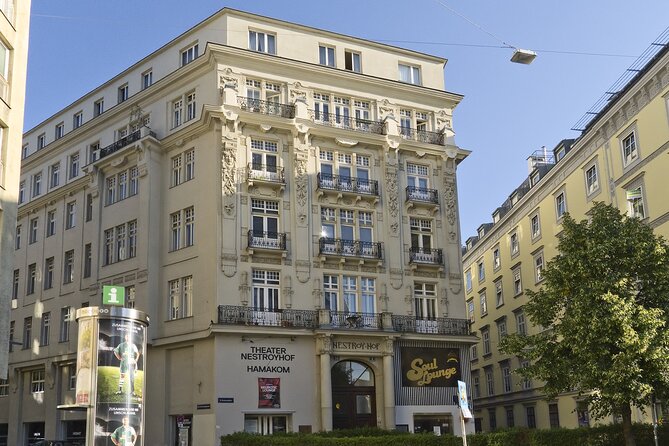
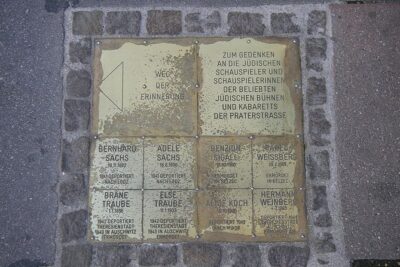
The route continues to the Theater Nestroyhof Hamakom. You view the building from outside, including its Art Nouveau exterior, and learn about its earlier role as a home for Yiddish-speaking theater groups.
This stop widens the subject beyond religious buildings and memorials. Jewish influence in Vienna reached the stage, the arts, publishing, music, business, and public life. A theater is a particularly good place to discuss that cultural role because performance brings language, identity, and public debate together.
The exterior itself gives the stop visual interest. The Art Nouveau design belongs to the Vienna many visitors already know, but the theater’s Jewish connection adds another layer to the familiar style. Your guide can connect the building to the modern Jewish community and its role in the city’s cultural life.
The limitation is clear: you do not go inside, and there is no admission included. If you are hoping for a theater performance or a full interior tour, this stop will not provide that. Its value comes from the explanation and the wider context, not from a long visit to the building.
This is also where a strong guide matters. Peter has been praised for mixing historical and personal details, while Annelie Pichler has been noted for using narration and visual material to bring the city’s Jewish past to life. Jan is another guide associated with warm, story-driven tours. The exact guide depends on the date, so you should book for the subject rather than for a promised individual.
Leopoldstadt and the four white columns
The walk then heads through Leopoldstadt, Vienna’s second district. This area is closely tied to Jewish life, making it an important change from the grander central streets around the City Temple.
The key site is the memorial for the destroyed Leopoldstädter Temple. Four imposing white columns rise into the sky where the temple once stood. The design is simple, but it is not easy to ignore. The empty space between the columns suggests the missing building and the community that once gathered there.
This stop works best when you allow yourself time to look rather than treating it as another address on a route. Your guide explains what was destroyed and how the area’s Jewish past fits into Vienna’s broader development.
The memorial is free, so there is no extra admission charge here. The practical issue is that the tour is a walking route rather than a series of indoor museum visits. Expect to spend time outdoors, and wear shoes suited to city pavement.
The metro ride also matters. Metro fare is not included, and if you do not have a visitor pass, the guide helps you purchase a ticket at the first station. That support is useful, especially if you are unfamiliar with Vienna’s ticket machines, but you should still budget for the fare.
The movement to Leopoldstadt gives the tour a good rhythm. You are not standing in one square for two and a half hours. You walk through a real district, see how the city changes around you, and connect present-day streets with vanished institutions.
More Jewish Vienna walks:
- Jewish Vienna: City Synagogue Guided Tour
★ 4.6 · 208 reviews - Vienna: Jewish Museum Vienna and Museum Judenplatz Tickets
★ 4.5 · 170 reviews - Vienna: Jewish Life in Leopoldstadt 2-Hour Walking Tour
★ 4.9 · 109 reviews - Private Jewish Walking Tour Vienna
★ 5.0 · 30 reviews
Judenplatz and the weight of the final stop
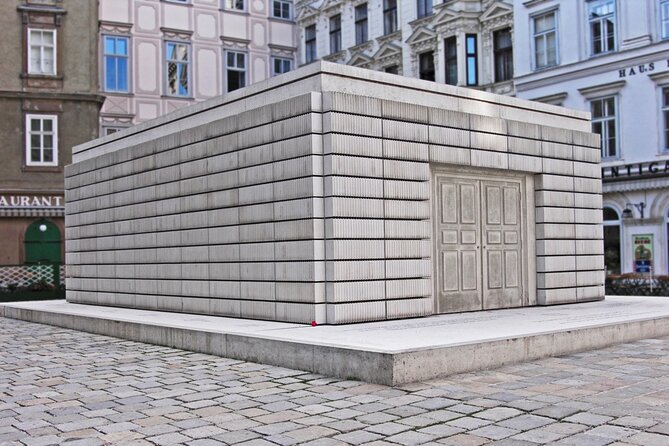
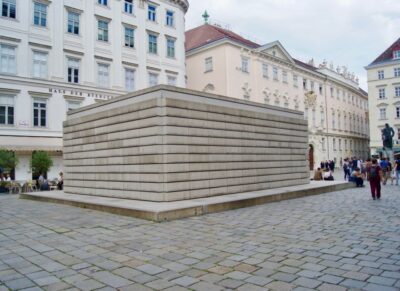
The tour ends at the Judenplatz Holocaust Memorial in central Vienna. This is the most emotionally demanding part of the route, and the guide discusses both the victims and survivors of Nazi genocide.
The memorial, also known as the Nameless Library, recalls the Austrian Jews murdered during the Holocaust. Nearby, the tour also addresses the destroyed synagogues of Ashkenazi and Sephardic congregations. The setting brings together medieval Jewish history, the city’s religious communities, and the catastrophe of the twentieth century.
Judenplatz is an effective final stop because it asks you to hold several periods in mind at once. Jewish life in Vienna did not begin with the Nazi era, and it did not end there. At the same time, the scale of the destruction cannot be treated as one chapter among many.
Your guide also discusses antisemitism in Europe. That makes the memorial more than a place for silent reflection. You receive the historical background needed to understand how discrimination developed and how persecution became mass murder.
The walk ends only a few minutes from the City Temple, so you are not left in an unfamiliar part of the city. Judenplatz is also a practical point for continuing your day in central Vienna, though the tour itself does not include a meal or a coffeehouse visit.
One private tour lasted longer than the planned schedule and ended at a coffeehouse, but you should not count on that. The stated duration is approximately two and a half hours, and the official endpoint is the Holocaust Memorial.
The guide makes or breaks this experience
This tour is sold around expert-led interpretation, not a long list of entry tickets. The guide is the main value.
The team includes professors, doctoral students, historians, journalists, art critics, and published authors. That range matters because Jewish Vienna is not only a political subject. It involves architecture, religion, literature, theater, urban planning, family life, and memory.
The strongest guide style here appears to be clear, warm, and story-based. Peter has been described as personable and engaging, with useful restaurant suggestions after the walk. Jan has been singled out for his ability to explain history through stories and help people remember what they learned. Annelie Pichler has been praised for adapting the discussion to special interests, including film music, and for helping with city navigation and restaurant choices.
You should still allow for differences between guides. One may focus more on medieval settlement, another on twentieth-century persecution, and another on architecture or cultural life. That is not necessarily a flaw. It is part of booking a small tour with several historians rather than a fixed audio script.
The small group size helps. With a maximum of eight people, you can ask about family history, synagogue architecture, Austrian politics, or the current Jewish community without trying to attract a guide’s attention across a crowd. If your group is smaller, the discussion may feel closer to a private walk.
What $179.74 buys you
At $179.74 per person, this is an expensive two-and-a-half-hour walking tour. The price makes the most sense if you want expert interpretation and a small group, not if you are mainly looking for access to buildings.
There are no included admission tickets to the City Temple, Nestroyhof Theater, or Judenplatz Memorial. Leopoldstadt’s memorial is free, and the metro fare is extra. You are paying mainly for the guide’s preparation, the route, the historical explanation, and the chance to ask questions.
That can be good value for a visitor who wants more than surface facts. Vienna’s Jewish sites are spread across different areas and periods, and it would be easy to pass them without understanding what happened there. A guide provides the links between them.
The price is harder to justify if you prefer museums, independent reading, or self-guided walks. You could visit Judenplatz and see the City Temple from outside on your own. You would not get the same structured account of Jewish life, the connections between the sites, or the specialist conversation.
The small maximum of eight is the strongest practical reason for the cost. A private guide would normally cost more, while a large group would likely cost less. This sits in the middle: a focused walking experience with the chance for personal questions.
The tour is booked, on average, about 61 days ahead. That suggests you should plan early if your Vienna dates are fixed, especially since the group is limited to eight people.
Timing, meeting point, and practical planning
The tour starts at the City Temple and ends at Judenplatz. The endpoint is only a few minutes on foot from the starting area, which makes it easy to continue sightseeing or return to your hotel.
Give yourself enough time to find Seitenstettengasse 4. One person found the meeting point less accessible than expected, so do not arrive at the last minute. The guide meets you outside the temple, not inside.
The tour is offered in English and uses a mobile ticket. Most people can participate, but it is still a walking experience with outdoor stops and a metro ride. If you need a slower pace or have mobility concerns, ask before booking because the supplied information does not promise a specific accessibility arrangement.
Free cancellation is available up to 24 hours before the start time for a full refund. Changes or cancellations inside that window are not accepted for a refund. The experience also requires a minimum number of participants, so if the operator cancels for that reason, you receive a different date or experience, or a full refund.
Who should book this Jewish Vienna tour?
I would choose this tour if you care about Jewish history, Vienna’s cultural life, or the way a city remembers persecution. It is especially useful for a first visit because it gives you a framework for seeing other Jewish sites on your own.
It suits people who enjoy explanation more than quick photo stops. The guide talks about Jewish life across long periods, not only the Holocaust, and the route includes both cultural places and memorial sites.
It also suits visitors who want a small group. Eight people is a manageable number, and the academic background of the guide can add depth that a general city tour may not provide.
I would hesitate if your main goal is to enter a synagogue or visit a museum. The City Temple and theater are seen from outside, and the tour does not include synagogue admission. In that case, pair this walk with a separate City Temple visit when available from April through October.
Should you book it?
Book this Jewish Vienna Walking Tour if you want the meaning behind the sites, not just the sites themselves. The route links the City Temple, Yiddish theater, Leopoldstadt, and Judenplatz into one clear story, and the small group gives you time to ask questions.
At $179.74, it is not a bargain city stroll. It is a specialist tour whose value depends on the guide. For an interested visitor, the historians’ stories, cultural context, and careful treatment of antisemitism and the Holocaust can make the cost worthwhile.
If you book, allow the full two and a half hours, budget for metro fare, wear comfortable shoes, and decide in advance if you also want the separate synagogue interior visit. With those expectations, this is a thoughtful and focused way to understand Jewish Vienna.
FAQ
How long is the Jewish Vienna Walking Tour?
The tour lasts approximately two hours and 30 minutes.
Where does the tour begin?
It begins outside the Jewish City Temple at Stadttempel, Seitenstettengasse 4, 1010 Vienna.
Where does the tour end?
It ends at the Judenplatz Holocaust Memorial in Judenplatz, 1010 Vienna. The endpoint is a few minutes’ walk from the City Temple.
Is the City Temple interior included?
No. The tour discusses the City Temple from outside. Separate synagogue tours are available from April through October, Monday through Thursday, and admission is not included in this experience.
Is metro fare included?
No. If you do not have a visitor pass, the guide helps you purchase a metro ticket at the first station.
How many people can join the tour?
The maximum group size is eight people.
Just added around Vienna
- Vienna: UNESCO Schönbrunn Palace Guided Tour with Entry★ 4.5 · 94 reviews
- World War II History Vienna Old Town Private Walking Tour★ 4.8 · 9 reviews
- Vienna: Winery and Wine Tasting Tour with a Wine Expert★ 5.0 · 5 reviews
- Vienna: Wine Tasting E-Bike Tour★ 4.9 · 46 reviews
- Vienna: Wine Tasting at Schönbrunn Palace★ 4.3 · 71 reviews
- Vienna: Wine Tasting Tour★ 4.8 · 61 reviews
- Vienna: Wachau Valley Private Kayak and Wine Tour★ 5.0 · 3 reviews
- Vienna: Wiener Schnitzel and Strudel Cooking Class★ 4.9 · 126 reviews
Jewish Heritage Tours, compared.
Jewish Museum Vienna and Museum Judenplatz Tickets
Read our review →
Jewish Life in Leopoldstadt 2-Hour Walking Tour
Read our review →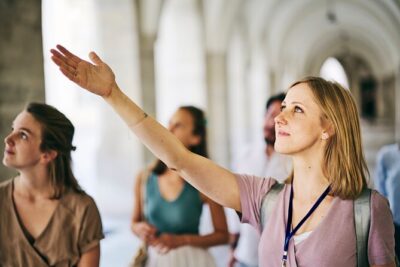
The Cultural Heritage of Jewish Vienna walking tour
Read our review →
Browse the lists this tour appears in