
Reviewed · WALKING TOURS
Nuns and Nazis Walking Tour in Salzburg
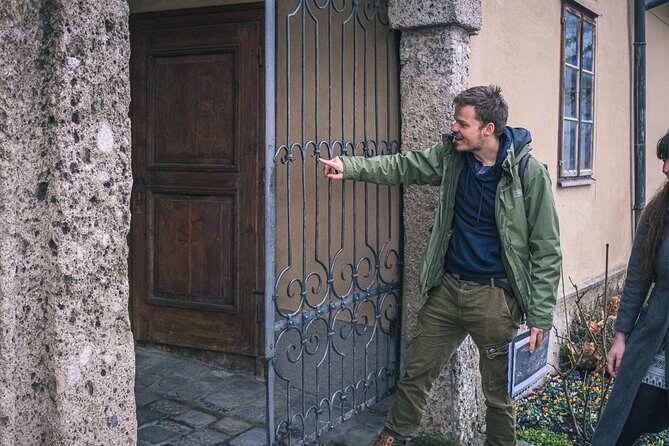
Salzburg’s postcard beauty hides a difficult wartime story, and this walk connects the two in a thoughtful way. Guide Leo takes you from The Sound of Music filming sites to Stolpersteine, forced-labor history, the Nazi takeover of Austria, and the real Trapp family story. It is not a general city tour dressed up with a few movie stops.
I like the way the tour joins popular culture with serious history, making Salzburg’s World War II past easier to understand without turning the walk into a dry lecture. I also like its personal angle: Leo’s family history was shaped by the war, which gives the subject a direct human connection.
The main consideration is pace and weather. The walk lasts about two hours to two hours and fifteen minutes, and one participant found it lasted closer to three hours. You will be outdoors throughout, so cold or rain can make the experience feel longer.
Five things to know before you book
- The tour links two very different stories: Salzburg’s role during World War II and the real history behind The Sound of Music.
- Guide Leo leads the walk: His personal connection to the war and enthusiasm for Salzburg shape the tour.
- You visit nine free outdoor stops: The route runs from Mirabell Gardens across the old town to Nonnberg Abbey.
- The Stolpersteine add a personal human scale: You hear about people affected by Nazi rule, not just political events.
- The finish is useful for sightseeing: From Nonnberg Abbey, you can continue on foot toward Hohensalzburg Fortress.
Why this Salzburg walk is different
Many Salzburg tours lean heavily toward one of two subjects: Mozart or The Sound of Music. This one takes a less comfortable route. The movie provides an easy way into the city, but the tour keeps returning to the real events surrounding the film’s setting.
The title may sound cheeky, yet the content is serious. The nuns refer to Nonnberg Abbey and the movie’s convent scenes. The Nazis refer to the political takeover, persecution, forced labor, book burning, and everyday choices made by people in Salzburg during the war.
I appreciate that the tour is not presented as a general introduction to Salzburg. If you want the basic story of the city, a standard free walking tour is likely the better first step. This experience assumes you want a focused look at World War II and the Trapp family, with film locations used as part of the route.
Leo is the guide named in the tour details, and the personal element matters. His own family history was influenced by World War II, so the subject is not treated as a distant chapter from a textbook. At the same time, the walk moves through real places and documented events rather than relying only on personal storytelling.
More Walking Tours in Salzburg
- Salzburg 2.5-Hour Walking Tour: Mozart, Old Town & More
★ 4.2 · 987 reviews - Salzburg: Old Town, Mozart, & Mirabell Gardens Walking Tour
★ 4.8 · 461 reviews - Salzburg Oldtown: Sightseeing Walking Tour with Licensed Local Guide
★ 5.0 · 392 reviews
Mirabell Gardens and the opening movie connection
The tour begins at Kurgarten on Rainerstraße at 3 pm. From there, the group crosses Schloss Mirabell and Mirabell Gardens, one of the most recognizable filming locations connected with The Sound of Music.
This is a smart opening. You start with a place many people already know from the movie, then begin asking what is real, what was changed for the screen, and how the city looked during the war years. The gardens are also an easy place to begin a walking tour because there is no admission charge and plenty to see before the historical subjects become heavier.
You should not expect a full tour of Mirabell Palace. The stop is listed at about 15 minutes, so the focus is on the gardens and their movie connection. If you have watched the film recently, you will get more from the references. One useful tip is to rewatch The Sound of Music before arriving. Several Salzburg locations appear only briefly, and the walk gives those short scenes more context.
Makartplatz and the names on the map
The next stop is Makartplatz, a square whose name changed several times before, during, and after World War II. That detail may sound small, but place names can show how political power reaches everyday life.
The square also contains buildings affected by the war. This is where the tour begins shifting from movie memories to the city’s public spaces and political past. You are not only looking at grand monuments. You are considering how streets and squares were renamed, used, and remembered as governments changed.
The stop lasts about 10 minutes. That is enough for a focused explanation, though not enough for every detail about the surrounding buildings. The route is designed as a connected story, so you should listen for the link from one place to the next rather than expect a separate lecture at each stop.
Linzergasse and Salzburg’s Stolpersteine
Linzergasse was a neighborhood for ordinary people, and here Leo introduces the Stolpersteine. These small memorial stones are placed in the pavement for people persecuted and killed under the Nazi regime.
This is one of the most meaningful parts of the walk because it brings a huge historical subject down to individual names and lives. A square or government building can tell you where power operated. A Stolperstein asks you to think about a person who lived on that street, had a home, and then lost the right to live freely.
The stop is scheduled for about 10 minutes. Watch your footing while listening, especially on a busy street. The stones are easy to miss if you are rushing, which is exactly why a guide’s explanation adds value.
A completely different way to spend a day here:
- The Original Sound of Music Tour in Salzburg
★ 4.5 · 6,129 reviews - Salzburg: Original Sound of Music Tour
★ 4.8 · 5,059 reviews - From Salzburg: Half-Day Tour to Hallstatt
★ 4.6 · 3,596 reviews - Salzburg: Mozart Concert at Mirabell Palace
★ 4.8 · 3,498 reviews
Steingasse and an uncertain wartime story
At Steingasse, Leo tells an urban legend connected with World War II in Salzburg. You are asked to decide for yourself whether you believe it.
That is a useful change of tone. Not every story attached to a historic place has the same level of proof, and a responsible guide can distinguish between established fact and local legend. This stop gives you a chance to think about how wartime stories grow, survive, and become part of a city’s memory.
It also keeps the walk from feeling like a sequence of dates and names. The stop lasts roughly 10 minutes, and you should treat the story as a question rather than a confirmed event.
Staatsbrücke and forced labor
At Staatsbrücke, the main bridge in Salzburg’s old town, the tour addresses hundreds of prisoners of war and forced laborers who worked against their will on its construction during World War II.
This is among the most sobering stops. A bridge is usually something you cross without a thought. Here, it becomes a reminder that major public works can have a human cost hidden beneath their finished appearance.
The subject is especially valuable because it moves the tour beyond famous leaders and headline events. War was also experienced through labor, coercion, hunger, fear, and the loss of personal freedom. You spend about 10 minutes here, enough to understand why the bridge belongs in a World War II walking route.
Alter Markt and the choices facing Jewish families
At Alter Markt, Leo turns to the lives of ordinary people, including a Jewish family and the difficult question of who escaped Salzburg before the Nazi takeover and who did not.
This stop gives the tour a local, personal scale. Political change can sound abstract when described only through the Anschluss, the term for Nazi Germany’s annexation of Austria. Stories about a family deciding whether to leave make the danger and uncertainty easier to grasp.
The Old Market is also a useful setting because it is one of the city’s central public squares. You are standing in a place associated with normal daily life while considering how quickly normal life can be broken. The stop takes about 10 minutes.
The Festspielhaus and the real Trapp family
The Salzburg Festspielhaus is tied to the end of The Sound of Music, when the Trapp family performs before fleeing Salzburg. The tour asks an important question: did the family actually perform there?
This is where the movie and the historical record can be compared directly. The Trapp family’s real story is not identical to the film version, and learning where the movie compresses or changes events helps you enjoy the film without mistaking it for a documentary.
The answer is part of the tour’s appeal, especially if you know the movie well. The stop lasts about 15 minutes and gives you a chance to connect a famous screen moment with a real Salzburg venue. If you have never seen the movie, you can still follow the history, but the references will have less emotional weight.
Residenzplatz, the Anschluss, and Salzburg’s book burning
Residenzplatz is the longest stop, at about 20 minutes, and it brings several major themes together. Here you hear about the Anschluss, the Nazi takeover of Austria, the Trapp family, the film’s historical changes, and the only book burning that took place in Salzburg during World War II.
This is the tour’s main political and historical center. The square helps you understand how a takeover becomes visible in public life. It also shows why Salzburg cannot be treated only as a pretty setting for a musical. The same city that appears charming on screen experienced political pressure, exclusion, and persecution.
The book burning is a particularly important detail because it shows how Nazi control targeted ideas and culture as well as people. You may find this section more demanding than the movie material, but that contrast is the point. The tour gives the popular story a harder historical frame.
Nonnberg Abbey and the final view
From Residenzplatz, the route continues uphill to Stift Nonnberg. This is the final stop and the place that gives the tour its title its clearest meaning.
Nonnberg Abbey is associated with the convent in The Sound of Music. It is also described as the oldest women’s monastery in the world. The setting offers views toward the Alps, and Leo finishes with more movie facts and stories about the Trapp family.
The route’s final climb is worth noting. The tour requires a moderate level of physical fitness, and the walk is not entirely flat. The exact difficulty will depend on your pace and the weather, but you should wear comfortable shoes and expect to be on your feet for the full two hours or more.
The ending works well from a sightseeing point of view. Nonnberg Abbey’s church is a worthwhile place to see, and the footpath toward Hohensalzburg Fortress lets you continue exploring without returning to the starting point. The tour does not include an admission ticket to a paid attraction, so you can decide what to visit next.
Price, group size, and timing
At $20.64 per person, this is reasonably priced for a guided, two-hour city walk with a clear subject and a named guide. All nine listed stops are free, so your payment goes toward the guide’s time, research, and interpretation rather than entry fees.
The maximum group size is 25 people. That is not an intimate private walk, but it is still manageable for an urban route if everyone stays close. The open-air setting also means you are not packed into a small room.
The published duration is about two hours to two hours and fifteen minutes. Plan for more time if questions create a longer discussion. One account describes a tour lasting about three hours, so do not schedule a tight appointment immediately afterward.
The start time is 3 pm, which leaves the morning and early afternoon free for Salzburg’s other sights. The tour ends at Nonnberg Abbey rather than back at Mirabell Gardens. That is helpful if you want to continue toward the fortress, but less convenient if you need to return to your hotel on the other side of the river.
The ticket is mobile, and confirmation is sent within 48 hours, subject to availability. Free cancellation is available if you cancel at least 24 hours before the local start time. Changes or cancellations made later are not accepted for a refund.
Who will get the most from this tour
I would choose this walk if you have a real interest in World War II, local memory, or the gap between a famous film and the events that inspired it. It is also a good second tour after a basic Salzburg orientation, since the route assumes you want one subject examined in detail.
Fans of The Sound of Music will get extra pleasure from the filming locations, but you do not need to be a superfan. The historical sections carry the experience, and the movie acts as a familiar thread through a difficult subject.
I would think twice if you want a light, purely scenic walk or if you dislike emotionally serious material. The tour includes persecution, forced labor, Jewish family history, political takeover, and book burning. It is also a poor fit for anyone who wants to spend substantial time inside museums or monuments, since the route is mainly outdoors and all listed stops are free.
Rain and cold deserve practical attention. One participant described a cold, rainy day, yet still found the tour worthwhile. Bring weather protection, wear walking shoes, and leave enough time for the route to run beyond its nominal length.
Should you book it?
Book the Nuns and Nazis Walking Tour if you want Salzburg to be more than a pretty backdrop. Leo’s route connects Mirabell Gardens, the Trapp family, Stolpersteine, forced labor, the Anschluss, and Nonnberg Abbey in a way that gives each subject a place on the map.
It offers particularly good value for someone who has already seen the main city sights and wants a more focused story. Watch The Sound of Music beforehand, keep your afternoon open, and expect a serious walk with a strong local voice.
Skip it if you want a quick introduction, indoor comfort, or a tour centered only on film locations. For everyone else, this is a thoughtful way to see Salzburg through both its famous screen image and its difficult real past.
FAQ
How long does the Nuns and Nazis Walking Tour last?
The tour lasts approximately two hours to two hours and fifteen minutes. You should allow extra time because the walk may run longer if the group has questions.
What time does the tour start?
The scheduled start time is 3 pm.
Where does the tour begin?
The tour begins at Kurgarten, Rainerstraße 2, 5020 Salzburg, Austria.
Where does the tour end?
The tour ends at Nonnberg Abbey, Nonnberggasse 8, 5020 Salzburg. From there, you can continue along the footpath toward Hohensalzburg Fortress.
Who guides the tour?
The guide named for this experience is Leo. The tour includes his personal connection to World War II and his interest in Salzburg and The Sound of Music.
Is the tour suitable for people with limited mobility?
The tour requires a moderate level of physical fitness. It is a walking route that ends at Nonnberg Abbey, so you should be prepared to remain on your feet and walk uphill.
Can I cancel for a full refund?
Yes. You can cancel for a full refund up to 24 hours before the experience’s local start time. Cancellations or changes made less than 24 hours before the start are not accepted for a refund.
Just added around Salzburg
- Zell am See: Schmittenhöhe Tandem Paragliding Flight★ 4.9 · 82 reviews
- Zell am See: Paragliding Tandem Flight★ 5.0 · 31 reviews
- Werfen: Hohenwerfen Castle Entrance Ticket★ 4.5 · 84 reviews
- Viator Exclusive: ‘The Sound of Music’ Private Tour★ 5.0 · 28 reviews
- Zell am See Alpine Village Private Day Trip from Salzburg★ 5.0 · 3 reviews
- Private Austrian Food Tasting Tour in Salzburg’s Old Town★ 4.5 · 3 reviews
- Private transfer from Salzburg to Vienna, 2 hours for sightseeing★ 4.5 · 7 reviews
- Private Transfer from Salzburg to Munich with 2 hours for sightseeing★ 5.0 · 8 reviews
Walking Tours, compared.

Guided Walking Tour of City Center Highlights
Read our review →
Guided Walking Tour of City Highlights & Hidden Gems
Read our review →
Vienna Historic Center Small Group Walking Tour
Read our review →
Browse the lists this tour appears in