

Reviewed · WALKING TOURS
Salzburg Introduction Private Walking Tour
Salzburg’s charm is easiest to grasp on foot, and this private walk takes you from medieval lanes and Baroque facades to Mozart sites, St. Peter’s Abbey, and Mirabell Gardens. It is a useful first look at the city, especially if you want a guide to explain how Salzburg’s salt wealth, archbishops, music, and film fame fit together.
I like the private format, which lets your group of up to 10 set the pace, and I like the focus on local history rather than a simple parade of photo stops. The main drawback is the price: at $565.93 per group, it makes the most sense for a full group, not one or two people. The tour also moves quickly, and Mozart Residence admission costs extra.
Key points at a glance
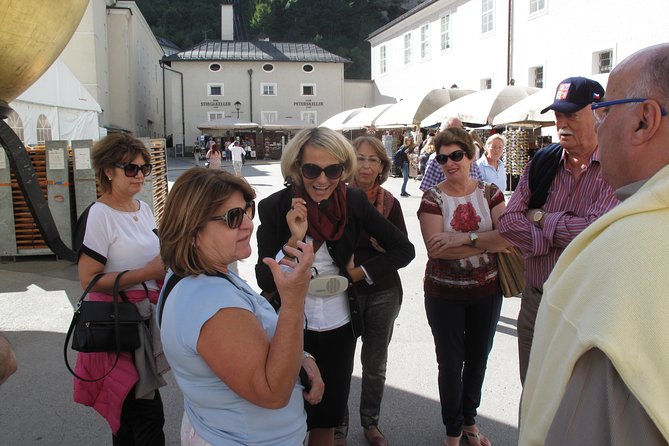
- Getreidegasse begins the story: Walk through Salzburg’s crooked medieval commercial center, lined with ornate Baroque fronts and traditional shop signs.
- Mozart is part of the city, not just a museum stop: See his birthplace and learn about his family, childhood, and fellow Salzburg composer Michael Haydn.
- St. Peter’s Abbey adds older layers: The Benedictine abbey traces its foundation to 696 and gives the walk a strong historical anchor.
- Mirabell Gardens finish the route: Italian-influenced Baroque design, statues, flowers, and familiar film settings provide a graceful final stop.
- Private guiding has real value: Your own scholar guide can tailor the pace and explain details that are easy to miss on a self-guided walk.
- Budget for the Mozart Residence: The walking tour is included, but admission to the Mozart Residence is not.
This is a compact introduction to Salzburg’s historic center. The published duration is about two and a half hours, although the route description also refers to roughly three hours. Either way, you should think of it as a half-day orientation, not a full museum tour or a detailed study of every building.
You meet at 2 p.m., arriving 15 minutes early, at Coffeehouse Salzburg on Linzergasse 39. The general meeting information also refers to Café Glockenspiel, so confirm the exact spot after booking. That small check matters in Salzburg, where several cafés and squares sit within an easy walk of one another.
From there, you head into the Old Town with a private guide. The guide is described as a local historian and an enthusiastic host, so the appeal lies in explanation rather than simply following a route. You can ask questions, pause for photographs, and set a pace that suits your group.
A private tour is especially useful if you are visiting Salzburg for the first time. The Old Town is compact, but its details can blur together: an archbishop’s residence here, a medieval passage there, a famous musician’s former home around the corner. A good guide gives those pieces an order.
The walk begins in Getreidegasse, Salzburg’s best-known shopping street. Its narrow route and crooked passageways preserve the shape of the old burgher town, even though the street now serves as a busy commercial center.
Look above the shop windows. Wealthy burgher houses rise behind Baroque facades, and the architecture tells you that Salzburg was not merely a small provincial settlement. The city grew wealthy through salt, and powerful archbishops used that money to shape the center with churches, squares, residences, and decorative fronts.
The tour allows about 25 minutes here. That is enough time for your guide to point out the street’s layout and explain how commerce worked under the archbishops. It is not enough time for serious shopping, a long café stop, or a close look at every side lane.
You will also notice the famous wrought-iron signs hanging over the street. They make the route easy to recognize and add to its old-world appearance, but the real pleasure is looking past the polished storefronts to the passages and courtyards behind them.
This is a good place to ask your guide how Salzburg’s medieval salt trade shaped its growth. The subject gives the city a practical foundation. Salzburg’s grand churches and palaces did not appear by accident. They were tied to money, authority, and the city’s position as an important religious center.
The route continues to No. 9 Getreidegasse, the birthplace of Wolfgang Amadeus Mozart. The Mozart family lived on the third floor from 1747 to 1773, and the building is now one of Salzburg’s most famous addresses.
Your guide explains Mozart’s childhood and family life rather than treating him as a name on a sign. That context helps you see Mozart as a local child who grew up in a working household shaped by music, travel, and ambition, before becoming one of Europe’s most celebrated composers.
The route also brings in Michael Haydn, another important composer linked to Salzburg. That wider view is useful. Salzburg’s musical identity is often reduced to Mozart, but the city’s story includes other composers and a long tradition of church and court music.
The information provided for the tour also mentions Mozart’s Residence, where he lived until age 17. Its museum exhibition covers his musical ability and dramatic life. Admission to the Mozart Residence is not included, so you should allow extra money if you want to go inside.
That distinction is important. The walking tour gives you exterior context and a guided explanation, but it does not make every Mozart museum visit part of the price. If you already plan to visit the birthplace or Residence separately, the guide’s commentary can help you know what to look for. If you want a slow museum visit, you will need to return on your own or plan additional time.
St. Peter’s Abbey is one of the most meaningful stops on the route. Founded in 696, it is considered one of the oldest monasteries in the German-speaking world.
The abbey offers a useful counterpoint to Mozart’s personal story. Instead of focusing on one celebrated individual, it points to the religious institutions that shaped Salzburg for centuries. This is also where the city’s connection to archbishops, church power, education, and music becomes easier to understand.
The scheduled stop is about 25 minutes, with no admission charge listed for the tour. You should not expect a long interior visit unless your guide confirms one. The value here comes from the setting and explanation, along with a chance to understand why Salzburg became such an important religious center.
The abbey is also a good pause in the walking route. Salzburg’s center is easy to cover, but narrow streets and crowded commercial areas can make the first hour feel visually busy. A stop at St. Peter’s gives the tour a quieter historical focus.
Your guide may also connect the city’s religious past to its work in medicine and learning, subjects included in the tour’s broader story. These details keep the walk from becoming only a Mozart and movie tour.
The final major stop is Mirabell Palace and Gardens, reached through the Residenz district. Here the mood changes from narrow medieval lanes to broad Baroque design.
The Italian-influenced squares show how the archbishops wanted Salzburg to look and feel. The palace and gardens use symmetry, sculpture, flowers, and carefully planned views to express order and authority. You can read the city’s political history in the architecture.
The gardens include mythological statues and ornate flower arrangements. They are also associated with The Sound of Music, whose Salzburg filming locations draw many people to the city. The tour includes stories about the film, but it does not treat the movie as the whole point of Salzburg.
That balance is welcome. If you love The Sound of Music, you will enjoy hearing how the city provided locations for the wartime story. If you are less interested in the film, the gardens still work as a fine example of Baroque planning and a pleasant place to end a walk.
The listed time here is about 30 minutes. That gives you room for photographs and a clear explanation of the palace grounds, but not a leisurely garden visit in every season. The tour ends in central Salzburg, leaving you well placed to continue exploring on your own.
The clearest advantage is attention. Only your group participates, with a limit of 10 people. You do not have to listen over a large crowd or wait for a guide to gather people at every corner.
The guide can also respond to your interests. You might want more Mozart, more church history, more architecture, or more about The Sound of Music. The tour description does not promise a custom route, but a private setting gives you a better chance to ask for added explanation than a large scheduled group walk.
The quality of the experience depends heavily on the guide. One guide named Liza received especially warm praise for keeping spirits up during frigid weather and choosing sunny places to stop. That detail is practical: Salzburg can be very cold, and a guide who pays attention to comfort can make a real difference.
At the same time, the experience is not guaranteed to feel equally strong with every guide. A separate assessment found the explanation muddled and felt that much of the route could have been done independently. That is a fair warning. A private tour does not automatically mean a great tour. The guide’s storytelling and organization matter.
The price is $565.93 per group of up to 10 people. For a group of 10, that works out to about $57 per person. For five people, it is about $113 per person. For two people, it is more than $280 each, before any museum admission.
That makes the booking much better value for a family or larger group than for a couple. You are paying for a private professional guide, not just admission to a site. The value comes from saving research time, getting a city overview, and having someone explain the connection between Salzburg’s salt wealth, archbishops, music, and film locations.
You should also remember that food, drinks, and Mozart Residence admission are not included. Since the walking route itself covers public streets, gardens, and exterior sights, the price is largely for the guide’s time and interpretation.
I would consider the price reasonable for a group that wants a private introduction and plans to ask questions. I would be less enthusiastic about it for one or two people who are comfortable using a guidebook and visiting the museums independently.
The afternoon start at 2 p.m. works well if you arrive in Salzburg earlier in the day or have already checked into your hotel. It also leaves your morning free for another attraction. On the other hand, a late start can be less useful in winter, when daylight fades early.
Wear comfortable shoes. The route follows narrow Old Town streets and includes several walking sections between the main stops. The tour is described as suitable for most people, and it is near public transportation, but the information does not provide a detailed accessibility assessment.
Weather deserves attention. Liza’s effort to find sunny stopping places during very cold conditions shows how much outdoor comfort can affect this experience. Bring a warm layer in cold months and plan for changing conditions. The tour is outside for much of its duration, with limited control over wind, rain, or temperature.
You should also arrive early. The stated meeting instruction is 15 minutes before the start, and the references to both Coffeehouse Salzburg and Café Glockenspiel make it sensible to verify the precise location before the day.
This tour suits you best if:
- You want a private introduction before exploring Salzburg independently.
- You are traveling with a family or group of friends that can share the fixed price.
- You care about architecture, Mozart, church history, and The Sound of Music.
- You prefer asking questions to a local guide instead of following a large group.
- You have about half a day and want several major sights connected in one story.
It may not suit you if you want long museum visits, extensive time inside the abbey, or a slow photography walk. It also may not be the best value for a solo visitor or couple on a tight budget.
The 4.7 rating from nine posted assessments suggests a generally positive experience, but the small number of assessments means you should not treat that figure as a guarantee. The mixed feedback makes the guide a key part of the decision.
Book this Salzburg walk if you are part of a group, want a private guide, and value context more than ticking off interior attractions. The route covers the city’s essential first impressions: Getreidegasse, Mozart’s birthplace, St. Peter’s Abbey, the Residenz district, and Mirabell Gardens.
I would especially recommend it for a first afternoon in Salzburg. You will finish with a map in your head and a clearer sense of which sites deserve a longer return visit.
Skip it if the price falls mainly on one or two people, or if you prefer to explore at your own pace with a guidebook. In that case, you can walk much of the same public route independently and pay separately only for the museums you want.
FAQ
More Walking Tours in Salzburg
- Salzburg 2.5-Hour Walking Tour: Mozart, Old Town & More
★ 4.2 · 987 reviews - Salzburg: Old Town, Mozart, & Mirabell Gardens Walking Tour
★ 4.8 · 461 reviews - Salzburg Oldtown: Sightseeing Walking Tour with Licensed Local Guide
★ 5.0 · 392 reviews
How long does the Salzburg private walking tour last?
The experience is listed as approximately 2.5 hours. The route description also refers to three hours, so confirm the expected finish time with the provider.
Where does the tour begin?
The stated meeting point is Coffeehouse Salzburg at Linzergasse 39, 5020 Salzburg. The overview also refers to Café Glockenspiel, so confirm the precise meeting location after booking and arrive 15 minutes early.
What sights are included?
The walk covers Getreidegasse, Mozart’s birthplace, Mozart’s Residence area, St. Peter’s Abbey, the Residenz district, and Mirabell Palace and Gardens.
A completely different way to spend a day here:
- The Original Sound of Music Tour in Salzburg
★ 4.5 · 6,129 reviews - Salzburg: Original Sound of Music Tour
★ 4.8 · 5,059 reviews - From Salzburg: Half-Day Tour to Hallstatt
★ 4.6 · 3,596 reviews - Salzburg: Mozart Concert at Mirabell Palace
★ 4.8 · 3,498 reviews
Is Mozart Residence admission included?
No. Admission to the Mozart Residence is not included in the tour price.
How many people can join the private tour?
The private tour is for your group only, with a maximum of 10 people.
What happens if I need to cancel?
You can cancel for a full refund up to 24 hours before the experience start time. Cancellations or changes made less than 24 hours before the start are not accepted for a refund.
Just added around Salzburg
- Zell am See: Schmittenhöhe Tandem Paragliding Flight★ 4.9 · 82 reviews
- Zell am See: Paragliding Tandem Flight★ 5.0 · 31 reviews
- Werfen: Hohenwerfen Castle Entrance Ticket★ 4.5 · 84 reviews
- Zell am See Alpine Village Private Day Trip from Salzburg★ 5.0 · 3 reviews
- Viator Exclusive: ‘The Sound of Music’ Private Tour★ 5.0 · 28 reviews
- Private Austrian Food Tasting Tour in Salzburg’s Old Town★ 4.5 · 3 reviews
- Private transfer from Salzburg to Vienna, 2 hours for sightseeing★ 4.5 · 7 reviews
- Private Transfer from Salzburg to Munich with 2 hours for sightseeing★ 5.0 · 8 reviews
Walking Tours, compared.
Guided Walking Tour of City Center Highlights
Read our review →
Guided Walking Tour of City Highlights & Hidden Gems
Read our review →
Vienna Historic Center Small Group Walking Tour
Read our review →
Browse the lists this tour appears in