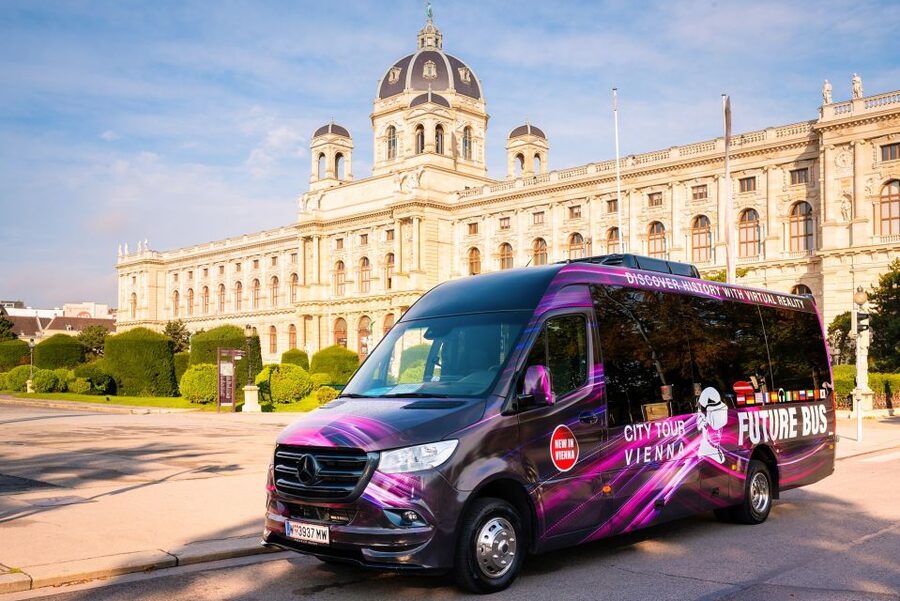
Reviewed · TOURS
Vienna: Bus Tour with Virtual Reality Experience
Vienna’s Future Bus turns a quick city tour into a short history lesson with goggles. You ride past the Opera, Heroes Square, Parliament, City Hall, MuseumsQuartier, Naschmarkt, and Karlskirche, then pause four times to see historical scenes in virtual reality. I like the clever mix of real streets and reconstructed moments, and I like that the whole circuit takes just one hour.
The tour is a good use of $32 if you want a fast orientation without committing half a day. The tradeoff is space and access: this is a compact minibus, not a hop-on, hop-off coach, and it is not suitable for children under seven, people with mobility impairments, or people with visual impairments.
Key points to know before booking
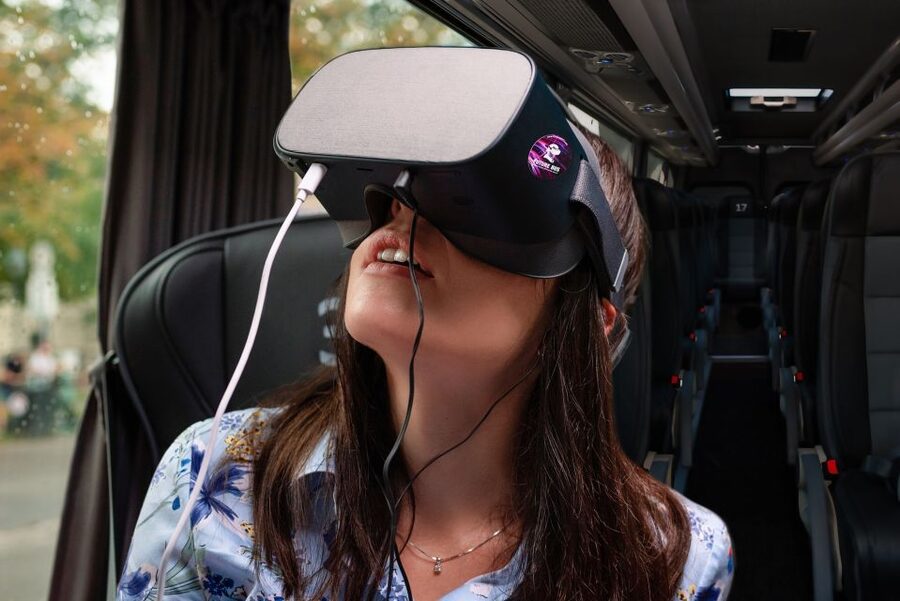
- Four VR stops give the tour its main appeal: You meet figures including Eugene of Savoy, Archduke Charles, and Maria Theresia through short virtual scenes.
- The route packs in major sights: The bus passes the Opera, Heroes Square, Parliament, City Hall, Votive Church, MuseumsQuartier, Naschmarkt, and Karlskirche.
- The audio guide does the talking: Commentary is available in English, German, Spanish, French, Italian, Japanese, Chinese, Russian, Portuguese, and Arabic.
- The minibus is comfortable and air-conditioned: That matters on a rainy or chilly day, though the compact vehicle has less room than a large sightseeing bus.
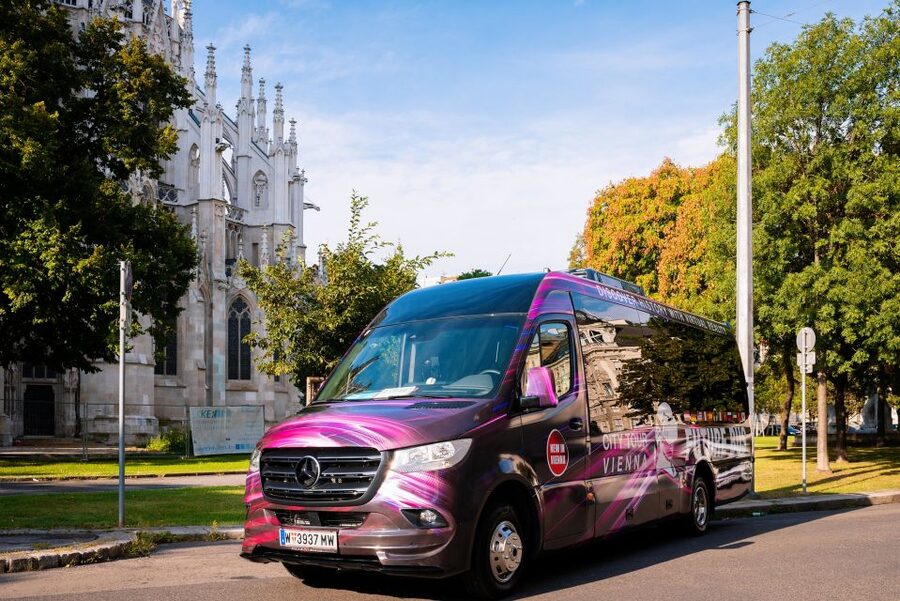
- The tour starts and ends behind the Opera: Meet at Albertinaplatz at least 10 minutes early and look for the purple minibus and purple-shirted driver.
- This is a sampler, not a museum visit: You see buildings from outside and do not receive entrance to any interior.
Why the Future Bus is different from a standard city tour
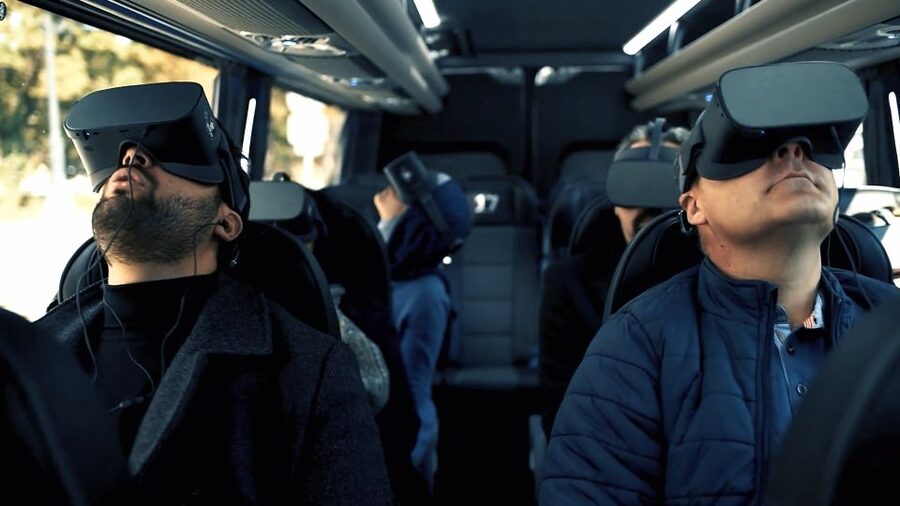
Most quick Vienna bus tours point out grand buildings and keep moving. This one adds four stops where you put on VR glasses and see parts of the past represented in a more direct, visual way.
That format works well for Vienna. The city center is full of statues, palaces, churches, and official buildings, but a passing facade can blur together if you do not know why it matters. The virtual scenes give the buildings a human link. Eugene of Savoy, Archduke Charles, and Maria Theresia are not just names attached to monuments. They become part of the story you are hearing while sitting in the modern city.
I also like the tour’s scale. The purple minibus can cover a substantial section of the central city in an hour, but you are not spending most of that hour walking between sights. This makes the experience useful on your first day in Vienna, during a short city break, or when the weather is not friendly to a long outdoor stroll.
Still, keep your expectations in check. You are not getting a full guided walking tour, an interior visit to a palace, or a detailed architectural lecture at every stop. Think of it as a lively introduction, with VR as the main feature and the bus route as the setting.
A few more Vienna days worth a look
- Vienna: Vivaldi’s Four Seasons Concert in Karlskirche
★ 4.7 · 14,951 reviews - Vienna: Spanish Riding School Training
★ 3.9 · 9,281 reviews - Vienna: Skip-the-cashier-desk-line Giant Ferris Wheel Ride
★ 4.5 · 7,859 reviews
Starting behind the Opera at Albertinaplatz
The meeting point is at Albertinaplatz, directly behind the Vienna State Opera. Arrive at least 10 minutes before departure, show your voucher to the driver or representative, and look for the purple minibus. The driver wears a purple shirt, which should make the vehicle easier to identify in a busy central area.
Once aboard, you receive earphones and a quick briefing. The vehicle is air-conditioned and described as comfortable and well equipped. That is useful in Vienna, where a sudden shower or a cold spell can make an open-air sightseeing ride less pleasant.
The driver speaks English, German, and Russian. The recorded audio guide offers a much wider range of languages: English, German, Spanish, French, Italian, Japanese, Chinese, Russian, Portuguese, and Arabic. Check the available language option when booking so you know what to expect.
The bus format also helps you see a lot without a long physical effort. You remain seated for much of the ride, then leave the minibus at the four VR stops. The experience is not suitable for people with mobility impairments, so you should consider the stop-and-board arrangement before reserving.
From the State Opera to Maria Theresia Square
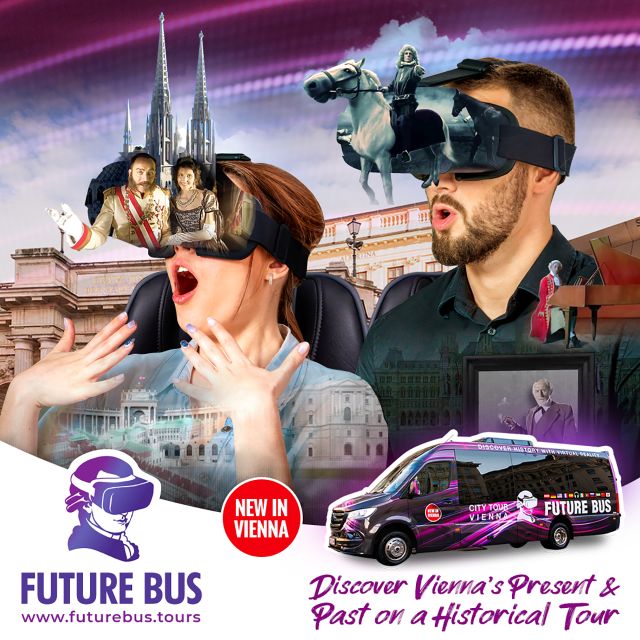
The opening route takes you past some of Vienna’s most recognizable imperial-era sights. The State Opera sets the tone, with its grand position on the Ringstrasse. From there, the bus continues toward the Neue Burg area, Heroes Square, and Maria Theresia Square.
Heroes Square is one of the city’s grandest ceremonial spaces. The broad setting and monumental buildings make more sense when seen as part of Vienna’s imperial center rather than as isolated attractions. Maria Theresia Square, with its large monument and major museum buildings, gives you another strong view of the city’s formal public architecture.
The first VR stop comes in this section of the route. You follow the audio instructions, put on the glasses, and enter a virtual presentation connected to Vienna’s past. The experience includes figures such as Eugene of Savoy, Archduke Charles, and Maria Theresia.
This is where the tour earns its price. You are not simply hearing a list of dates while looking out a bus window. You are given a visual way to connect famous people with the places around you. For children old enough to use the equipment and for adults who like history presented with a modern twist, this can make the early part of the ride more memorable.
The glasses are also the reason to book this experience instead of a standard city bus. If you dislike virtual reality or prefer quiet observation, the added technology may feel like a distraction. But if you enjoy visual storytelling, it gives the first stretch a clear purpose.
City Hall and the Burgtheater: the second VR stop

After the first presentation, the bus continues past the Volksgarten and the Austrian Parliament before stopping near Vienna’s City Hall. The stop is close to the Burgtheater, giving you a view of two major civic and cultural buildings in the same part of the city.
City Hall is especially striking from the outside, with its tall Gothic-style tower and grand facade. The Burgtheater adds a different note, linking the area to Vienna’s long performance tradition. You do not enter either building, so your experience here is based on the exterior view, the audio commentary, and the VR presentation.
At the second VR stop, you again follow the instructions and put on the glasses. The supplied details do not identify every scene at this point, so you should expect another short historical presentation rather than a standard guided visit inside City Hall or the Burgtheater.
I find this pause useful because it breaks up the ride. A continuous bus circuit can become passive, especially when the sights arrive one after another. Getting out, using the glasses, and then returning to the bus gives the hour a better rhythm.
The main drawback is that four VR stops cannot provide much time at each location. You will see a lot, but you will not linger beside City Hall or study the Parliament facade at length. Bring your camera only if you can use it quickly, since the schedule is built around keeping the circuit moving.
A completely different way to spend a day here:
- Vienna: Schönbrunn Palace & Gardens Skip-the-Line Tour
★ 4.7 · 7,739 reviews - Vienna: Light of Creation Votive Church Immersive Light Show
★ 4.8 · 6,779 reviews - Vienna Spanish Riding School Guided Tour
★ 4.7 · 6,765 reviews - Vienna: Classical Concert in the World-Famous Musikverein
★ 4.6 · 6,673 reviews
Schottentor and the Votive Church
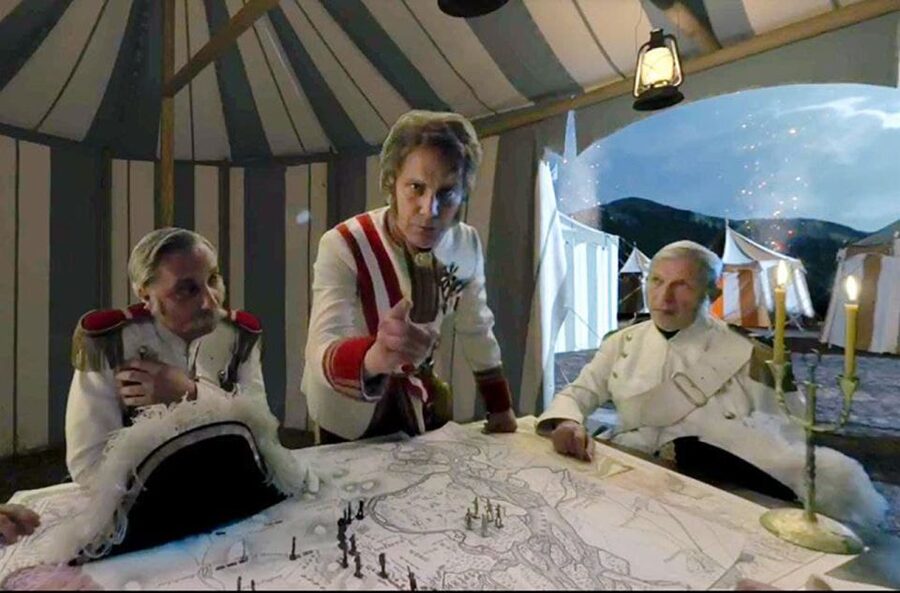
The route then heads toward Schottentor and the Neo-Gothic Votive Church. This church is one of Vienna’s most distinctive exterior sights, with pointed forms and tall architectural details that look very different from the imperial buildings near the Opera and Heroes Square.
The third VR stop focuses on an assassination attempt involving Emperor Franz Joseph and his brother Maximilian. This gives the ride a more specific historical subject. Instead of only meeting famous rulers in general terms, you receive a story linked to the city and the people connected with the imperial family.
The contrast between the real church outside the window and the virtual historical scene is the point. You can look at the building in front of you, then use the glasses to picture an event from another period. That combination helps explain why the VR works best as an addition to the route, not as a separate attraction.
As with the other stops, this is a short presentation. You should not expect a full account of the Habsburg period or a long historical lecture. The audio guide fills in more information as the bus moves on.
The long sightseeing stretch through central Vienna
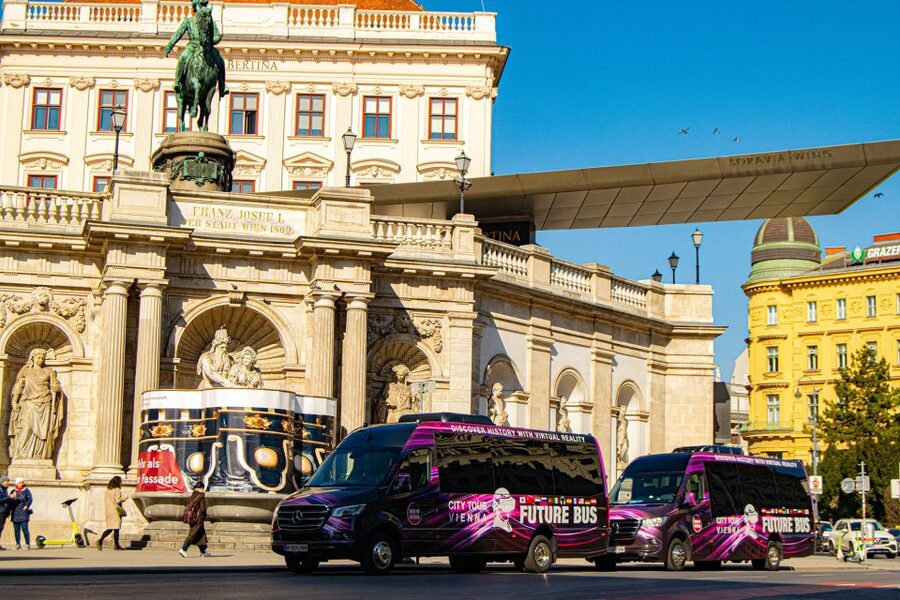
Between the VR stops, the bus passes an impressive list of central Vienna sights. You see the Volkstheater, MuseumsQuartier, the Secession building, Naschmarkt, Karlskirche, and other notable buildings through the large side window.
This is the part of the tour that gives you a useful sense of Vienna’s layout. MuseumsQuartier and the nearby Volkstheater show the city’s cultural side. The Secession building introduces the decorative style associated with Vienna around 1900. Naschmarkt adds a food-market setting, while Karlskirche brings you back to grand church architecture.
The large window matters here. You are not viewing the city through a tiny coach pane, and you can take in facades as the bus passes. The audio guide helps keep the ride from becoming a silent parade of buildings.
I would use this circuit as a planning tool. If the Secession, Naschmarkt, or Karlskirche catches your eye, make a note and return later on foot. The one-hour tour gives you a broad first look, but it does not replace time at the sights themselves.
Food and drinks are not included, and neither is food or drink allowed in the vehicle. That is easy to manage because the tour is only about an hour, but you should plan accordingly if you are booking it around a meal.
Returning to the Ringstrasse and the fourth VR stop
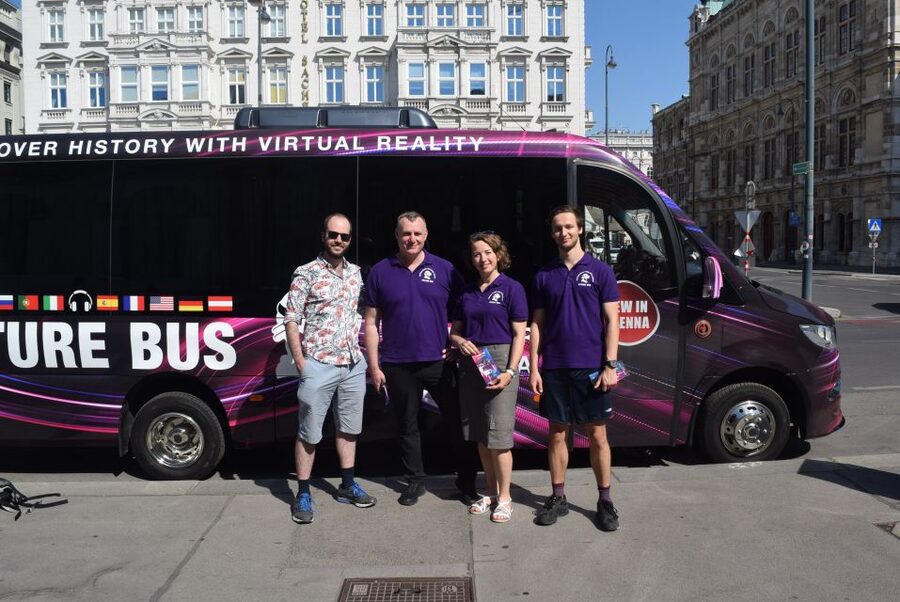
The bus eventually returns to the famous Ringstrasse and heads back toward the Opera area. The final VR presentation takes place at the original meeting point behind the Opera, completing the four-stop format.
Ending where you began is convenient. You do not need to arrange a taxi or figure out public transport from an unfamiliar neighborhood. It also makes the tour easy to fit into a day of sightseeing around the central city.
The fourth presentation gives the experience a proper finish rather than leaving the last portion as a simple drive back. You can treat it as the closing chapter of the virtual route, then continue with your own plans from Albertinaplatz.
The total duration is approximately one hour. That short length is one of the tour’s strongest practical features, but also its main limit. You receive a brisk introduction, not an in-depth historical tour. The experience works best when you want a compact activity before lunch, between museum visits, or at the start of a first afternoon in Vienna.
Is $32 a fair price?
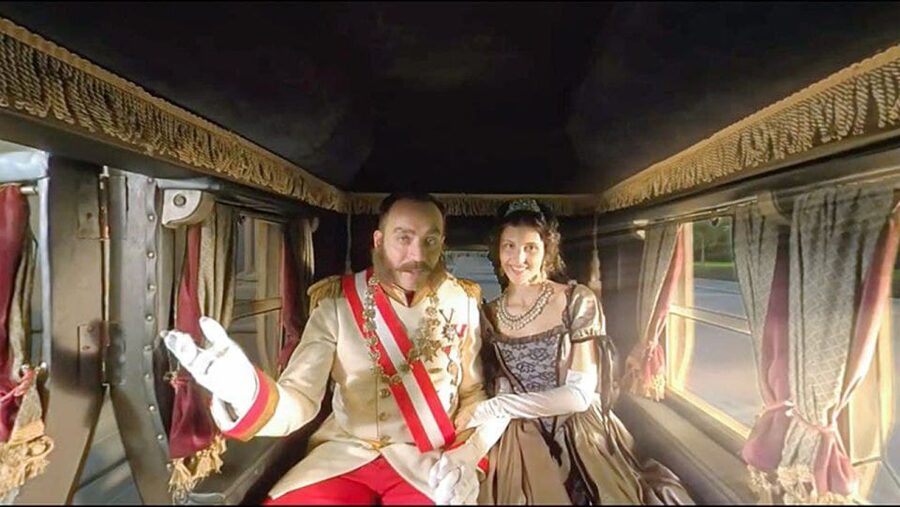
At $32 per person, the value depends on what you want from a city tour. A standard sightseeing ride may offer more time on the road, while a walking tour may provide richer detail and more chances to stop. The Future Bus charges for the combination of transport, recorded commentary, and four VR presentations.
For me, that makes the price reasonable for people who are curious about the technology and want a broad view of central Vienna in one hour. You also avoid paying separate admission to several attractions because the tour does not include building entrances. That keeps the plan simple, but it means the value comes from the guided route and VR rather than access to interiors.
The tour received a 4.7 rating from 148 reviews, and the strongest praise focuses on the virtual presentation, the friendly driver and guide service, and the amount of ground covered in a short time. One useful practical detail is that a passenger who missed a scheduled slot was allowed to attend a later one, though you should not assume that flexibility is guaranteed.
The experience also works well for families with children aged seven and older. The VR element gives younger participants something active to focus on, and the one-hour length is easier than a long walking route. Keep in mind that children must be old enough for the activity, and the tour is not suitable for children under seven.
Who should book this Vienna tour?
I would recommend it to a first-time visitor who wants a quick introduction to central Vienna. It is also a good choice if you have limited time, prefer air-conditioned transport, or want an activity that combines sightseeing with a clear visual feature.
History-minded visitors may enjoy meeting major figures through the VR scenes, especially Maria Theresia, Eugene of Savoy, and Archduke Charles. Families can also find the format easier to follow than a long lecture, provided everyone meets the age and accessibility requirements.
You may want to skip it if your priority is entering palaces, churches, museums, or government buildings. You should also choose another activity if you need a fully accessible vehicle or rely on visual content being adapted for impaired sight.
Book this tour if you want a fast, comfortable overview with four VR stops and do not mind seeing most attractions from outside. Skip it if you prefer a slow walking tour with extended time at each site. At $32, it is a fair buy for a compact introduction, particularly on a first day when you want to understand Vienna’s center before exploring it on foot.
FAQ
Where does the Vienna Future Bus tour start?
The tour starts at Albertinaplatz, directly behind the Vienna State Opera. Arrive at least 10 minutes before departure and present your voucher to the driver or representative.
How long does the tour last?
The tour lasts approximately one hour. Check availability for the specific starting times.
Where does the tour finish?
The tour ends at the same meeting point behind the Opera.
How many VR stops are included?
The experience includes four virtual reality stops. The route combines these presentations with an audio-guided minibus ride through central Vienna.
What languages are available for the audio guide?
The audio guide is available in English, German, Spanish, French, Italian, Japanese, Chinese, Russian, Portuguese, and Arabic.
What languages does the driver speak?
The driver speaks English, German, and Russian.
Is the tour suitable for children and people with mobility impairments?
The tour is not suitable for children under seven, people with mobility impairments, or people with visual impairments.
Just added around Vienna
- Vienna: UNESCO Schönbrunn Palace Guided Tour with Entry★ 4.5 · 94 reviews
- World War II History Vienna Old Town Private Walking Tour★ 4.8 · 9 reviews
- Vienna: Winery and Wine Tasting Tour with a Wine Expert★ 5.0 · 5 reviews
- Vienna: Wine Tasting E-Bike Tour★ 4.9 · 46 reviews
- Vienna: Wine Tasting at Schönbrunn Palace★ 4.3 · 71 reviews
- Vienna: Wine Tasting Tour★ 4.8 · 61 reviews
- Vienna: Wachau Valley Private Kayak and Wine Tour★ 5.0 · 3 reviews
- Vienna: Wiener Schnitzel and Strudel Cooking Class★ 4.9 · 126 reviews
Tours, compared.
Schönbrunn Palace & Gardens Skip-the-Line Tour
Read our review →

Skip-the-Line Sisi Museum, Hofburg and Gardens Tour
Read our review →
Skip-the-Line Schönbrunn Palace & Gardens Tour
Read our review →
Guided Walking Tour of City Center Highlights
Read our review →