
Reviewed · WALKING TOURS
Private Vienna Art Nouveau Walking Tour
Vienna’s Art Nouveau is easiest to understand when you follow it through the city streets, not just behind museum glass. This private walk links Klimt’s Beethoven Frieze, Otto Wagner’s elegant transit buildings, the Secession movement, and the everyday markets around Naschmarkt. You get a close look at the moment Vienna’s artists and architects broke with old rules and created something new.
I like the private format, since your group can ask questions about art, architecture, or Vienna’s past without waiting for a large tour to catch up. I also like the route’s variety: grand civic buildings give way to metro stations, an urban park, and the food stalls of Naschmarkt.
The main drawback is the price: $490 per group is a serious outlay for three hours, especially for one or two people. Entrance fees are also extra, and the walk makes the most sense for you if Vienna’s design history is a real interest rather than a side note.
Key points at a glance
- Klimt’s Beethoven Frieze: Add the Secession Building visit to see one of Vienna’s most famous works.
- Otto Wagner’s citywide influence: Follow his work from Karlsplatz stations to the Postal Savings Bank.
- A private guide for up to 10 people: Ask questions and adjust the conversation to your interests.
- A useful mix of art and daily life: The route includes Stadtpark and Naschmarkt, not only formal monuments.
- Three hours on foot: Wear comfortable shoes, and remember that museum admissions and food are not included.
Why Vienna’s Art Nouveau deserves three hours
Vienna’s Art Nouveau, often called Jugendstil in German-speaking Europe, was not just a decorative fashion. Around the turn of the 20th century, artists and architects wanted a fresh language for a changing city. The Vienna Secession became the organized break from older artistic institutions, and its members carried that spirit into buildings, furniture, paintings, and public transport.
This tour gives you a way to see those ideas in different settings. At the Secession Building, you encounter an exhibition hall designed as a statement. At Karlsplatz, Otto Wagner’s work shows how modern design could serve a practical purpose. At the Postsparkasse, the same architect applied clean lines and industrial materials to a major financial institution.
I find this more useful than seeing one isolated Art Nouveau building. You begin to notice how Vienna’s designers worked with curves, metal, glass, ornament, and proportion. The guide can connect the visual details to the city’s political and cultural changes, which is where a private tour earns its keep.
The route is also approachable if you are not trained in art or architecture. One of the named guides, Wolfgang, led a couple where one person already knew the movement and the other did not. That makes the tour sound well suited to mixed-interest groups, since the subject can be explained without assuming you already know the vocabulary.
More Walking Tours in Vienna
- Vienna: Guided Walking Tour of City Center Highlights
★ 4.7 · 4,989 reviews - Vienna: Vienna Central Cemetery Guided Walking Tour
★ 4.8 · 3,307 reviews - Vienna: Guided Walking Tour of City Highlights & Hidden Gems
★ 4.9 · 2,180 reviews
Inside the Secession Building and Klimt’s Beethoven Frieze
The Secession Building is the natural place to begin the artistic side of the tour. Joseph Maria Olbrich completed it in 1898 as an exhibition hall and architectural manifesto for the Vienna Secession, the group of artists who broke away from Vienna’s established fine art institution.
The building itself is worth your attention before you even enter. Its design announces that this is not a traditional palace or church. The distinctive structure was made to house new art and to signal a new artistic identity.
Inside, the major draw is Gustav Klimt’s Beethoven Frieze. The work was painted for one of the Secession’s original exhibitions and presents a large, symbolic interpretation of the search for happiness and artistic fulfillment. You do not need to know every reference to appreciate its scale, detail, and unusual setting.
Admission to the Secession Building is not included. From Tuesday through Sunday, the stated price is €9.50 for adults and €6 for students and seniors. Your guide helps you pay, which is handy, but you should allow for the extra cost when comparing the tour with other Vienna walks.
The listed visit is about 30 minutes. That is enough for an introduction and a focused look at the Beethoven Frieze, but not a long museum session. If Klimt is your main reason for booking, you may want to confirm the exact amount of time available when you reserve.
Stadtpark brings the city back into view
After the formal art setting, the route includes Stadtpark, a large municipal park stretching from the Ringstraße in Vienna’s first district toward Heumarkt. The scheduled stop is about 15 minutes and admission is free.
This short pause gives the tour a change of pace. You are not looking at a single facade or painting. Instead, you get a sense of how Vienna’s public spaces fit together and how the city moves between grand central streets and open green areas.
Do not expect a long park visit. Fifteen minutes is enough to orient yourself, hear why the park matters to the route, and continue toward the architectural highlights. The stop is useful mainly because it breaks up the indoor and facade-heavy portions of the tour.
Karlsplatz shows Otto Wagner’s public design
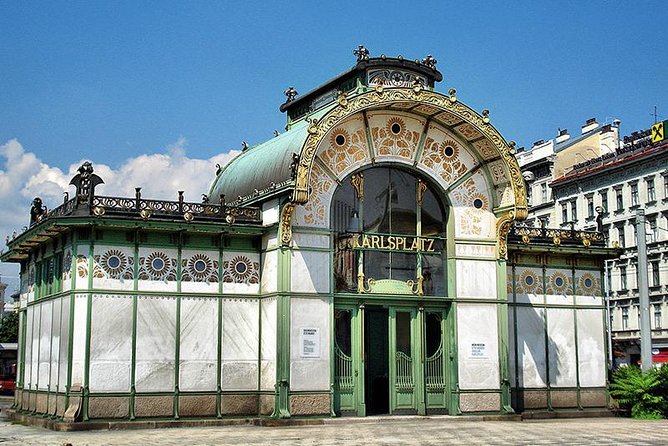
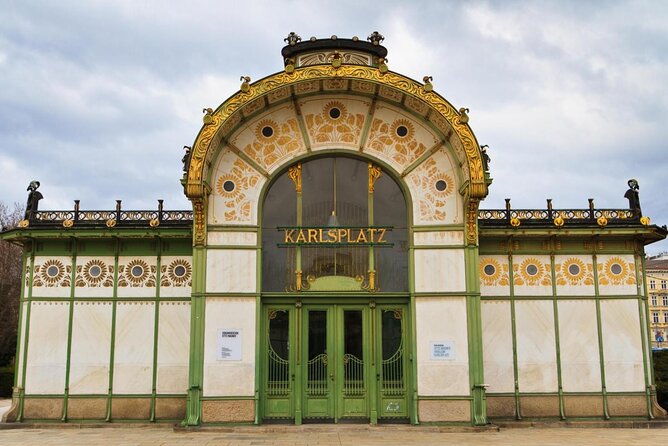
At Karlsplatz, the tour turns firmly toward Otto Wagner. The former Stadtbahn station buildings here are among the clearest examples of Vienna’s Jugendstil architecture. Wagner designed them with Joseph Maria Olbrich, after serving as an adviser to Vienna’s Transport Commission.
These buildings matter because they were created for public transportation, not as private villas or exhibition pieces. Wagner showed that a metro or railway station could be functional and visually refined at the same time. The details are easier to appreciate when a guide points out how structure, decoration, and city planning work together.
The stop lasts about 20 minutes. Admission is not included for the Karlsplatz station area, although the main value here is the exterior and the explanation of the buildings’ role in Vienna’s transport system.
This is one of the best parts of the tour for visitors who want to see Art Nouveau in ordinary urban life. You are not simply looking at an artwork protected inside a gallery. You are seeing design applied to movement, streets, and the daily business of a capital city.
A completely different way to spend a day here:
- Vienna: Vivaldi’s Four Seasons Concert in Karlskirche
★ 4.7 · 14,951 reviews - Vienna: Spanish Riding School Training
★ 3.9 · 9,281 reviews - Vienna: Skip-the-cashier-desk-line Giant Ferris Wheel Ride
★ 4.5 · 7,859 reviews - Vienna: Schönbrunn Palace & Gardens Skip-the-Line Tour
★ 4.7 · 7,739 reviews
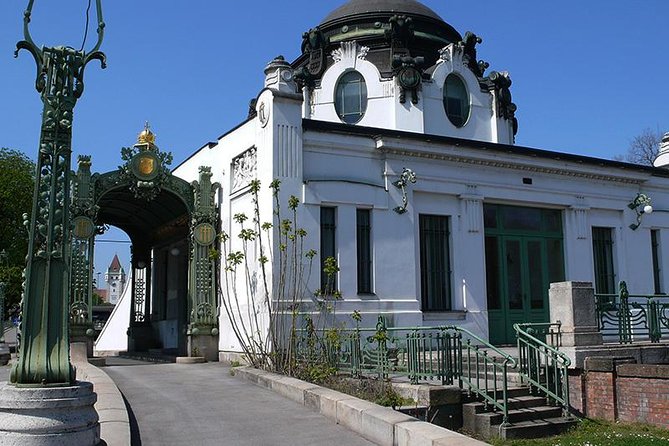
The Otto Wagner Pavillon offers a closer look
The Otto Wagner Pavillon at Karlsplatz is a former station building designed by Wagner and now used for an exhibition about his life and work. The scheduled visit is around 15 minutes.
The pavilion helps put the architect’s public projects into context. After seeing the station buildings from outside, you can step into a small museum setting devoted to the designer behind them. That makes the stop useful if you want more than photographs of ornate facades.
The pavilion museum is open from April through October. Admission is listed as €5 for general admission and €4 for seniors, students, Vienna Card holders, and people with disabilities. Outside the museum’s open season, this portion may not be available in the same way, so check the timing if you are visiting in winter.
Fifteen minutes is a brisk visit. Think of it as a compact introduction, not a full architectural museum. The advantage is that it adds context without taking over the entire walk.
Postsparkasse reveals Wagner’s modern side
The Austrian Postal Savings Bank, or Postsparkasse, is one of Otto Wagner’s most important buildings in Vienna. It is associated with the Vienna Secession branch of Art Nouveau and shows how Wagner brought his ideas into a serious civic and financial setting.
The tour allows about 25 minutes here, with no admission charge listed. That is enough time to study the exterior and discuss the building’s design. The Postsparkasse is especially useful after Karlsplatz because you can compare two very different commissions by the same architect.
At the station, Wagner was working with transport and public access. At the Postal Savings Bank, he was working with money, administration, and institutional authority. The contrast helps you see that Vienna’s Art Nouveau was not limited to fanciful decoration. It could serve a large organization and still look fresh.
This is also the point where an expert guide can make a real difference. A quick photo stop will show you the surface. A good explanation can help you understand why the building is important within Vienna’s move toward modern design.
Naschmarkt adds flavor to the route
Naschmarkt is Vienna’s best-known culinary market, with about 120 market stands and restaurants. The stop is scheduled for roughly 10 minutes and is free.
I like this ending because it keeps the tour connected to present-day Vienna. After looking at buildings shaped by artistic rebellion and civic ambition, you finish among food stalls and restaurants where the city’s daily life takes over.
Ten minutes is not enough for a full meal or a slow market browse. Food and drinks are not included, so plan to return later if you want to eat, shop, or take your time. The short visit is best treated as an orientation to the area rather than a market tour.
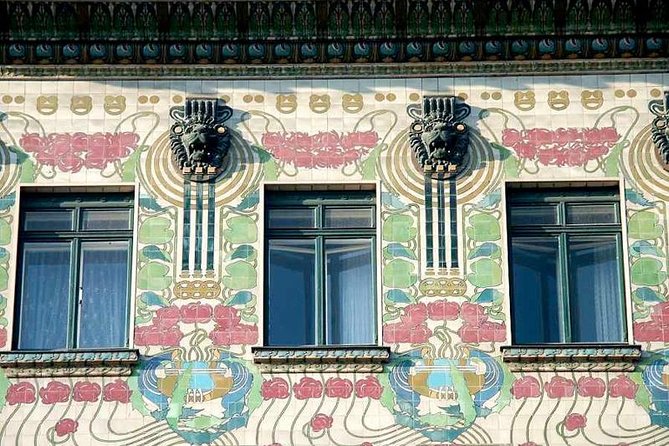
The route also brings you near the Majolikahaus buildings around Naschmarkt, an Art Nouveau sight singled out by one of the tour’s past participants. Those buildings are not separately listed as formal stops, so do not assume the walk includes a full visit unless you confirm it with your guide. Still, the area adds another useful layer to Vienna’s design story.
What the private format is worth
The tour costs $490 per group of up to 10 people. For a full group, that works out to $49 per person before entrance fees, which can be reasonable for three hours with a private professional guide. For two people, the cost is much harder to justify unless you place a high value on personal attention.
The private setup is most useful when your group has specific questions. You can ask about Klimt, Wagner, Secession architecture, Vienna’s transport system, or the city’s past and present. Guides such as Barbara, Wolfgang, and Annelie have been praised for handling varied interests and explaining the subject clearly.
There is also practical value in not having to manage the route yourself. The meeting point is at Operngasse 7 in Vienna’s first district, near public transportation. Pickup is offered as a feature, but hotel pickup and drop-off are not included, so confirm exactly where you will meet before the day of the tour.
The tour lasts about three hours. That is long enough to build a clear picture of Vienna’s Art Nouveau without consuming an entire day. You should still wear comfortable shoes, since the experience is a walking tour with several outdoor stops.
Who should book this Vienna architecture walk
I would recommend this tour to anyone who already enjoys architecture, design, or European cultural history. It is especially good for a couple or small family where one person knows the subject and another wants a friendly introduction.
It also suits repeat visitors who have already seen Vienna’s major imperial sights. The route takes you away from the usual palace circuit and shows how the city became a center for modern art and design.
You may want to skip it if you prefer food tours, long museum visits, or a broad introduction to Vienna’s main attractions. The guide focuses on Art Nouveau, not on a general survey of the city. The Secession and Pavillon admissions are extra, and the total cost is high for a very small group.
Book at least a few days ahead if possible. The experience is booked, on average, 11 days before the tour date, suggesting that you should not leave a preferred day until the last minute. You can cancel for a full refund up to 24 hours before the start time, but changes or cancellations inside that window are not accepted.
Is the Private Vienna Art Nouveau Walking Tour worth it?
Book it if you want to understand why Vienna’s Art Nouveau looks the way it does, and if you value a guide who can connect paintings, stations, banks, parks, and markets into one story. The combination of the Secession Building, Klimt’s Beethoven Frieze, Karlsplatz, the Otto Wagner Pavillon, Postsparkasse, and Naschmarkt gives you a varied three-hour route.
Skip it if the $490 group price feels too steep for your party or if you want a wider city introduction. For design fans, though, the private format and focused route offer a strong way to see Vienna beyond its imperial monuments.
FAQ
How long does the tour last?
The tour lasts approximately three hours.
Is this a private tour?
Yes. Only your group participates, with a maximum group size of 10 people.
What is the price?
The price is $490 per group of up to 10 people.
Where does the tour begin?
The meeting point is Operngasse 7, 1010 Vienna, Austria.
Does the tour include hotel pickup?
Pickup is offered as a feature, but hotel pickup and drop-off are listed as not included. Confirm the meeting arrangements when booking.
Is admission to the Secession Building included?
No. Admission is extra. From Tuesday through Sunday, the listed price is €9.50 for adults and €6 for students and seniors.
Can I see Klimt’s Beethoven Frieze?
Yes. The Secession Building visit includes the chance to see Gustav Klimt’s Beethoven Frieze, subject to the building being open.
Is the Otto Wagner Pavillon open all year?
The museum portion is open from April through October. Admission is listed as €5 for general admission and €4 for seniors, students, Vienna Card holders, and people with disabilities.
Are food and drinks included?
No. Food and drinks are not included unless specifically stated. The route includes a short stop at Naschmarkt, where you can find food stands and restaurants.
Can I cancel for a full refund?
Yes. You can cancel at least 24 hours before the experience start time for a full refund. Cancellations or changes made less than 24 hours before the start time are not accepted.
Just added around Vienna
- Vienna: UNESCO Schönbrunn Palace Guided Tour with Entry★ 4.5 · 94 reviews
- World War II History Vienna Old Town Private Walking Tour★ 4.8 · 9 reviews
- Vienna: Winery and Wine Tasting Tour with a Wine Expert★ 5.0 · 5 reviews
- Vienna: Wine Tasting E-Bike Tour★ 4.9 · 46 reviews
- Vienna: Wine Tasting at Schönbrunn Palace★ 4.3 · 71 reviews
- Vienna: Wine Tasting Tour★ 4.8 · 61 reviews
- Vienna: Wiener Schnitzel and Strudel Cooking Class★ 4.9 · 126 reviews
- Vienna: Concert by the Vienna Baroque Orchestra★ 4.6 · 56 reviews
Walking Tours, compared.
Guided Walking Tour of City Center Highlights
Read our review →
Guided Walking Tour of City Highlights & Hidden Gems
Read our review →
Vienna Historic Center Small Group Walking Tour
Read our review →
Browse the lists this tour appears in