
Reviewed · WALKING TOURS
An Introduction to Vienna Walking Tour
Vienna’s grand center can look like a polished collection of palaces until someone explains the people, power struggles, artistic rebellions, and wartime scars behind the stone. This walking tour connects the Hofburg, Stephansdom, Secession, Ringstraße, Graben, Naschmarkt, and museum quarter in one clear route. Guides including Katarina, Annelie, Wolfgang, Ilse, and Christina are praised for turning architecture and Austrian history into an easy conversation.
I like the very small group size, capped at eight people, and the way the walk mixes famous sights with less obvious details. I also like the practical advice built into the experience: cafés for Sacher torte without the long wait, places for schnitzel and sausages, and suggestions for what to see next. The main drawback is the price, $181.02 per person, which is a lot for a 2.5-hour walk if you only want a quick roll call of landmarks.
Key points at a glance
- Small groups capped at eight: You can ask questions without shouting across a crowd.
- A strong first-day orientation: The route gives you a useful map of central Vienna and its main historical eras.
- History beyond the Habsburgs: Expect stories about imperial power, modern architecture, music, war, and everyday life.
- Famous sights plus local pointers: You see Stephansdom and the Hofburg, then get help choosing cafés, restaurants, and further stops.
- A flexible guide-led walk: Several guides are praised for adjusting the pace and focus to suit the group.
- Good for serious history fans: The tour is led by an historian and works best if you want context, not just photographs.
Starting at Café Hawelka in Vienna’s old center

The tour begins at Café Hawelka on Dorotheergasse, a fitting meeting point in Vienna’s historic first district. You are already close to the Hofburg, Graben, Kohlmarkt, Stephansdom, and several of the city’s classic cafés before the walk even gets moving.
The café itself helps set the tone. Vienna’s coffeehouse tradition is part of the city’s social life, and the starting point puts you in the middle of that old central district rather than at a distant transport stop. The tour ends in Vienna rather than at a specific named attraction, so it is wise to ask your guide where the walk finishes and plan your next stop from there.
The walk is offered in English and takes about two and a half hours. That is long enough to build a useful picture of the city without taking your entire day. Still, you will be on your feet for most of it, so wear comfortable shoes and keep your schedule loose enough for pauses and questions.
More Walking Tours in Vienna
- Vienna: Guided Walking Tour of City Center Highlights
★ 4.7 · 4,989 reviews - Vienna: Vienna Central Cemetery Guided Walking Tour
★ 4.8 · 3,307 reviews - Vienna: Guided Walking Tour of City Highlights & Hidden Gems
★ 4.9 · 2,180 reviews
The Hofburg and the story of Habsburg power
The Hofburg is the natural anchor for a Vienna history walk. The palace complex served as the Habsburg seat of power from the 13th century, and its buildings help explain how Vienna became the center of a large European empire.
Here, your guide can connect imperial rooms and public squares to the people who ruled Austria for centuries. One of the tour’s strengths is that the story is not limited to palace glamour. The past includes political conflict, family strategy, war, religion, and the daily machinery of an empire that shaped much of Central Europe.
The Hofburg area is also useful for orientation. You are close to major museums, Stephansdom, the Ringstraße, and the shopping streets, so the explanations you receive here can help you make sense of the rest of your stay. I would take notes at this point, especially if you plan to visit more Habsburg sites on your own.
Several guides have been praised for adding personal and local detail. Katarina, for example, is described as covering everything from Roman times to present-day Vienna, along with art, music, housing, and ordinary life. That broad range matters because Vienna is more than a palace city.
Stephansdom and the city’s central symbol
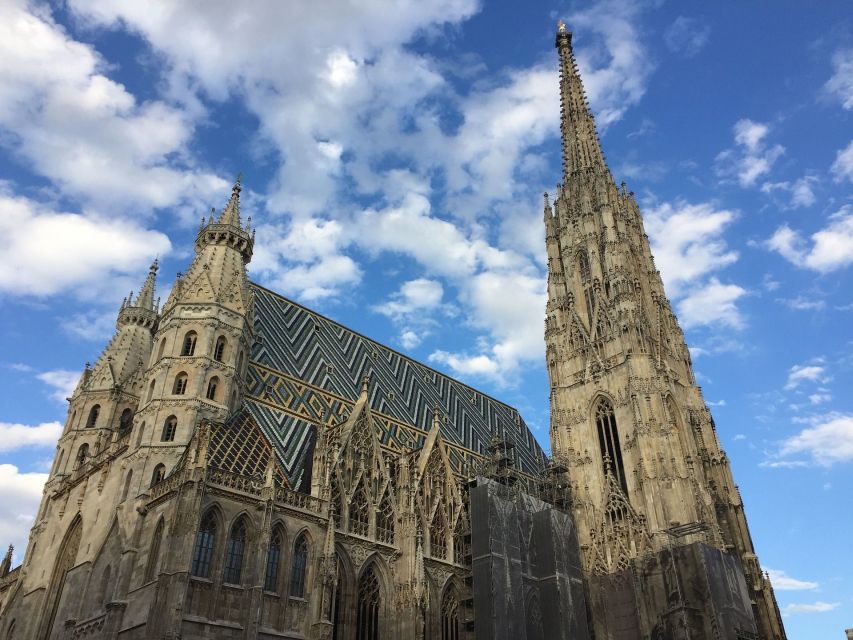
Stephansdom, or St. Stephen’s Cathedral, is Austria’s great architectural icon and one of the clearest markers of central Vienna. The tour takes you to the cathedral as part of the outdoor walk, giving you the setting and historical context without treating the stop as a rushed photo break.
The building is a useful lesson in Vienna’s changing styles and religious importance. It also shows how the city’s most famous sites sit within ordinary urban life. Shops, cafés, pedestrians, and busy streets surround the cathedral, making it easier to see Vienna as a living city rather than a museum set.
If you want to go inside or climb part of the cathedral later, use the tour as an introduction and return on your own. The experience is not advertised as an interior cathedral visit, and food, drinks, and admission costs are not included. That distinction is important if you expect a ticketed attraction at every stop.
Kohlmarkt, Graben, and the plague column
From the Hofburg area, the route moves through Kohlmarkt and the Graben, now among Vienna’s most fashionable shopping streets. This is where luxury storefronts meet layers of older history, and a good guide can help you look beyond the polished surfaces.
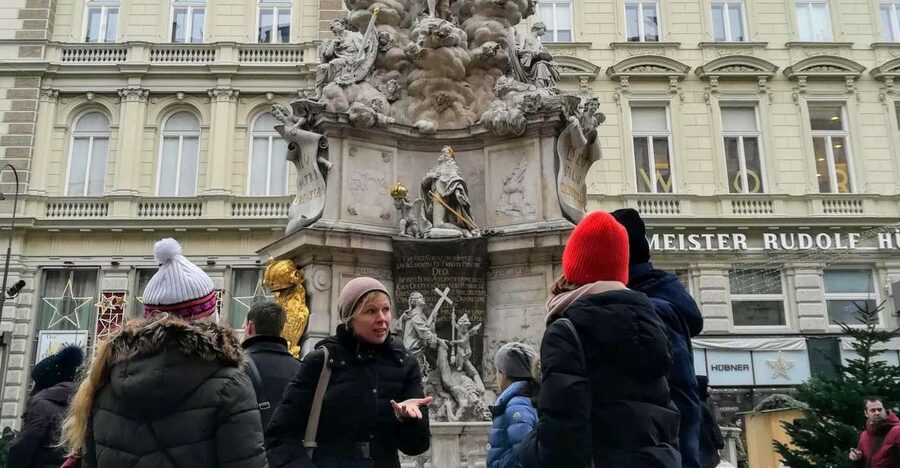
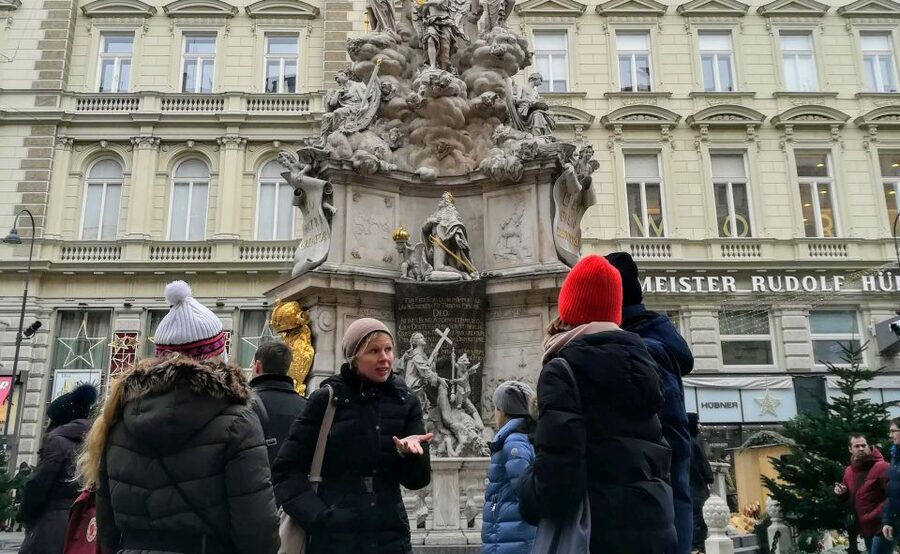
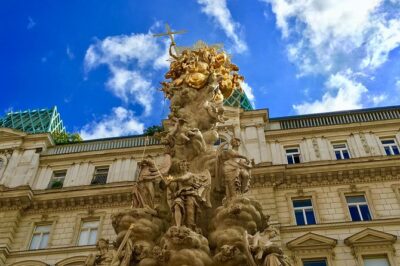
The Graben’s plague column commemorates the 17th-century outbreak of bubonic plague. It is an especially useful stop because it turns a grand public monument into a human story about fear, faith, disease, and civic memory. The column is easy to pass without understanding what it represents. With context, it becomes one of the more meaningful details on the route.
This section also shows the tour’s balance. You are not only moving from palace to cathedral. You are seeing how Vienna’s main streets changed use over time, from imperial ceremonial spaces to fashionable commercial districts. The walk is strongest when your guide connects those changes to the city’s broader story.
One practical point: do not expect every nearby landmark to be covered in depth. One less satisfied participant wished the route had included City Hall, Parliament, more of the plague column, and the Holy Lance. The published route has a lot to cover, so some sights are passed rather than visited.
A completely different way to spend a day here:
- Vienna: Vivaldi’s Four Seasons Concert in Karlskirche
★ 4.7 · 14,951 reviews - Vienna: Spanish Riding School Training
★ 3.9 · 9,281 reviews - Vienna: Skip-the-cashier-desk-line Giant Ferris Wheel Ride
★ 4.5 · 7,859 reviews - Vienna: Schönbrunn Palace & Gardens Skip-the-Line Tour
★ 4.7 · 7,739 reviews
The Ringstraße and Vienna’s grand 19th-century face
The Ringstraße is the city’s grand boulevard, built in the middle of the 19th century. Walking along it gives you a visual lesson in the period when Vienna reshaped itself with major public buildings, luxury hotels, and monumental architecture.
The boulevard is also a good place to discuss ambition. Vienna was presenting itself as an imperial capital, and the scale of the buildings reflects that goal. The route notes that many luxury hotels were established inside former palace walls, a detail that helps you notice how old aristocratic spaces were reused for modern city life.
Your guide may also point out the green and gray Loos House, designed by Austrian architect Adolf Loos. Its design is linked to Vienna’s turn-of-the-century architectural arguments, when some artists and architects were pushing against heavy decoration and older imperial habits.
This is a rewarding part of the walk if you enjoy buildings, but it may feel less gripping if you only want famous interiors. The tour focuses on exterior views and explanation. You will not spend the morning touring each palace, hotel, or civic building from inside.
Secession, Klimt, Mahler, and the city’s artistic rebellion
The Secession building gives the tour a sharp change of mood. Here, the story moves from imperial Vienna toward the city’s avant-garde culture at the turn of the 20th century.
The building is tied to figures such as Gustav Klimt and the composer Gustav Mahler, and it offers a way to understand Vienna as a center of artistic experimentation. This stop is valuable because it prevents the city’s story from ending with the Habsburgs. Vienna was also a place of arguments about modern art, music, design, and public taste.
If you are interested in Klimt, the Secession is a useful outside reference even if you plan to visit other art sites separately. Ask your guide how this stop connects with the museums around Maria-Theresien-Platz. The tour does not include admission to museums or galleries, but it can help you decide which ones deserve your time.
The experience may also include small touches that make this period easier to feel. Annelie has been praised for using Mozart and Haydn music, sharing Sisi’s favorite candies, and adding a Viennese snack that is not usually found in standard guidebooks. These extras are not guaranteed, but they show the kind of personal approach the small format can allow.
Maria-Theresien-Platz and Vienna’s museum quarter
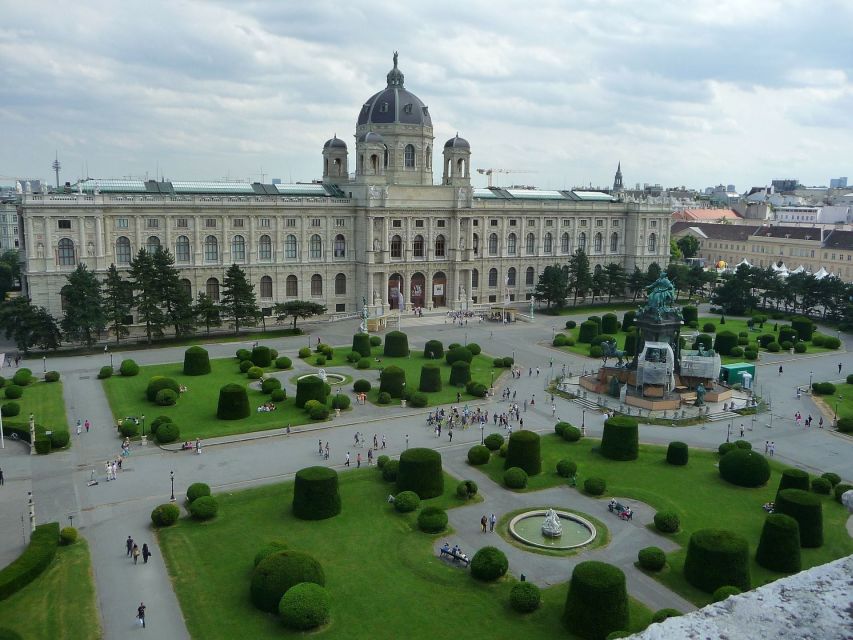
Maria-Theresien-Platz contains the city’s largest concentration of museums. The square gives the tour another strong orientation point, particularly if you plan to spend time with art, imperial collections, or natural history after the walk.
Your guide can explain how the square fits into Vienna’s larger civic design and how the museums relate to the city’s imperial past. It is a practical stop because you can decide which buildings to return to instead of trying to see everything at once.
This is also where the tour’s limits become clear. A two-and-a-half-hour walk can introduce the museum district, but it cannot replace a proper museum visit. If you are an art specialist, treat the tour as a map and a history lesson, then reserve separate time for the interiors.
Naschmarkt and Vienna beyond the palaces
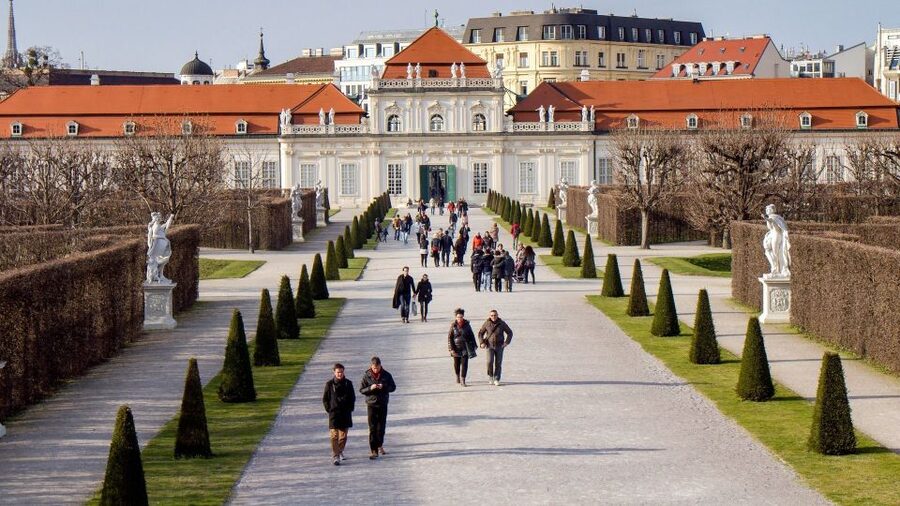
The route passes the Naschmarkt, Vienna’s traditional food market and a place where locals meet, shop, and mingle. Compared with the Hofburg or Ringstraße, this stop gives you a more everyday view of the city.
The market is particularly useful for food planning. Food and drinks are not included in the tour, but your guide may point you toward places to try Viennese specialties later. Several guides are praised for recommending cafés, schnitzel, sausages, and alternatives to the famous Sacher Hotel.
That advice can save you both money and time. One guide suggested other places to find Sacher torte without lining up at the Sacher Hotel, while other guides offered restaurant and coffeehouse tips that participants later used. You should still treat recommendations as guidance rather than a fixed tasting itinerary. The tour is a walking history experience, not a food tour.
What the guide adds to the walk
The guide makes or breaks a history walk, and this experience has a strong record on that point. Guides named in the feedback include Katarina, Annelie, Wolfgang, Ilse, Christina, Angelika, Elisabeth, and Billie.
The most praised qualities are clear: strong command of Austrian history, good storytelling, patience with questions, and a willingness to adjust the route or emphasis. Katarina is praised for explaining small historical details and encouraging questions. Wolfgang is praised for using quieter paths and making the buildings and people of the past feel present. Ilse is described as combining academic skill with an easy manner.
The small group format supports that style. The booking limit is six people, while the total activity limit is eight, so the exact group may vary but should remain intimate. Some departures have ended up with only one couple or even one person. That can turn a scheduled group walk into something close to a private conversation, though you should not book expecting to have the guide to yourself.
A good guide may also respond to your interests. If you care about music, architecture, war history, food, or the Habsburg family, say so early. Christina, for example, is praised for adjusting the itinerary and making the pace comfortable.
Is $181.02 a fair price?
At $181.02 per person, this is a premium walking tour. You are paying for a small group, an historian guide, English-language interpretation, and the chance to ask questions throughout the walk. You are not paying for meals, museum admissions, transport, or hotel pickup.
The value depends on how you like to see a city. If you want a cheap checklist of Vienna’s landmarks, a larger group walk will cost less and may suit you better. One participant felt the price was too high for a walking-only experience and specifically suggested considering a cheaper large-group option.
I see the strongest value for a first day in Vienna, especially if you have limited time or find imperial history confusing. A well-timed explanation can help you choose later visits, avoid poor restaurant choices, and understand why the city’s buildings look the way they do. The personal attention also matters if you have a long list of questions.
The rating is 4.9 from 67 ratings, with 97 percent recommending the experience. Those numbers do not erase the price concern, but they fit the consistent strengths: good guides, small groups, useful history, and practical local advice.
Who should book this Vienna walk?
Book it if you want context before sightseeing. The tour is especially useful for first-time visitors, people with only a short stay, and anyone who wants to understand Vienna before choosing museums, palaces, cafés, and restaurants.
It also suits curious adults who enjoy architecture, music, politics, and social history. The guides can move from the Habsburg dynasty to Klimt, Mahler, Loos, wartime damage, cafés, markets, and everyday life without locking the walk into one narrow theme.
You may want another option if your main goal is entering attractions, sampling food, or covering every major civic building. This route does not include hotel pickup, food, drinks, or admission fees, and it may pass City Hall, Parliament, or other sites without stopping for a full visit.
The tour offers free cancellation up to 24 hours before the start time. A cancellation inside that window is not refunded, and late changes are not accepted. The meeting point is near public transport, and most people can take part, but comfortable footwear remains a sensible choice.
Should you book it?
I would book this tour early in a Vienna visit, particularly if you value a strong guide more than a low price. The mix of Hofburg power, cathedral architecture, Ringstraße ambition, Secession modernism, market life, and café advice gives you a useful framework for the rest of the city.
The decision comes down to attention and budget. If $181.02 feels reasonable for a small group and an informed conversation, this is a smart orientation walk. If you only need landmark names and quick photographs, choose a cheaper large-group tour and spend the difference on a museum or coffeehouse.
FAQ
How long is the Vienna walking tour?
The guided walk lasts approximately 2 hours and 30 minutes.
What language is the tour offered in?
The tour is offered in English.
Where does the tour begin?
It begins at Café Hawelka, Dorotheergasse 6, 1010 Vienna, Austria.
Where does the tour end?
The listed end point is Vienna, Austria. A specific final landmark is not provided.
How many people can join the tour?
Each booking can include a maximum of six people, and the activity has a maximum total group size of eight people.
What sights are included?
The route includes the Hofburg, Stephansdom, Ringstraße, Loos House, Maria-Theresien-Platz, Secession, Naschmarkt, Kohlmarkt, and Graben.
Is food included?
No. Food and drinks are not included unless specifically stated.
Does the tour include hotel pickup and drop-off?
No. Hotel pickup and drop-off are not included.
Is the tour suitable for most people?
Yes. The provided information states that most people can participate, and the meeting point is near public transport.
Can I cancel for a full refund?
Yes. You can cancel at least 24 hours before the experience start time for a full refund. Cancellations and changes made less than 24 hours before the start are not accepted for a refund.
Just added around Vienna
- Vienna: UNESCO Schönbrunn Palace Guided Tour with Entry★ 4.5 · 94 reviews
- World War II History Vienna Old Town Private Walking Tour★ 4.8 · 9 reviews
- Vienna: Winery and Wine Tasting Tour with a Wine Expert★ 5.0 · 5 reviews
- Vienna: Wine Tasting E-Bike Tour★ 4.9 · 46 reviews
- Vienna: Wine Tasting at Schönbrunn Palace★ 4.3 · 71 reviews
- Vienna: Wine Tasting Tour★ 4.8 · 61 reviews
- Vienna: Concert by the Vienna Baroque Orchestra★ 4.6 · 56 reviews
- Vienna: Wachau Valley Private Kayak and Wine Tour★ 5.0 · 3 reviews
Walking Tours, compared.
Guided Walking Tour of City Center Highlights
Read our review →
Guided Walking Tour of City Highlights & Hidden Gems
Read our review →
Vienna Historic Center Small Group Walking Tour
Read our review →
Browse the lists this tour appears in