
Reviewed · HISTORICAL TOURS
Historical Hitler Walking Tour of Vienna
Vienna’s grand center can look polished and peaceful, but this walk shows how quickly that surface cracked in the 20th century. You’ll follow Hitler’s early connection to the city, the Nazi takeover of Austria, wartime destruction, and the persecution of Vienna’s Jewish population.
I like the way the tour links famous sights, such as the State Opera and Heldenplatz, with quieter memorials that many visitors miss. I also like its strong Austrian focus, rather than treating Vienna as a footnote to German history. The main caution is simple: two and a half hours outdoors can feel long in cold, wet, or windy weather.
Key points to know before you book
- Hitler’s Vienna, not a general World War II tour: The focus is Hitler’s early life, Vienna’s political climate, the Anschluss, and the city’s Nazi-era experience.
- A serious route through central Vienna: You’ll see the State Opera, the Memorial Against War and Fascism, Heldenplatz, Judenplatz, Morzinplatz, and the Stadttempel area.
- A guide-led history lesson: Guides including Dieter, Wolfgang, Stephan, Charles, and Siggy have been praised for clear storytelling and thoughtful answers.
- Easy central walking: The route begins at Albertinaplatz and ends near Schwedenplatz, with U1 and U4 connections close by.
- Good value for history fans: At $32.65, the price is reasonable for a 2.5-hour guided walk with a maximum of 25 people.
- Dress for Vienna’s weather: Bring water, sun protection, and a raincoat or umbrella. Comfortable shoes matter more than fashionable ones.
What this Hitler walking tour is really about
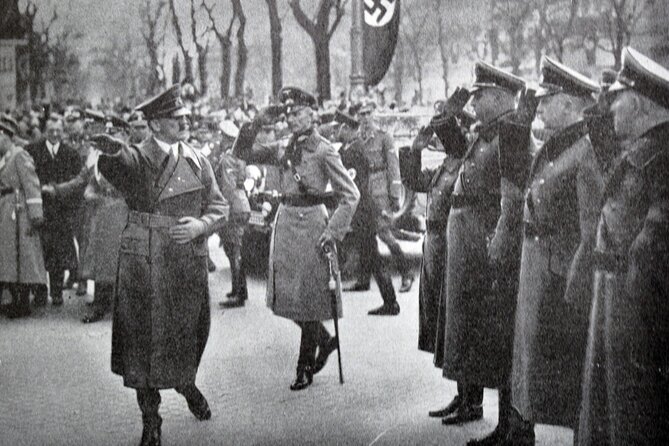
The title may suggest a tour devoted only to Adolf Hitler. It is better understood as a walk through the city that shaped part of his early life and later became an important setting for the Nazi takeover of Austria.
That distinction matters. You will learn about Hitler’s time in Vienna and the art school that rejected him, but much of the tour explains the political, cultural, and social setting around him. You’ll also spend time on Vienna’s Jewish population, Nazi terror, wartime destruction, and the way Austria remembered, or failed to remember, this period.
The route is built around places rather than a museum room or a single historic building. Your guide supplies the connecting story as you move through the center. Several guides, including Dieter, Wolfgang, Stephan, Charles, and Siggy, have been singled out for strong English, careful pacing, and a serious approach to the subject. The guide can vary, so you should not book on the assumption that one particular person will lead your walk.
The group can include up to 25 people. That is large enough to give the walk some energy, but still manageable in the central streets. One practical issue is hearing. A participant found it difficult to hear through the guiding device, so stay near the guide and speak up early if the sound is unclear.
More Walking Tours in Vienna
- Vienna: Guided Walking Tour of City Center Highlights
★ 4.7 · 4,989 reviews - Vienna: Vienna Central Cemetery Guided Walking Tour
★ 4.8 · 3,307 reviews - Vienna: Guided Walking Tour of City Highlights & Hidden Gems
★ 4.9 · 2,180 reviews
Starting at the Albertina and Vienna State Opera
Meet outside the Albertina Museum at Albertinaplatz for the 2:30 p.m. start. This is a busy central spot, so give yourself time to find the meeting point. The organizer has a meeting-point manager, but it is still wise to arrive early and identify your guide before the group begins moving.
The first major stop is the Vienna State Opera. Its opening in 1869, in the presence of Emperor Franz Joseph and Empress Elisabeth, is a useful reminder of Vienna’s imperial cultural power. Mozart’s Don Juan was chosen for the premiere, and the building became one of the city’s great symbols of music and status.
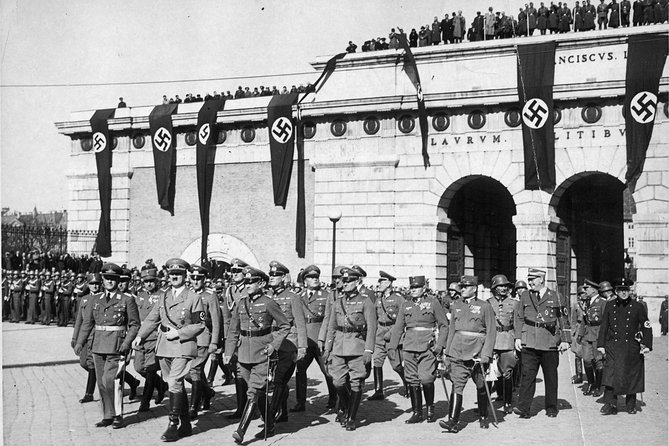
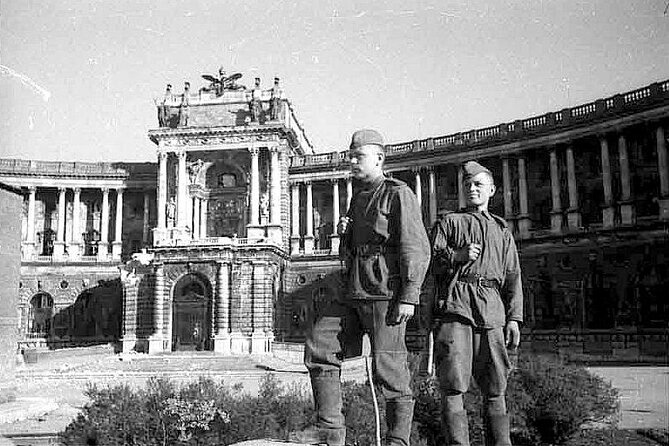
The story changes after the Anschluss in 1938. Hitler visited the opera on June 19 and October 27 of that year, while artists and employees faced dismissal, persecution, exile, or murder. Some works were banned from performance. This gives you an early sense of the tour’s approach: it is not only about military events, but also about how dictatorship reached into music, theater, art, and daily work.
You spend about 10 minutes here, though the guide’s explanation is more important than the amount of time spent looking at the building. The opera is a powerful opening because you see how a place associated with beauty and high culture was affected by political control.
The Memorial Against War and Fascism
At Albertinaplatz, the Memorial Against War and Fascism confronts the grand imperial setting with a much harsher visual language. Austrian sculptor Alfred Hrdlicka created the memorial, which has been here since 1988.
The memorial is dedicated to victims of war and fascism and is meant to recall what is described as the darkest period in Austrian history. Your guide can use this stop to explain Austria’s complicated role during the Nazi period, including the difference between the country’s postwar self-image and the historical record.
This is a short stop, about 10 minutes, but it helps set the tone. You are not being led through a parade of attractive buildings with a few grim facts added at the end. The memorial asks you to think about responsibility, remembrance, and how public spaces tell a country’s story.
The art school that rejected Hitler
The Akademie der bildenden Künste, or Academy of Fine Arts, connects the tour to Hitler’s early years. He applied to the art school and was not accepted. That fact is often treated as a neat explanation for what came later, but the useful part of the stop is hearing the broader context rather than reducing his life to one rejection.
The guide explains Hitler’s early days in Vienna and the ideas circulating in the city at the time. The tour draws from the historical study Hitler’s Vienna by Austrian historian Brigitte Hamann, so Vienna itself remains central to the discussion.
Expect another short stop of about 10 minutes. The building is not presented as a shrine to Hitler. Instead, it is a place to consider his ambitions, failures, and the political and social setting in which his views developed. If you are mainly looking for military history from 1939 to 1945, this part may feel less familiar and less direct.
More history walks around Vienna:
- Vienna: Time Travel and Magic Vienna History Tour
★ 4.6 · 3,879 reviews - Vienna: World War II Historical Walking Tour
★ 4.8 · 1,772 reviews - Vienna Historic Center Small Group Walking Tour
★ 5.0 · 1,746 reviews - Time Travel-Magic Vienna History Tour Ticket
★ 4.5 · 1,099 reviews
Heldenplatz and the March 15, 1938 speech
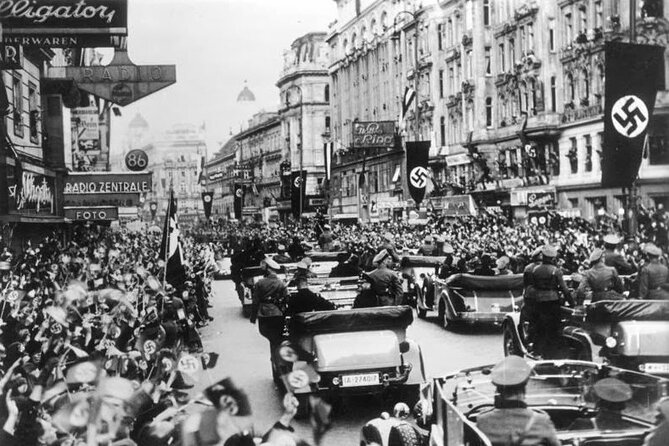
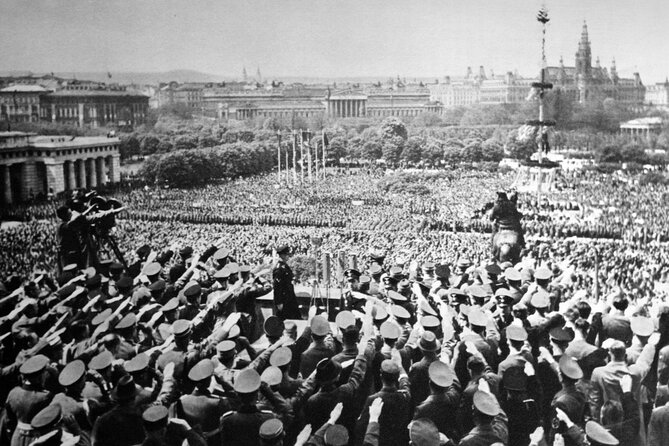
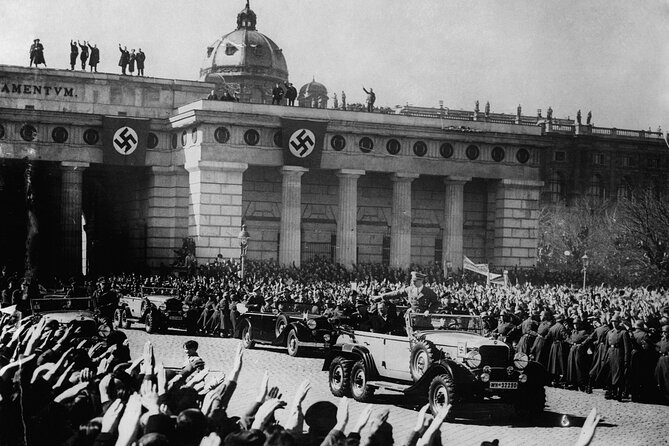
Heldenplatz is one of the tour’s most important locations. On March 15, 1938, Hitler addressed a huge crowd from the balcony of the Neue Hofburg after Germany’s annexation of Austria.
The speech became a symbol of the Nazi seizure of power and the broad public approval that accompanied it. It also became a lasting trauma for Austria’s Second Republic. Standing in the square gives the event a physical setting that a book or documentary cannot quite provide. You can see the scale of the space and understand why this location became so loaded with meaning.
This is also one of the prettiest parts of the walk, which creates an uncomfortable contrast. Imperial architecture, open space, and formal ceremony are set against the reality of political intimidation and mass support for a criminal regime.
The guide’s job here is to add context, not just recite the date. Several guides have been praised for balanced explanations and for connecting the past with present-day Austria. Some also use photographs, maps, or other images on a tablet to show how the square looked during the 1938 event.
Judenplatz and the memory of 65,000 victims
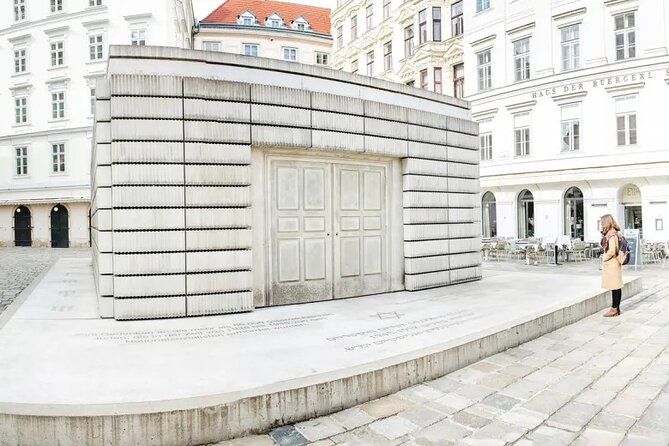
The walk then crosses the historic center toward Judenplatz. This is one of the most important stops because it shifts attention from Hitler’s biography to the people who suffered under Nazi rule.
The Holocaust Memorial for the Austrian Jewish victims of the Shoah commemorates more than 65,000 Austrian Jews murdered by the National Socialists between 1938 and 1945. The memorial’s form suggests a library with books turned outward, but the key point is the scale of the loss and the absence represented by those closed volumes.
Your guide may also explain Vienna’s Jewish life before the Holocaust, the growth of antisemitism, deportations, and the many people who took their own lives rather than face deportation. These details make the stop more than a quick photo opportunity. You are asked to consider a community that was part of Vienna’s cultural and civic life, not just a statistic from wartime history.
For me, this is where the tour earns much of its value. Hitler’s personal story can attract attention, but the route keeps redirecting that attention toward the people and institutions damaged by Nazism. That is a more responsible way to approach this subject.
Morzinplatz and the former Gestapo headquarters
At Morzinplatz, the group visits a memorial marking the former Hotel Metropole. Before the Nazi period, it was a luxury hotel. Under the Third Reich, it became one of the Gestapo’s most brutal headquarters.
The building is gone, but the site makes the machinery of repression more concrete. The tour can explain how the Gestapo used the location for interrogation, imprisonment, and abuse. You are not looking at a preserved Nazi building, so the guide’s narration is especially important here.
This stop also helps balance the better-known public scenes at Heldenplatz. The speech represented open political theater. Morzinplatz points to the less visible violence that followed: arrests, intimidation, torture, and fear inside an institutional setting.
The memorial takes about 10 minutes. It is a sober pause before the final section on Vienna’s Jewish religious life and the survival of the city’s main synagogue.
Why Vienna’s main synagogue is hidden
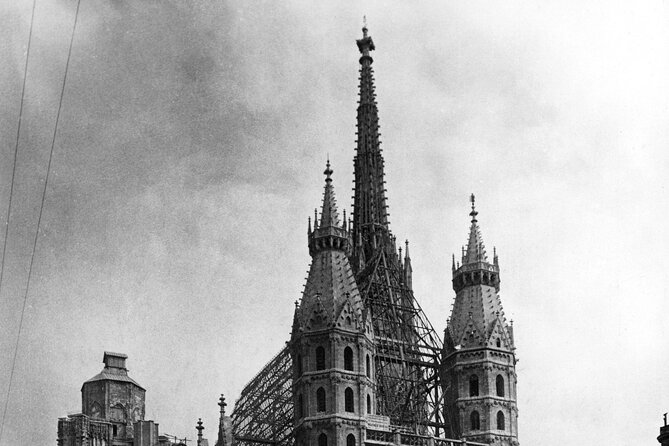
Near the end of the route, the walk reaches the Seitenstettentempel, Vienna’s main synagogue, in the area covered by the Jewish Vienna information point. The synagogue is hidden behind a five-story apartment building rather than facing directly onto the street.
The reason goes back to regulations that required non-Catholic places of worship to be concealed from public view. The building on the street masks the synagogue behind it, creating a physical reminder of the restrictions placed on Jewish religious life.
Above the entrance gate is the inscription, Come to his gates with thanksgiving, to his courts with praise. The tour does not treat this as an architectural oddity alone. It uses the building to explain how Jewish life had to operate within a Catholic city, and how the synagogue survived despite centuries of discrimination and later Nazi persecution.
You may not enter the synagogue on this walk. The value is in understanding the street arrangement and the historical reason for it. This is a good example of the tour’s less obvious material: an ordinary apartment frontage becomes evidence of older religious rules.
Finishing near Schwedenplatz
The tour ends a few minutes from Schwedenplatz. This is practical for the rest of your day, since the U1 and U4 subway lines serve the area and there are many restaurants nearby.
The 2:30 p.m. starting time means you finish in the early evening, depending on the exact pace and pauses. That makes dinner near Schwedenplatz an easy follow-up. You will probably appreciate food and a warm seat after two and a half hours on foot, especially in winter.
The route is described as an easy walk, but do not confuse that with a fully indoor activity. You will spend most of the time outside, and Vienna’s weather can change quickly. Comfortable shoes, water, sunblock, and rain protection are sensible. In cold conditions, the guide may include indoor pauses, a detail that has helped some groups keep going, but you should still dress for the weather.
Price, group size, and overall value
At $32.65 per person, this is a fair price for a 2.5-hour guided walk in central Vienna. You are paying for a licensed guide and a carefully connected story, not admission to museums or a meal. The main value comes from interpretation: many of these places are free to see on your own, but the meaning behind them is easy to miss.
The tour is booked about 25 days ahead on average, which suggests you should not assume you can leave it until the last moment during a busy visit. Confirmation arrives at booking, and the mobile ticket makes the arrangement simple.
Free cancellation is available up to 24 hours before the start time. Changes or cancellations inside that window are not refunded. The walk requires good weather and a minimum number of participants, so a cancellation by the operator can lead to another date, another experience, or a full refund.
This is not a tour for someone seeking luxury transport, museum entry, or a short overview. It is a walking history lesson. At roughly $13 per hour, the price is strongest if you want context and discussion rather than a checklist of sights.
Who will enjoy this walk most
You should consider booking if you enjoy modern European history, political memory, architecture, or the social forces behind dictatorship. It also suits visitors who want to understand Austria’s role in the Nazi period rather than hear only about Hitler’s military career.
The walk is especially useful early in a Vienna visit because it introduces several central landmarks. You can later return to the State Opera, Heldenplatz, Judenplatz, or Schwedenplatz with a better sense of what you are seeing.
You may want to skip it if you have limited walking ability, dislike serious historical subjects, or want a tour with lots of interior visits. The group is asked to have moderate physical fitness, and the weather can make the experience harder than the route itself.
The guide quality is a major part of the experience. Dieter has been praised for warm delivery, careful group management, and deep preparation. Wolfgang has been noted for thoughtful explanations and a philosophical approach. Stephan has used maps and photographs on an iPad, while Charles and Siggy have also received strong praise for clear presentations. Because the guide is assigned rather than selected, treat these names as examples of the team, not a guarantee.
Should you book the Historical Hitler Walking Tour of Vienna?
Book it if you want a serious, Austria-centered look at Hitler’s early Vienna, the 1938 annexation, Nazi repression, and Jewish Vienna. The most valuable parts are not just the famous Heldenplatz speech or the art school rejection. They are the links between grand public spaces, private fear, cultural persecution, and the memorials Vienna built later.
Do not book it expecting a narrow Hitler biography or a full World War II battlefield-style tour. The route is broader and more reflective. For history-minded visitors who can handle two and a half hours outdoors, $32.65 is a sensible price for the context a good guide adds to otherwise free city sights.
FAQ
How long does the Historical Hitler Walking Tour of Vienna last?
The tour lasts approximately 2 hours and 30 minutes.
Where does the tour begin?
It begins at Albertinaplatz outside the Albertina Museum in central Vienna.
Where does the tour finish?
The walk ends near Schwedenplatz, a short distance from the U1 and U4 subway lines and several restaurants.
What time does the tour start?
The scheduled start time is 2:30 p.m.
Is the tour offered in English?
Yes. The tour is offered in English.
What places do you visit?
The route includes the Vienna State Opera, the Memorial Against War and Fascism, the Academy of Fine Arts, Heldenplatz, the Judenplatz Holocaust Memorial, Morzinplatz, and the area around Vienna’s Stadttempel Synagogue. Other places may also be included.
Is food or hotel transportation included?
No. Hotel pickup and drop-off, food, drinks, and guide gratuities are not included.
What should I bring?
Wear comfortable shoes and clothing. Bring water, sunblock, and a raincoat or umbrella because the walk takes place outdoors and Vienna’s weather can be unpredictable.
Just added around Vienna
- Vienna: UNESCO Schönbrunn Palace Guided Tour with Entry★ 4.5 · 94 reviews
- World War II History Vienna Old Town Private Walking Tour★ 4.8 · 9 reviews
- Vienna: Winery and Wine Tasting Tour with a Wine Expert★ 5.0 · 5 reviews
- Vienna: Wine Tasting E-Bike Tour★ 4.9 · 46 reviews
- Vienna: Wine Tasting at Schönbrunn Palace★ 4.3 · 71 reviews
- Vienna: Wine Tasting Tour★ 4.8 · 61 reviews
- Vienna: Wachau Valley Private Kayak and Wine Tour★ 5.0 · 3 reviews
- Vienna: Wiener Schnitzel and Strudel Cooking Class★ 4.9 · 126 reviews
Historical Tours, compared.
Vienna Historic Center Small Group Walking Tour
Read our review →
Skip-the-Line Schonbrunn Palace Guided Tour and Vienna Historical City Tour
Read our review →
Vienna Mozart Concert in Historical Costumes at the Musikverein
Read our review →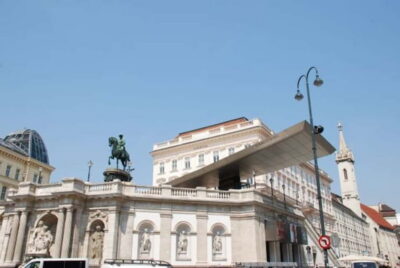
Browse the lists this tour appears in