
Reviewed · WALKING TOURS
Introducing Vienna Walking Tour: The Capital of the Habsburgs
Vienna’s imperial center packs an astonishing amount into a compact area, and this two-hour walking tour gives you the stories that make those grand buildings easier to understand. You move from Roman ruins and Habsburg power to opera, war, art, and the modern Austrian state, finishing beside St. Stephen’s Cathedral.
I like the small group limit of 15, which gives you a better chance to hear the guide and ask questions. I also like the local touch: Herbert Stojaspal is Viennese, and his talks often connect palace history with everyday city life, restaurant suggestions, and modern Vienna. The main drawback is pace. You cover many major sights in two hours, so there is little time to stop for photographs or enter the buildings.
Key points to know
- Imperial Vienna in a compact walk: See the Hofburg, Heroes’ Square, Joseph’s Square, the Albertina, the Opera, and St. Stephen’s Cathedral.
- Guides with local perspective: Herbert Stojaspal leads many departures, while Dorothea is another named guide associated with the tour.
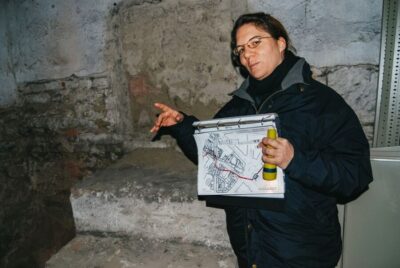
- A useful first-day orientation: You get a working map of central Vienna and ideas for museums, food, and later sightseeing.
- Small-group format: The maximum is 15 people, a more personal setup than a large city walk.
- Mostly easy walking: The route is on flat terrain, but you remain outdoors in all weather.
- Check the language carefully: The experience is offered in English, but one booking mix-up involved a German-language departure.
Why this two-hour walk works well in Vienna
Vienna can feel grand before it feels understandable. You see vast palace fronts, statues of emperors, elegant squares, and streets lined with impressive buildings, but the connections are not always clear on your own.
This walk gives you a basic storyline. The Habsburgs ruled from Vienna for centuries, and their former residence, the Hofburg, remains at the center of the city. From there, the route links court life, military power, religion, art, music, and the darker chapters of the 20th century.
I would take it near the start of a Vienna stay. The route points out museums and landmarks you can return to later, and several people found it useful for deciding what deserved more of their time. You should not expect a full tour of palace interiors. This is an outdoor orientation walk with historical explanation.
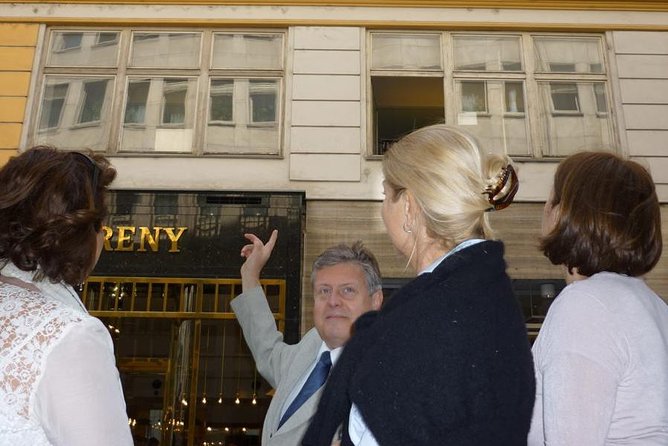
The guide matters a great deal here. Herbert Stojaspal is the main name connected with the experience, and his style comes across as lively, humorous, and full of facts. He has used old photographs to show how parts of Vienna changed, and he is willing to answer questions rather than simply recite dates.
More Walking Tours in Vienna
- Vienna: Guided Walking Tour of City Center Highlights
★ 4.7 · 4,989 reviews - Vienna: Vienna Central Cemetery Guided Walking Tour
★ 4.8 · 3,307 reviews - Vienna: Guided Walking Tour of City Highlights & Hidden Gems
★ 4.9 · 2,180 reviews
Starting at St. Michael’s Church and the Hofburg
The meeting point is Michaelerplatz 3, in front of St. Michael’s Church. This is a sensible place to begin because the square offers several layers of Vienna at once.
The church itself has medieval roots, while Roman and medieval remains can be seen in the area. That gives the opening talk a useful time scale. Vienna is not only an imperial capital built in the Baroque period. It also grew from older settlements and a much earlier Roman presence.
From here, you move toward the Hofburg complex. The palace was the residence of the Habsburg dynasty from the 12th century, and its scale helps explain how much political weight Vienna once carried. This is not a single neat palace building. It is a sprawling collection of wings, courtyards, state rooms, museums, and former imperial offices.
The guide explains how the complex developed over time. That context is useful because the Hofburg can otherwise seem like a series of grand facades with no clear plan. You learn to read it as the working center of a dynasty that governed a large and changing empire.
Lipizzaner stallions and the imperial court
One stop focuses on Vienna’s famous white stallions. The presentation provides details about the horses and their place in the imperial court, adding a human and animal dimension to the palace story.
You should be aware that this is a walking explanation, not a horse performance. The tour does not include entry to a riding school show, and the package includes no food or drinks. Still, the stallions help make Habsburg court culture feel less abstract. They connect ceremony, military tradition, breeding, and royal display.
This is one of the moments when a good guide can make a familiar attraction more interesting. Instead of simply pointing toward a famous institution, the talk explains why the animals became such a lasting symbol of Vienna.
Heroes’ Square and the Austrian state
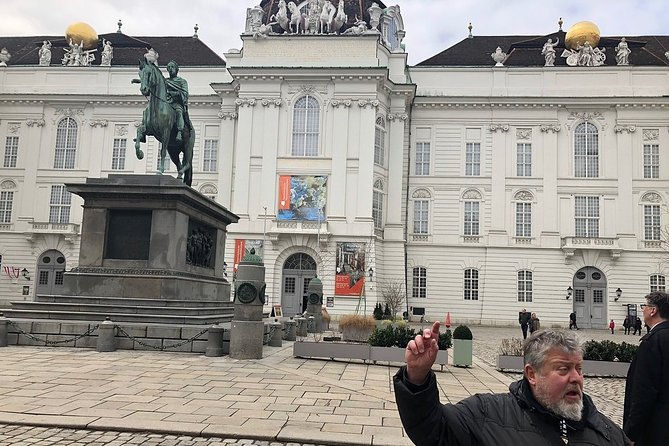
The walk continues to Heroes’ Square, or Heldenplatz. The name itself is worth unpacking. It refers to military heroes and imperial victories, and the square’s monumental design reflects the political ideals of the Habsburg era.
You also receive an explanation of Austria’s government system. That makes this stop more than a photograph in front of a statue. It links the old monarchy with the present-day republic, helping you understand how Vienna’s political center changed after the empire ended.
Heroes’ Square is also a place where history can feel uncomfortable. Its symbolism was used by different political movements, and modern Vienna has had to face the way the square was connected with Nazi rule. The guide addresses the broad sweep of European history rather than presenting the imperial past as a simple parade of grand achievements.
A completely different way to spend a day here:
- Vienna: Vivaldi’s Four Seasons Concert in Karlskirche
★ 4.7 · 14,951 reviews - Vienna: Spanish Riding School Training
★ 3.9 · 9,281 reviews - Vienna: Skip-the-cashier-desk-line Giant Ferris Wheel Ride
★ 4.5 · 7,859 reviews - Vienna: Schönbrunn Palace & Gardens Skip-the-Line Tour
★ 4.7 · 7,739 reviews
The Holy Lance and imperial objects
A particularly unusual part of the talk concerns objects linked to the Holy Roman Empire. The guide discusses the Holy Lance, traditionally associated with the spear that pierced Jesus, and the crown of the Holy Roman Empire.
You do not handle these objects on the walk, and the tour does not include a museum admission. The value is in understanding how rulers used sacred objects, ceremonies, and old symbols to support political authority.
For many people, this is where the tour moves beyond a basic list of palace dates. Vienna’s rulers were not merely wealthy monarchs living in fine rooms. They claimed a place in a long Christian and imperial tradition, and the objects connected their rule to that larger idea.
Joseph’s Square and Maria Theresa
Joseph’s Square offers another change of mood. Here, the guide discusses Maria Theresa’s reign and the political secrets and pressures surrounding her time in power.
Maria Theresa was one of the most important Habsburg rulers, and her reign brought reform as well as dynastic ambition. The square also gives you a glimpse of how imperial Vienna arranged its monuments, institutions, and public spaces around the court.
The walk does not provide time for a full lecture on every ruler. Instead, it gives you enough structure to recognize the major names and understand their place in Vienna’s story. If Maria Theresa interests you, this stop can help you choose later museum visits and palace tours with a clearer idea of what to look for.
The Albertina and the world of art
The route passes the former residence of Albert and Maria Christina, now associated with the Albertina. The building houses one of the world’s largest drawing collections.
This stop works well because it shows how Habsburg Vienna was not only a center of government and ceremony. It was also a place where aristocratic families collected art, supported artists, and turned private residences into cultural institutions.
You should treat the Albertina explanation as an introduction rather than a gallery visit. The tour does not include admission, and two hours is not enough to see the collection. If you enjoy prints, drawings, or old-master art, note the museum for a separate visit.
The guide may also help you understand the building from the outside, which is valuable when you return independently. A short description of who lived there and how the collection developed gives the facade more meaning.
Facing Vienna’s difficult 20th century
The route includes Vienna’s Monument Against War and Fascism. Its official purpose is to remember victims of war, including those who suffered under Nazi rule in Austria.
This is an important counterweight to the palace stories. Vienna’s center can tempt you into admiring imperial architecture without thinking about the political damage carried out in the name of empire, nationalism, and dictatorship. The monument brings the discussion into the modern era and gives the walk a more honest balance.
The stop is brief, but it matters. You are not asked to treat Vienna as a museum of elegant old buildings. You are reminded that the city’s past includes persecution, war, and responsibility for facing painful facts.
The State Opera and bargain ticket advice
The Vienna State Opera provides one of the tour’s most practical moments. The guide explains that the opera program changes daily and that the cheapest tickets can cost as little as 3 euros.
This does not mean every seat or performance costs 3 euros, so you should check the current arrangements before making plans. Still, the advice is useful for budget-minded visitors. Vienna’s opera culture is not limited to expensive evening seats, and a last-minute or standing-ticket option may make a performance possible on a modest budget.
The Opera stop also helps connect architecture with present-day city life. The building is not just a grand imperial monument. It remains part of Vienna’s active cultural routine.
Ending at St. Stephen’s Cathedral and chocolate
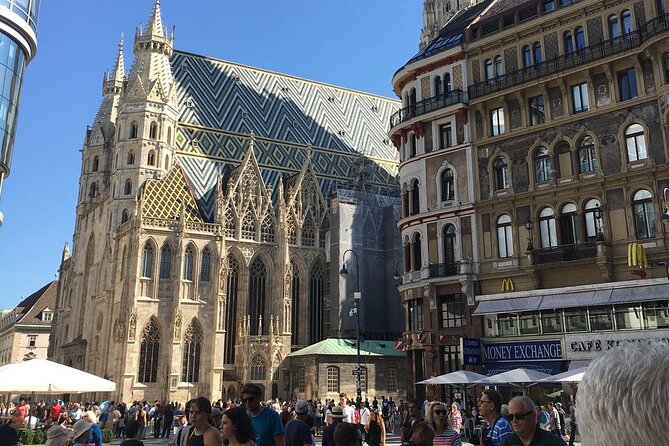
The walk finishes in central Vienna near St. Stephen’s Square, at the Lindt Chocolate Boutique on Stephansplatz 8A. The nearest subway station is Stephansplatz, served by the U1 and U4 lines.
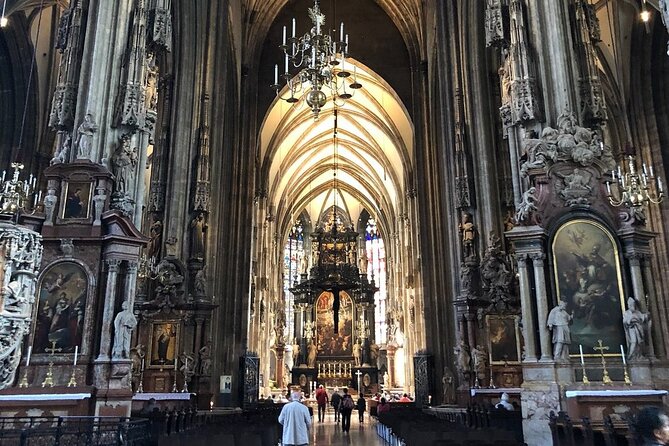
Ending here is practical. St. Stephen’s Cathedral is one of Vienna’s defining landmarks, and you can continue exploring the square, enter the cathedral on your own, or visit the catacombs independently if they fit your plans. One useful strategy is to take photographs after the walk, when you can revisit the places without trying to listen and frame a picture at the same time.
The chocolate-shop finish is lighthearted rather than a formal tasting. Food and drinks are not included, but you end close to plenty of places where you can choose your own snack or meal. It also puts you in a good position for the rest of the historic center.
What the guide style adds
The strongest part of this experience is the storytelling. Herbert Stojaspal is described as a native Viennese guide with a particular interest in local history. He is also associated with recommendations for restaurants, foods to try, and places to visit beyond the main route.
His approach appears to be conversational. He has answered detailed questions, used historical images to show how locations changed, and sometimes allowed extra discussion when the group was engaged. That can be a real advantage if you enjoy asking why rather than only learning what.
Dorothea is also named as a guide, so the tone may vary by departure. The consistent promise is a certified professional guide, but the individual personality will shape the experience.
Do not expect a silent, polished audio-guide style. The appeal is the human explanation, including humor, local observations, and occasional quirky facts. If you prefer a strict schedule with long photo pauses, this may feel brisk.
Price, group size, and practical value
At $35.07 per person, the walk sits in a reasonable range for a two-hour guided city introduction. You are paying for a certified guide, a compact route through some of Vienna’s most important central sights, and the chance to ask questions in a group capped at 15.
The value is strongest if you are new to Vienna. You get a framework for the city, historical context for the Hofburg, and practical ideas for what to see next. It can save you from wandering past important buildings without knowing why they matter.
The value is weaker if you already know central Vienna well or want interior access. There are no palace admissions, museum tickets, food, drinks, or hotel transfers. You should budget separately for anything you decide to visit after the walk.
The route is described as easy and flat, making it manageable for most people. It operates in all weather, so wear suitable shoes and bring protection from rain or cold. A March morning, especially, can feel icy in the wind. Younger children may not enjoy the amount of historical explanation, and the activity is not recommended for them.
The group limit is a real benefit. Fifteen people is still a group, but it is small enough for questions and easier to keep together in busy streets.
One important language check
The experience is offered in English, but you should confirm the language shown during booking and on your ticket. One customer arrived expecting English and found a German-language departure instead. The operator explained that different days can use different languages and that dual-language tours are not offered.
This kind of mix-up can spoil an otherwise useful walk. Check the selected language before you leave home, especially if you booked through a third-party site or are arranging several activities close together.
Free cancellation is available if you cancel at least 24 hours before the start time. Changes or cancellations inside that window are not accepted for a refund.
Who should book this Vienna walking tour?
I would choose this for a first or second day in Vienna, especially if you want a clear introduction before committing to museums and palace interiors. It suits adults and older children who like history, architecture, political stories, and a guide with a sense of humor.
It is also useful for visitors with only a short stay. In two hours, you see a large share of the central sights and finish near the city’s main cathedral and subway connections.
I would skip it if your priority is a slow photo walk, extensive time inside attractions, or a specialist focus on art, music, or architecture. The route covers many subjects quickly. You will need to return independently for closer looks.
Should you book it?
Book this walk if you want a lively orientation to imperial Vienna rather than a ticketed palace tour. Herbert Stojaspal’s local background, the 15-person limit, the broad range of stops, and the practical city advice give the experience good value at $35.07.
Go in expecting a brisk outdoor introduction. Confirm the English departure, dress for the weather, and save the main photographs and interior visits for later. For a first look at Vienna’s Habsburg center, that is a sensible trade.
FAQ
How long does the Vienna walking tour last?
The tour lasts approximately two hours.
What language is the tour offered in?
The tour is offered in English. Check the selected language during booking because different departures may operate in different languages.
Where does the tour start?
The meeting point is St. Michael’s Church at Michaelerplatz 3, 1010 Vienna, Austria.
Where does the tour finish?
The tour ends at the Lindt Chocolate Boutique near St. Stephen’s Square, at Stephansplatz 8A, 1010 Vienna.
What sights are covered?
The walk includes St. Michael’s Church and Roman and medieval ruins, the Hofburg, the white stallions, Heroes’ Square, Joseph’s Square, the Albertina, the Monument Against War and Fascism, the State Opera, and St. Stephen’s Cathedral.
Is the tour suitable for children?
Most people can participate, but the activity is not recommended for younger children.
Just added around Vienna
- Vienna: UNESCO Schönbrunn Palace Guided Tour with Entry★ 4.5 · 94 reviews
- World War II History Vienna Old Town Private Walking Tour★ 4.8 · 9 reviews
- Vienna: Winery and Wine Tasting Tour with a Wine Expert★ 5.0 · 5 reviews
- Vienna: Wine Tasting E-Bike Tour★ 4.9 · 46 reviews
- Vienna: Wine Tasting at Schönbrunn Palace★ 4.3 · 71 reviews
- Vienna: Wine Tasting Tour★ 4.8 · 61 reviews
- Vienna: Wachau Valley Private Kayak and Wine Tour★ 5.0 · 3 reviews
- Vienna: Wiener Schnitzel and Strudel Cooking Class★ 4.9 · 126 reviews
Walking Tours, compared.
Guided Walking Tour of City Center Highlights
Read our review →
Guided Walking Tour of City Highlights & Hidden Gems
Read our review →
Vienna Historic Center Small Group Walking Tour
Read our review →
Browse the lists this tour appears in