
Reviewed · WALKING TOURS
Private Introduction to Vienna Walking Tour
Vienna’s past comes at you in layers on this private walk: imperial power at the Hofburg, wartime scars along the old walls, grand Ringstrasse planning, and modern culture around the MuseumsQuartier. I like the three-hour format, which gives you a useful first look without turning the day into a march. I also like the private guide, since your questions and pace can shape the outing.
The main consideration is price. At $566.25 for up to 10 people, it can be good value for a full group, but expensive for one or two guests. You should also expect a serious city walk, with several hours on your feet and no food or drinks included.
Key points at a glance
- Hofburg to Stephansdom: Begin with Vienna’s imperial center, then follow Kohlmarkt and the Graben to the city’s great cathedral.
- Three Habsburg burial places: See where the dynasty’s bodies, hearts, and entrails were placed in separate churches.
- Ottoman siege walls and Ringstrasse: Connect Vienna’s medieval defenses with the grand boulevard that replaced them.
- Private, adjustable guiding: Your historian guide can shape the pace and answer questions for your group alone.
- A broad city orientation: The route reaches Schwarzenbergplatz, Belvedere, Karlsplatz, Naschmarkt, and the MuseumsQuartier.
- Useful first-day timing: The walk is especially practical at the beginning of a Vienna stay, when you want the city to make sense quickly.
Why this private Vienna walk works well on a first day
Vienna can seem polished to the point of confusion. Palaces, churches, museums, coffeehouses, and broad boulevards fill the center, but it is not always clear how they fit together. This tour gives you a historical thread to follow.
You begin at Michaelerplatz, where the Hofburg occupies the center of the story. From there, the route moves through the old center and outward toward the Ringstrasse, then loops back through major cultural districts. I like that shape because it shows Vienna as both an imperial capital and a living city.
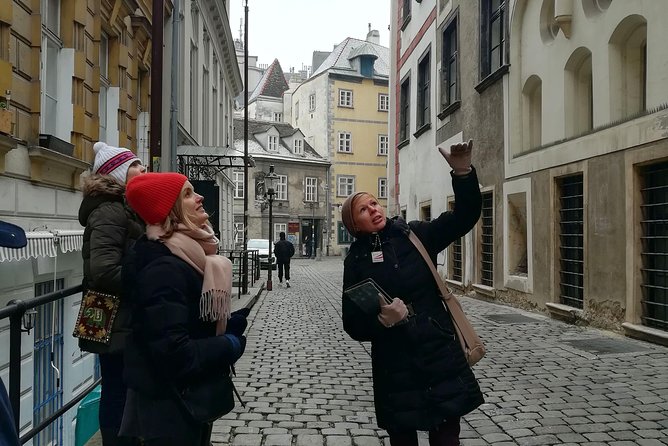
The guide is an important part of the experience. This is not a group lecture delivered at fixed stops. Your historian guide is with your party alone, so you can ask why the Habsburgs used separate burial places, how Vienna changed after the Ottoman sieges, or what the city’s present-day political and cultural life looks like.
Past guides have included Katarina, Selin, Biljana, and Else. The comments about them point to a useful strength: warm storytelling, an adaptable pace, and attention to detail. Else, for example, was praised for covering a lot without making the walk feel rushed. Biljana was especially appreciated for keeping younger adults interested. Those details matter if your group includes several ages or different levels of interest in history.
More Walking Tours in Vienna
- Vienna: Guided Walking Tour of City Center Highlights
★ 4.7 · 4,989 reviews - Vienna: Vienna Central Cemetery Guided Walking Tour
★ 4.8 · 3,307 reviews - Vienna: Guided Walking Tour of City Highlights & Hidden Gems
★ 4.9 · 2,180 reviews
Michaelerplatz and the Hofburg: Vienna’s power center
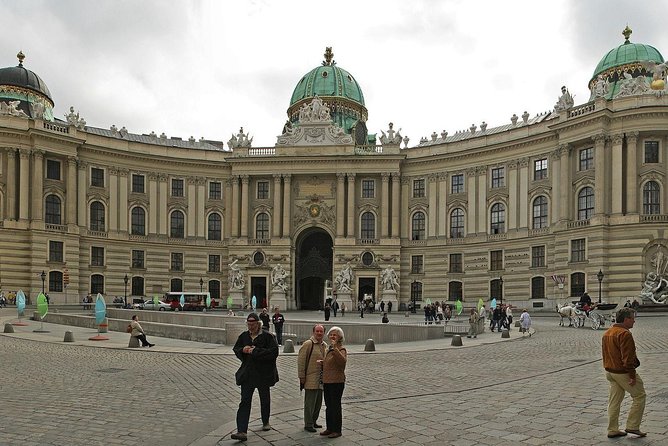
Michaelerplatz is a strong place to begin because it compresses several sides of Vienna into one view. The Hofburg, seat of Habsburg power since the thirteenth century, dominates the square. You are looking at a palace complex that grew over centuries rather than appearing as one tidy architectural project.
That slow growth is part of the lesson. Vienna was shaped by rulers who kept adding rooms, courtyards, institutions, and symbols of authority. The guide can help you read the palace not simply as a pretty building, but as the center of an empire and a working seat of power.
Across from the old imperial formality is the Loos House, designed by Adolf Loos. Its green and gray exterior offers a sharp contrast to the decorated palace surroundings. This is one of the tour’s most useful architectural moments because Vienna’s story is not only about baroque ornament and royal ceremony. It also includes modern design and arguments about what a city should look like.
You might spend more or less time here depending on your questions. Since the tour is private, you can ask for more architecture, more political history, or a faster look before moving on.
Kohlmarkt, the Graben, and Stephansdom
From Michaelerplatz, the walk continues along Kohlmarkt and the Graben. Today, these are fashionable shopping streets, but their setting carries much older memories. Grand façades, churches, and monuments crowd the route, giving you a quick lesson in how Vienna mixed commerce, religion, and imperial display.
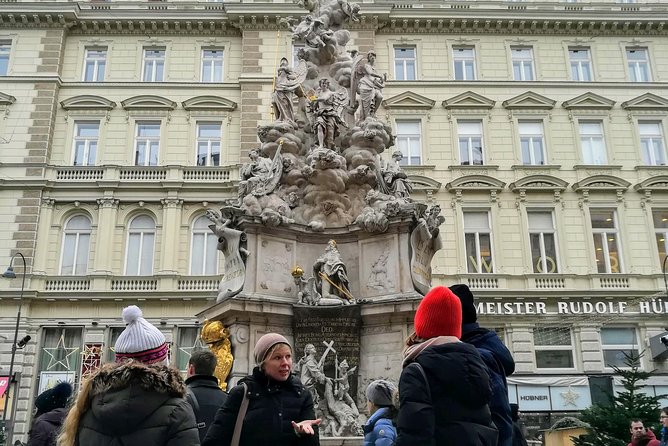
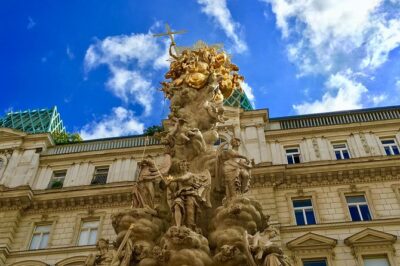
The plague column on the Graben is one of the key sights. It recalls the plague years and reflects the public religious culture of baroque Vienna. A guide can make this more than a photo stop by explaining how monuments like this turned suffering into a statement of faith and power.
The route then reaches Stephansdom, Vienna’s national architectural icon. Its scale and place in the city make it an obvious centerpiece, but the tour adds a more unusual detail: the cathedral is tied to one part of the Habsburg burial tradition. The dynasty’s entrails were placed here, while other remains went elsewhere.
That fact may sound macabre, but it reveals how carefully the Habsburgs built ceremony around death. Vienna’s imperial story is filled with rituals, symbols, and institutions, and this is one of the more memorable ways to understand the dynasty’s view of itself.
The route focuses on an outside orientation rather than promising a long interior visit. If entering Stephansdom is a priority, ask your guide how the timing works. The stated experience is a three-hour guided walk, not a cathedral admission tour.
The Habsburgs in three churches
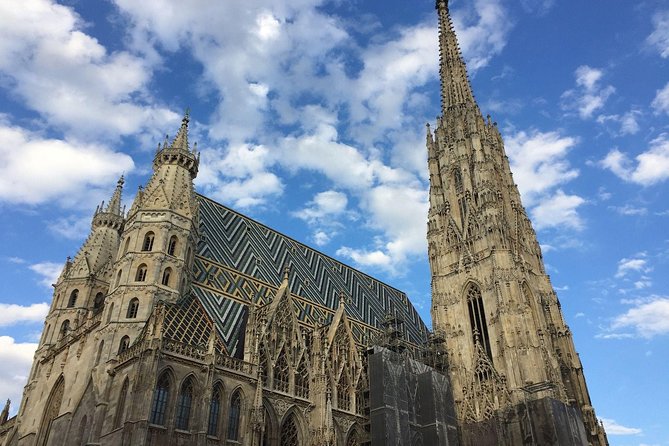
One of the most distinctive parts of the walk is the connection between three burial places. St. Stephen’s Cathedral holds the imperial entrails. The Capuchin Church contains centuries of sarcophagi for Vienna’s rulers. St. Augustine’s Church holds silver urns containing Habsburg hearts.
This arrangement gives you a compact and memorable look at dynastic ceremony. It also helps explain the Habsburgs as a family of institutions, not just a line of portraits in a palace. Their public identity was carefully maintained in churches, crypts, monuments, and ritual.
The Capuchin Church is described as humble in comparison with the palace and grand churches nearby. That contrast is worth noticing. Imperial Vienna could be lavish, but its burial traditions also included a stark, close look at mortality.
You should not expect a full guided visit inside all three sites unless your guide confirms it. The tour description presents them as stops along a walking history route. Still, even a short explanation at each location can add a lot to your understanding of Vienna.
A completely different way to spend a day here:
- Vienna: Vivaldi’s Four Seasons Concert in Karlskirche
★ 4.7 · 14,951 reviews - Vienna: Spanish Riding School Training
★ 3.9 · 9,281 reviews - Vienna: Skip-the-cashier-desk-line Giant Ferris Wheel Ride
★ 4.5 · 7,859 reviews - Vienna: Schönbrunn Palace & Gardens Skip-the-Line Tour
★ 4.7 · 7,739 reviews
The old walls and the two Ottoman sieges
As you reach the edge of the inner city, the walk examines remains of the old city walls. These defenses date to the twelfth century and protected Vienna during two major Ottoman sieges, in 1529 and 1683.
This is where the city’s shape starts to make more sense. The old center was once a fortified place, and the modern Ringstrasse later replaced much of that defensive line. You can see how a medieval city gave way to a nineteenth-century imperial capital.
The two sieges are not minor footnotes. They shaped Vienna’s political memory and its sense of place in Europe. The guide’s job here is to connect the physical remains to the larger story, rather than leaving you with another isolated date.
The walls were eventually torn down to make room for the Ringstrasse, Vienna’s grand circular boulevard. The comparison with Paris’s broad boulevards is useful, but Vienna’s Ringstrasse has its own message: this was a city presenting itself as a modern imperial capital.
Schwarzenbergplatz and a harder twentieth-century story
The walk continues to Schwarzenbergplatz, an open area marked by a large fountain and a memorial to Soviet soldiers who died liberating Vienna from the Nazis. This is an important change in tone.
Much of central Vienna can feel devoted to imperial splendor. Schwarzenbergplatz brings the twentieth century into view, including the Second World War and the complicated memory of liberation and occupation. The memorial is not just decorative city furniture. It points to the political history that followed the Habsburg period.
The square also sits near many embassies, adding another layer. Vienna is not only a former imperial capital. It remains a diplomatic city, and this part of the walk helps connect its past role with its present international position.
If you prefer a tour that avoids difficult history, this may feel heavier than the palace sections. I see that as a strength, though, because a city introduction should not stop with elegant buildings and royal anecdotes.
Belvedere, Karlsplatz, and the Naschmarkt view

The route makes a quick detour to Belvedere Palace before heading back toward Karlsplatz. The information provided does not promise admission to the palace, so treat this as an exterior orientation and city view rather than a museum visit.
The detour broadens your picture of Vienna. The Hofburg represents power inside the old center, while Belvedere adds another palace setting beyond it. Even a short stop can help you understand the scale of the city’s royal and aristocratic world.
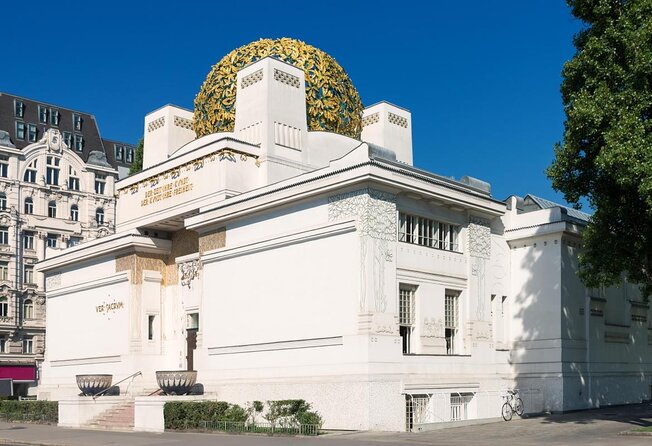
Near Karlsplatz, you get a striking view of one of the gold-domed Secession building and the Naschmarkt. The Secession building brings Vienna’s modern artistic identity into the story. Its dome and design help explain why Vienna is associated not only with imperial architecture but also with turn-of-the-century artistic change.
Naschmarkt adds a more everyday note. It is a market area rather than a palace or church, and the view helps shift the tour toward contemporary city life. Food is not included, so do not count on a tasting stop. If you want to return later for a meal or a look around, the tour gives you a useful first orientation.
MuseumsQuartier and Maria Theresien Platz
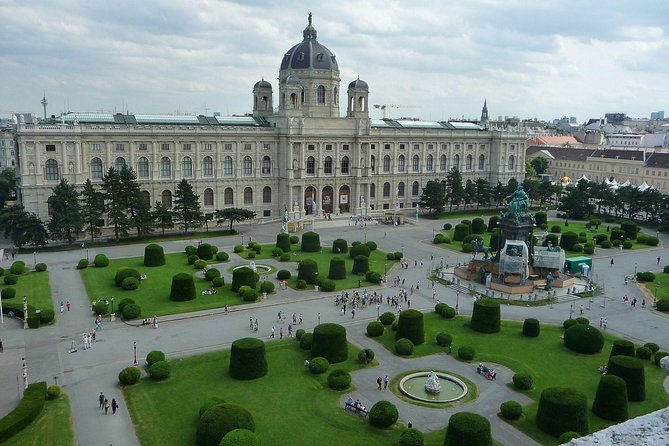
The final stretch weaves through the MuseumsQuartier and Maria Theresien Platz. This is a fitting finish because it moves from the Habsburg past to Vienna’s current cultural identity.
Maria Theresien Platz is home to the city’s largest concentration of museums. The setting makes the Habsburg habit of collecting, displaying, and organizing culture easy to see. The MuseumsQuartier then adds a more modern cultural setting, with a different feel from the palace squares and church streets.
The guide also discusses Austria’s present-day cultural, political, and economic direction. That topic gives the walk a useful endpoint. You are not left with Vienna frozen in the age of emperors. You get some help understanding the country and capital you are visiting now.
Three hours is enough for this broad overview, but not enough for extended museum visits, long interiors, or detailed exploration of every neighborhood. That is the tradeoff. You gain range and context, while a specialist museum tour would offer more depth in one place.
What the private format is worth
The cost is $566.25 per group of up to 10 people. With 10 participants, that works out to about $56.63 per person. For a couple, the same price is much harder to justify, unless private guiding is a high priority.
The value improves if your group includes family members with different interests. A private guide can adjust the explanation for children, adults, architecture fans, or people more interested in politics and religion. Biljana was praised for keeping a group of young adults engaged, while Else was appreciated for finding a comfortable pace for a couple.
The private setup also saves you from the usual group-tour compromises. You are not waiting for strangers, and you can ask for clarification without holding back a whole busload of people. Pickup may be arranged, which can make the start easier, but unless hotel pickup has been set up, you meet 15 minutes early at Cafe Hawelka on Dorotheergasse.
The tour is offered in English and includes a mobile ticket. Food and drinks are not included. Wear comfortable shoes, since the main activity is walking through the city for about three hours.
Who should book this walk?
I would choose this for a first morning or first full day in Vienna, especially if you want the city’s main districts to fit together before visiting museums on your own. It is also a good match for families and small groups who want control over pace and subject matter.
History lovers will appreciate the Habsburg burial customs, Ottoman siege context, and Ringstrasse story. Architecture fans will get a useful range, from the Hofburg and baroque churches to the Loos House and Secession building. You also get a look at modern Vienna through the MuseumsQuartier and the discussion of current affairs.
You may want something else if your goal is a long palace interior visit, a dedicated food experience, or a slow museum tour. This outing covers a lot of ground. Its strength is connection, not exhaustive time inside each attraction.
Cancellation is free if you cancel at least 24 hours before the start time. Changes or cancellations made later are not refunded, so keep that deadline in mind.
Should you book the Private Introduction to Vienna Walking Tour?
Book it if you want a private historical framework for Vienna and can share the cost with a family or larger group. The route covers the Hofburg, Stephansdom, Habsburg burial sites, old walls, Ringstrasse, Schwarzenbergplatz, Belvedere, Karlsplatz, Naschmarkt, and the MuseumsQuartier in one well-packed morning or afternoon.
For two people, compare the price with a small-group alternative before committing. For up to 10 people, the math is much better, and the chance to work with a guide such as Katarina, Selin, Biljana, or Else can make the city easier to read. You will leave with orientation, context, and a clear list of places worth returning to.
FAQ
How long is the Private Introduction to Vienna Walking Tour?
The tour lasts approximately three hours.
How much does the tour cost?
The price is $566.25 per group, with up to 10 people included.
Is the tour private?
Yes. Only your group participates in the activity.
What language is the tour offered in?
The tour is offered in English.
Where does the tour begin?
Unless hotel pickup has been arranged, meet your guide at Cafe Hawelka, Dorotheergasse 6, 1010 Vienna.
How early should I arrive?
You should meet your guide 15 minutes before the scheduled start time.
Is hotel pickup available?
Pickup is offered, but it must be arranged. Without an arranged hotel pickup, use the default meeting point at Cafe Hawelka.
Are food and drinks included?
No. Food and drinks are not included unless specifically stated.
What is the cancellation policy?
You can cancel for a full refund up to 24 hours before the experience start time. Cancellations or changes made less than 24 hours before the start are not refunded or accepted.
Just added around Vienna
- Vienna: UNESCO Schönbrunn Palace Guided Tour with Entry★ 4.5 · 94 reviews
- World War II History Vienna Old Town Private Walking Tour★ 4.8 · 9 reviews
- Vienna: Winery and Wine Tasting Tour with a Wine Expert★ 5.0 · 5 reviews
- Vienna: Wine Tasting E-Bike Tour★ 4.9 · 46 reviews
- Vienna: Wine Tasting at Schönbrunn Palace★ 4.3 · 71 reviews
- Vienna: Wine Tasting Tour★ 4.8 · 61 reviews
- Vienna: Wachau Valley Private Kayak and Wine Tour★ 5.0 · 3 reviews
- Vienna: Wiener Schnitzel and Strudel Cooking Class★ 4.9 · 126 reviews
Walking Tours, compared.

Guided Walking Tour of City Center Highlights
Read our review →
Guided Walking Tour of City Highlights & Hidden Gems
Read our review →
Vienna Historic Center Small Group Walking Tour
Read our review →
Browse the lists this tour appears in