
Reviewed · HISTORICAL TOURS
Private Vienna Highlights History Walk — WWII and Post War Vienna
Vienna’s grandest sights look different when you read them through the city’s wartime past. This private walk links the Belvedere’s post-war symbolism, the Soviet memorial, Hitler’s Anschluss speech at Heldenplatz, the Holocaust memorial at Judenplatz, and the cathedral’s wartime damage into one clear three-hour story.
I like the private format, which lets your guide adjust the pace and answer your questions instead of following a fixed group script. I also like the practical help with trams, trains, and the subway, especially if you are visiting for only a day or arriving from Bratislava or a cruise ship. The main drawback is that this is a brisk overview, not an interior tour of Vienna’s major museums and palaces. Public transport fares, food, and hotel drop-off are not included.
Key points to know before booking
- A history walk with a clear focus: The route covers Vienna’s shift from empire to Nazi rule, Soviet occupation, and modern republic.
- Private guiding for up to 10 people: Your party travels alone, with room to adjust the plan around your interests.
- A useful mix of walking and transit: The guide can help you use Vienna’s trams and other public transport between central sights.
- Major landmarks without a museum-heavy schedule: You see Belvedere Palace, the Hofburg, Heldenplatz, Judenplatz, and St. Stephen’s Cathedral from the outside.
- Strong local guide team: Walter, Brigitte, Alex, Andrea, Hannes, and Alexander Stollhof have all led this company’s tours, with Walter and Brigitte receiving especially warm praise for clear stories and personal help.
- Good fit for a short stay: The route gives you a fast orientation, but expect steady movement and only short pauses at most stops.
Why this Vienna walk works as a history tour
Many Vienna sightseeing walks stay safely in the imperial age. This one keeps the palaces and monuments, but asks what happened to them in the 20th century. That shift gives the route more purpose.
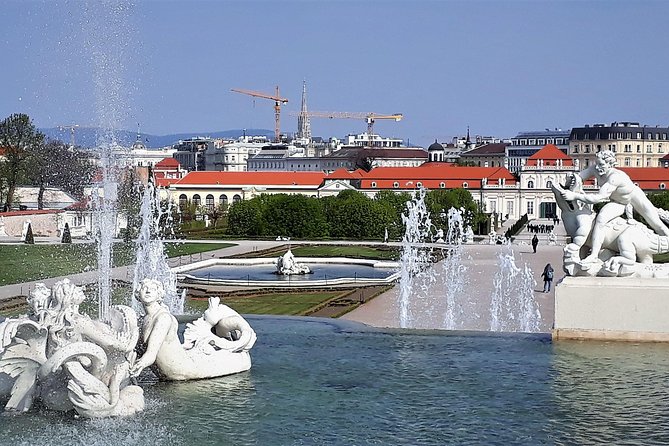
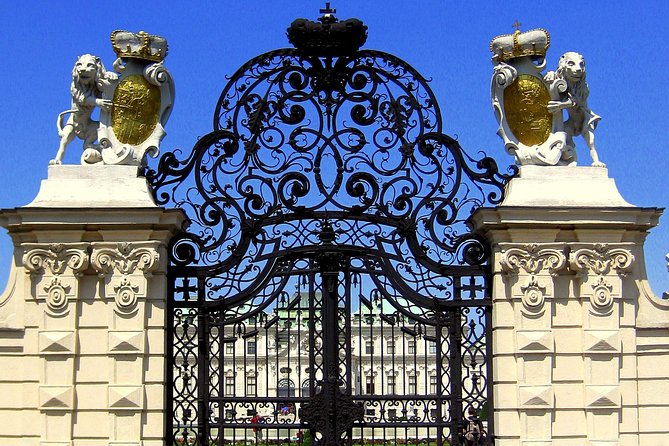
You begin with Prince Eugene’s Upper Belvedere, built for an imperial military commander who never became a ruler. From its terrace, your guide uses the view to explain a large change in Austria’s identity. The palace once expressed aristocratic power. In 1955, the Austrian State Treaty was signed there, ending the post-war occupation and restoring the country’s independence.
That opening gives you a useful framework. Vienna is not only a city of Habsburg ceremony, music, and coffeehouses. It is also a place shaped by annexation, destruction, occupation, neutrality, and the work of remembering.
The price is $342.40 for a group of up to 10 people. For one or two people, that is a serious expense. For a family or group of friends, the per-person cost becomes much more reasonable, especially since you get a private licensed Austria Guide and pickup from a hotel, rental, pier, or selected train station.
The tour lasts about three hours. That is enough time to connect the central sights, but not enough for long interior visits. If you want to spend an hour inside the Upper Belvedere viewing Klimt, or tour the Hofburg apartments, you will need a separate visit.
More Walking Tours in Vienna
- Vienna: Guided Walking Tour of City Center Highlights
★ 4.7 · 4,989 reviews - Vienna: Vienna Central Cemetery Guided Walking Tour
★ 4.8 · 3,307 reviews - Vienna: Guided Walking Tour of City Highlights & Hidden Gems
★ 4.9 · 2,180 reviews
Upper Belvedere and the view toward a new Austria
The Upper Belvedere is a strong place to begin because it gives you both beauty and political context. You pause for about 20 minutes, with admission listed as free for this outdoor stop, and look across the formal grounds and the city beyond.
The palace was built by Prince Eugene of Savoy, a military commander whose victories helped build his status in imperial Vienna. The architecture presents power in a very polished form. The gardens below reinforce that message with straight lines, controlled planting, and a carefully ordered axis between the Upper and Lower Belvedere.
Your guide reads the garden as more than decoration. Its symmetry reflects hierarchy and control, the values of a court society that wanted power to look orderly. That makes the descent through the gardens useful even if you are not especially interested in garden design.
The post-war connection changes the mood. In 1955, Austria’s state treaty was signed at the Belvedere, and the country regained its independence after the Allied occupation. The same palace that suggests imperial ambition also became connected with the birth of the Second Republic.
You should know that the stop is mainly an exterior introduction. The tour does not include museum admission, and there is no promise of a long visit inside the palace.
Schwarzenbergplatz and the uncomfortable meaning of liberation
At Schwarzenbergplatz, you see the Soviet War Memorial, erected to honor Red Army soldiers who died in the battle for Vienna in 1945. The stop lasts about 10 minutes and is free.
This is one of the most useful moments on the route because it avoids a simple victory story. The Soviet army helped defeat Nazi rule in Vienna, but Soviet forces then remained as an occupying power until 1955. The monument therefore carries two meanings at once: liberation from Nazi Germany and the beginning of Soviet control.
That tension is central to modern Austrian memory. Your guide can help you read the memorial in its setting rather than treating it as a decorative statue in a large square.
Nearby, the Hochstrahlbrunnen adds a lighter civic note. The fountain celebrates Vienna’s alpine water supply, while the French Embassy provides an elegant architectural backdrop. The pairing gives you a quick look at the presence of the Allied powers in post-war Vienna and the different ways states use public buildings and monuments to express themselves.
The Ringstraße by tram and the return of public life
A short tram ride takes you along the Ringstraße, Vienna’s grand 19th-century boulevard. Using public transport is one of this tour’s practical strengths. You do not need to work out the route on your own, and your guide can explain how the city’s system connects the central sights.
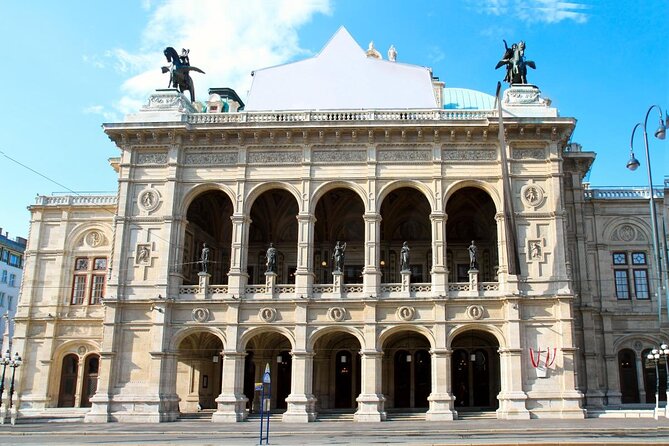
The Ringstraße was created as a showcase of imperial Vienna, lined with major civic and cultural buildings. On this route, the rebuilt State Opera becomes part of the post-war story. Its survival and restoration helped support the idea that Vienna’s cultural life could continue after bombing and destruction.
The tram portion also gives your feet a break. Still, public transport to and from the attractions is not included in the price, so you should expect to pay your own fares. The route can also be affected by weather, crowds, or normal city delays.
More history walks around Vienna:
- Vienna: Time Travel and Magic Vienna History Tour
★ 4.6 · 3,879 reviews - Vienna: World War II Historical Walking Tour
★ 4.8 · 1,772 reviews - Vienna Historic Center Small Group Walking Tour
★ 5.0 · 1,746 reviews - Time Travel-Magic Vienna History Tour Ticket
★ 4.5 · 1,099 reviews
Burggarten and the Academy of Fine Arts
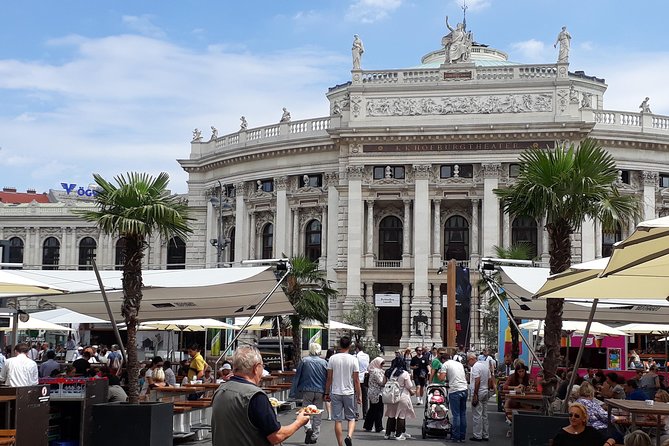
In Burggarten, a statue of Mozart recalls Vienna’s musical identity and the former imperial court. The stop is short, about five minutes, so think of it as a story point rather than a garden visit.
The nearby Academy of Fine Arts connects the elegant setting with a grim historical footnote. Adolf Hitler was rejected by the academy as a young man. Your guide can place that fact in context without pretending it explains the later course of history by itself.
This is a good example of the tour’s method. A familiar monument or building becomes a doorway into a more complicated subject. You are not simply collecting photographs of Vienna. You are learning why certain locations matter.
MuseumsQuartier and the concrete Flak tower
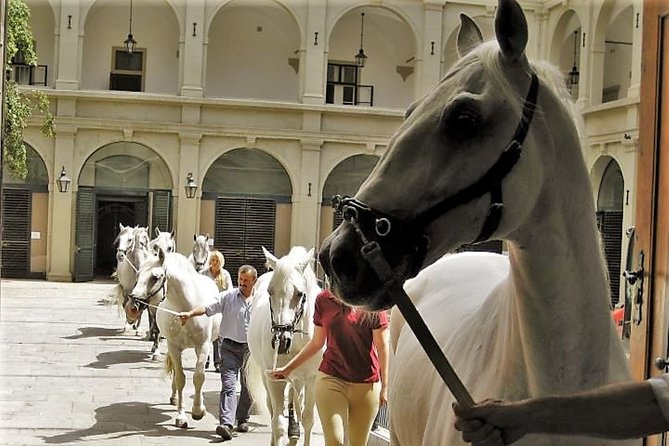
At Maria Theresa Square, the twin museums frame the statue of the empress. The square presents the confidence of the Habsburg age, with grand buildings designed to project education, art, and state power.
Behind this polished scene is one of Vienna’s six Flak towers, built as massive air-defense structures during the Second World War. The towers were designed to survive attack, and their huge concrete forms are difficult to ignore once pointed out.
The stop lasts about 10 minutes. You will not get an extended military architecture lesson, but the tower gives the war a physical presence in the middle of the city. It also shows why Vienna’s past cannot be separated into neat sections. Imperial ceremony, modern museums, and wartime military construction sit within the same urban view.
Heldenplatz and the danger of public spectacle
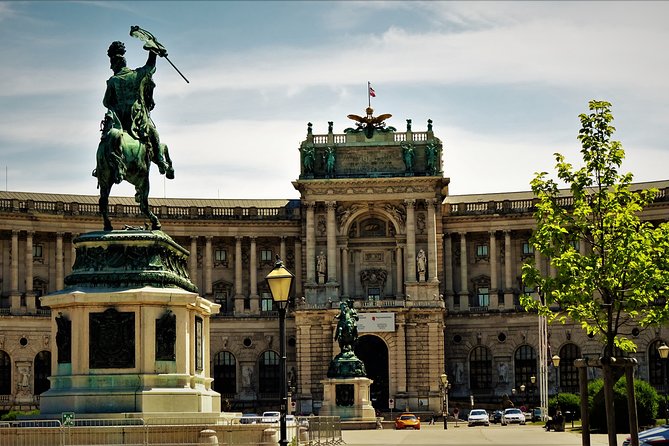
Heldenplatz is one of the tour’s most important stops. The square was designed for imperial display and military ceremony, but in March 1938 it became the setting for Hitler’s speech announcing the Anschluss, Nazi Germany’s annexation of Austria.
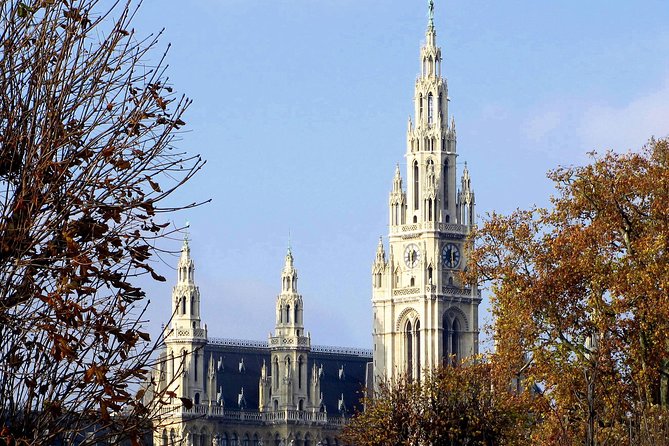
The square’s size and formal arrangement help explain how public space can be used to create political theater. The buildings around it include the Hofburg, the Austrian Parliament, Vienna City Hall, museums, and the Burgtheater. Together they form a sweeping picture of authority, culture, and public life.
You spend about 15 minutes here. That is enough for a focused explanation and photographs, but the subject deserves careful attention. If you want a longer visit to sites connected with Nazi persecution or Austrian resistance, you may need to add separate stops to your Vienna plans.
The Hofburg and Vienna’s long transfer of power
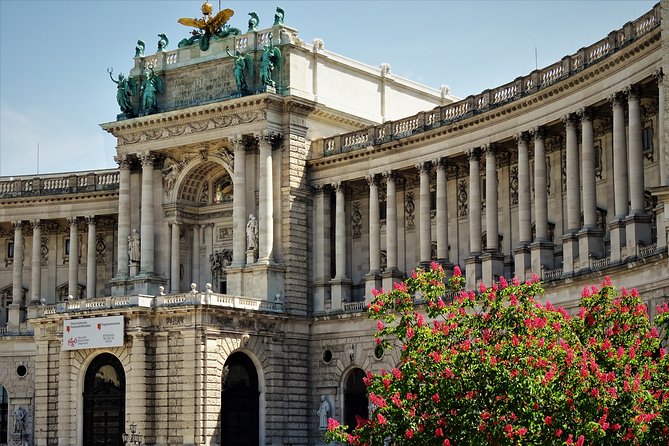
The Hofburg is not one single palace but a large complex that served as a center of power for about seven centuries. Its buildings grew over time, reflecting the changing needs of dukes, emperors, and the modern Austrian presidency.
The tour pauses here for about 15 minutes. Your guide uses the complex to explain the transition from monarchy to republic. That makes the Hofburg more than an ornate backdrop. It becomes a record of how institutions can survive while the political system around them changes.
The surrounding streets add another layer. Imperial façades meet churches, shops, and luxury boutiques. Vienna’s public image has always balanced ceremony, religion, commerce, and everyday life. You can see that mix within a few steps.
Judenplatz and the Nameless Library
Judenplatz is the quietest and most serious stop. The square marks the site of Vienna’s medieval Jewish community, destroyed in 1421. At its center is the Holocaust memorial known as the Nameless Library, commemorating the 65,000 Austrian Jews murdered in the Shoah.
You spend about 15 minutes here. The memorial’s sealed appearance and rows of book-like forms invite reflection without offering an easy visual conclusion. Your guide can connect the medieval destruction of the community with the later Nazi murder of Austrian Jews, showing that persecution in Vienna did not begin in the 20th century.
This is an essential stop, but it may feel emotionally heavy. I would not treat it as just another photo opportunity. Give yourself a quiet moment, listen closely, and allow extra time later in the day if you want to visit a museum or memorial at greater length.
The Plague Column and St. Stephen’s Cathedral
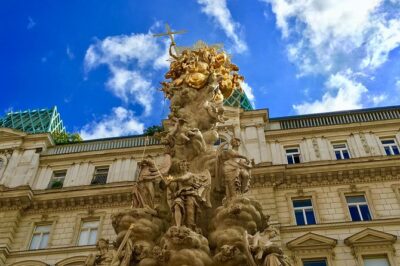
The Plague Column, or Pestsäule, brings you back to the religious and political world of the Counter-Reformation. It was created as a public expression of faith after a devastating plague, using sculpture and symbolism to present recovery as a spiritual achievement.
The stop lasts about five minutes. It is brief, but the column helps you read Vienna’s central streets as more than imperial decoration. Public monuments here often responded to crisis, whether the crisis was disease, war, or political upheaval.
The final stop is St. Stephen’s Cathedral, Vienna’s Gothic center. You spend about 10 minutes here, learning that parts of the cathedral burned in April 1945 after looters set fire to nearby shops.
That detail gives the war story a sharp ending. The destruction did not come only from direct military attack. In the confusion of the war’s final days, fire and looting damaged one of the city’s most important buildings.
The tour finishes in a central part of Vienna, but hotel drop-off is not included. You will need to make your own way back or continue sightseeing nearby.
What the guides add to the experience
The company uses several Austria Guides, including Walter, Brigitte, Alex, Andrea, Hannes, and Alexander Stollhof. Walter is especially associated with an energetic three-hour overview, quick movement through the public transport system, humorous stories, and careful attention to questions.
Brigitte is known for a warm, personal style and for adjusting a route around local interests. Alex has been praised for combining humor with solid answers, while Andrea is described as thorough and clear. Hannes and Alexander Stollhof have also led private Vienna walks for groups with specific requests.
The important point is not that every guide will deliver the same personality. The private format gives you a better chance to explain what you want at the start. Tell the guide if you prefer political history, architecture, Jewish Vienna, imperial culture, or simple orientation.
The company’s responses also suggest a useful level of flexibility around cruise passengers, day trips, and special interests. Still, your booking is confirmed within 48 hours and depends on availability, so do not assume every requested start time is guaranteed.
Who should book this private walk?
I would choose this tour if you are in Vienna for a short stay and want a strong first framework for the city. It suits people who enjoy history, public spaces, and the links between buildings and political events.
It is also a smart choice for families or friends who can share the $342.40 group price. A group of six to ten people gets much better value than a couple traveling alone.
The walk is less suitable if you want extended museum time, a slow café crawl, or a fully indoor experience. You need moderate physical fitness, and poor weather can make the outdoor sections less comfortable. Service animals are allowed, but pets are not permitted in some areas.
Pickup is available at hotels and vacation rentals in town, Vienna Central Station, Vienna West Station, and the Reichsbrücke pier. A special arrangement is available for A-Rosa passengers at Handelskai 265. The standard start times are 9:30 a.m. and 2 p.m.
Should you book it?
Book this private walk if you want Vienna’s famous sights explained through the difficult passage from empire to republic, Nazi annexation, Soviet occupation, and post-war independence. Its best features are the flexible guide, the efficient use of public transport, and the way the route connects monuments that you might otherwise see as unrelated.
Skip it if your main goal is to tour palace interiors or spend long stretches in museums. For most first-time visitors with only a day or two, though, this is a useful and serious introduction. The free cancellation policy allows a full refund when you cancel at least 24 hours before the start time, which gives you some room to adjust your plans.
FAQ
How long does the Vienna history walk last?
The tour lasts approximately three hours.
What are the available starting times?
The listed starting times are 9:30 a.m. and 2 p.m.
Is the tour private?
Yes. Only your group participates, and the group can include up to 10 people.
Is hotel pickup included?
Yes. Pickup is offered from hotels and vacation rentals in Vienna. Pickup can also be arranged at Vienna Central Station, Vienna West Station, the Reichsbrücke pier, and other agreed locations.
Is hotel drop-off included?
No. Hotel drop-off is not included.
Does the price include public transport?
No. Public transport fares to and from attractions are not included. The guide helps you use Vienna’s public transport during the route.
Are food and drinks included?
No. Food and drinks are not included.
Is admission to the listed stops included?
The listed stops are outdoor visits with admission shown as free. The tour does not include paid interior admission to attractions.
What level of fitness is needed?
You should have a moderate level of physical fitness because the experience includes walking and public transport.
Can I cancel for a full refund?
Yes. You can receive a full refund if you cancel at least 24 hours before the local start time. Cancellations or changes made less than 24 hours in advance are not accepted for a refund.
Just added around Vienna
- Vienna: UNESCO Schönbrunn Palace Guided Tour with Entry★ 4.5 · 94 reviews
- World War II History Vienna Old Town Private Walking Tour★ 4.8 · 9 reviews
- Vienna: Winery and Wine Tasting Tour with a Wine Expert★ 5.0 · 5 reviews
- Vienna: Wine Tasting E-Bike Tour★ 4.9 · 46 reviews
- Vienna: Wine Tasting at Schönbrunn Palace★ 4.3 · 71 reviews
- Vienna: Wine Tasting Tour★ 4.8 · 61 reviews
- Vienna: Wachau Valley Private Kayak and Wine Tour★ 5.0 · 3 reviews
- Vienna: Wiener Schnitzel and Strudel Cooking Class★ 4.9 · 126 reviews
Historical Tours, compared.
Vienna Historic Center Small Group Walking Tour
Read our review →
Skip-the-Line Schonbrunn Palace Guided Tour and Vienna Historical City Tour
Read our review →
Vienna Mozart Concert in Historical Costumes at the Musikverein
Read our review →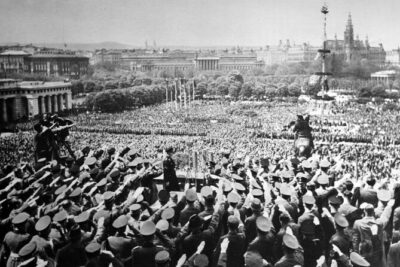
Browse the lists this tour appears in