
Reviewed · HISTORICAL TOURS
Vienna Historic Center Small Group Walking Tour
Vienna’s grand center makes a fine walking lesson, and this tour links its biggest sights in one well-planned route. You move from Maria-Theresien-Platz and the Ringstrasse to the Hofburg, Volksgarten, Graben, and St. Stephen’s Cathedral, while a guide explains how imperial power, music, science, and modern politics shaped the city.
I like the 15-person limit, which gives you a fair chance to hear the guide and ask questions. I also like the audio devices, especially on busy streets, and the practical advice on cafés, restaurants, food, and local customs. The main drawback is clear: this is chiefly an outdoor tour. You see the grand buildings, but museum entry is not included, and the pace can mean a lot of walking.
Key points to know before booking
- A 2.5-hour route covers Vienna’s essential center, from the museums at Maria-Theresien-Platz to St. Stephen’s Cathedral.
- The small group is capped at 15 people, with audio devices used so the guide can be heard.
- Guides including Dace, Giselle, Gabriela, and Beatrice are praised for clear stories, humor, and useful local advice.
- The tour is mostly exterior sightseeing, not a series of museum or palace visits.
- Expect serious walking, with one person reporting about 14,000 steps over the experience.
- Several start times and free cancellation up to 24 hours ahead make it easy to fit into a short Vienna stay.
Why this is a useful first walk in Vienna
Vienna can feel like a city built by several competing empires, artistic movements, and generations of Habsburgs. On your own, you may see an ornate façade and move on. With a guide, that façade gets a date, a purpose, and a story.
This route is especially useful on your first day. You get a map in your head before choosing which museums, churches, concert halls, and cafés deserve more of your time. Guides also offer personal suggestions for food and coffee, which can save you from spending every meal in the most obvious tourist spot.
The tour begins in central Vienna at Maria-Theresien-Platz. It ends at Stephansplatz, beside St. Stephen’s Cathedral. That start-to-finish design matters. You are not returned to an out-of-the-way meeting point, and you can continue sightseeing, shopping, or eating immediately after the walk.
The price is $72.56 per person. That is not a bargain if you expect admission tickets or lengthy interior visits. It is more defensible if you want a live history lesson, a carefully arranged route, a small group, and guidance during your first hours in the city. Vienna’s center is compact, but the amount of history packed into it is not.
More Walking Tours in Vienna
- Vienna: Guided Walking Tour of City Center Highlights
★ 4.7 · 4,989 reviews - Vienna: Vienna Central Cemetery Guided Walking Tour
★ 4.8 · 3,307 reviews - Vienna: Guided Walking Tour of City Highlights & Hidden Gems
★ 4.9 · 2,180 reviews
Maria-Theresien-Platz and the Ringstrasse
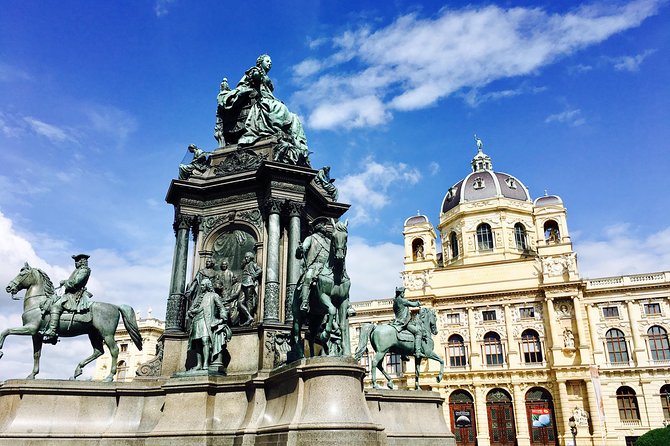
The opening stop gives you one of Vienna’s best visual introductions. Maria-Theresien-Platz sits between the Ringstrasse and the MuseumsQuartier, facing the Natural History Museum and the Kunsthistorisches Museum. Their matching façades frame the square, while the monument to Empress Maria Theresa anchors the middle.
Your guide explains the empress and the figures gathered around her monument. Wolfgang Amadeus Mozart is among the people represented there, a reminder that Vienna’s cultural story is tied closely to its imperial one.
The museums are part of the view, not part of the ticket. You will not enter either building on this tour. That is useful to know before booking, since the Kunsthistorisches Museum alone could take most of a day for an art lover.
From the square, the route reaches the Ringstrasse. This broad circular boulevard follows the line of Vienna’s former fortifications, which were replaced during the second half of the 19th century. The buildings along it use Classical, Gothic, Renaissance, and Baroque forms, often side by side.
This is one of the tour’s best teaching moments. Instead of treating the Ring as a parade of handsome buildings, the guide connects it to Vienna’s growth beyond its medieval walls. You see the City Hall, Parliament, Burgtheater, university buildings, and State Opera as parts of one grand urban plan.
Hofburg Palace and the memory of empire
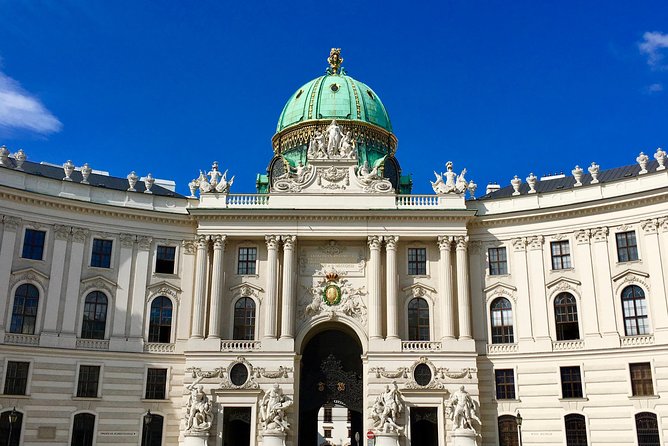
The route passes through Burgtor, the neoclassical gate built after the Napoleonic Wars, and into the Hofburg area. The former Habsburg palace is not one neat building. It is a large collection of courtyards, wings, museums, offices, and ceremonial spaces added over centuries.
That layered growth is what makes the Hofburg interesting. You learn how the palace worked as the center of imperial power, and how its courtyards and façades reflect different periods. The guide also brings in stories of emperors, empresses, court life, and the palace’s place in modern Austria.
You may hear about the empress Elisabeth, often called Sisi, whose life has been polished by popular culture but was far more complicated than the romantic image suggests. The palace area offers a useful chance to separate legend from the difficult lives behind it.
The New Castle section houses institutions including the Austrian History Museum, World Museum, Imperial Armoury, and National Library. The Austrian National Library is an important stop for understanding Vienna’s intellectual side, although you do not receive a general museum admission ticket through this walk.
The Hofburg also carries darker 20th-century memories. From the balcony of the New Castle, Adolf Hitler proclaimed Austria’s annexation into Nazi Germany in 1938. A good guide places that event in its proper historical setting rather than presenting the palace as only a pretty imperial backdrop.
At Heroes Square, you get an open view of the palace complex. The square was created after old defensive works were removed near the palace following the Napoleonic Wars. It is a fitting place to discuss how Vienna turned military defenses into ceremonial and civic space.
The Winter Riding School is another nearby landmark. It is associated with the Lipizzan horses and their performances and training. The route lets you locate it and understand where it fits within the Hofburg complex, but this tour does not promise a riding-school show.
Churches, courtyards, and small architectural surprises
St. Michael’s Church dates to 1220 and offers a change from the palace scale. Its atmosphere is more intimate, and the age of the church helps you picture Vienna before the Ringstrasse and imperial expansion transformed the city.
The route also passes the Federal Chancellery, the modern seat of Austrian government, and Vienna City Hall. Rathaus is an impressive neo-Gothic building with a strong civic role. Its grand exterior is a reminder that the Ringstrasse was not built only for palaces. It also created a stage for public institutions and city life.
Some departures may include brief access to buildings or indoor spaces such as a palace, university, café, or church, depending on the day. Treat this as a possible bonus, not the heart of the booking. The dependable part is the outdoor route and the guide’s explanation.
The tour may also point out Palais Ferstel, once home to the Austro-Hungarian National Bank and Stock Exchange. Places like this are easy to pass without context. Their value on a walking tour is not just the façade, but the explanation of how finance, government, and imperial administration occupied the same compact center.
More history walks around Vienna:
- Vienna: Time Travel and Magic Vienna History Tour
★ 4.6 · 3,879 reviews - Vienna: World War II Historical Walking Tour
★ 4.8 · 1,772 reviews - Time Travel-Magic Vienna History Tour Ticket
★ 4.5 · 1,099 reviews - Skip-the-Line Schonbrunn Palace Guided Tour and Vienna Historical City Tour
★ 3.5 · 940 reviews
Volksgarten, Burgtheater, and Vienna’s cultural life
Volksgarten provides a patch of open space after the formal palace district. At its center is the Theseus Temple, a small replica of the Hephaisteion in Athens, originally designed to display a sculpture by Antonio Canova.
The park also connects to Vienna’s musical traditions. The Cortisches coffee house was a place where Johann Strauss played waltzes. That detail helps you see coffeehouses as working cultural spaces, not just pretty rooms where you order cake.
Nearby Burgtheater is one of the city’s major theaters. The stop is brief, so you will not experience a performance, but the guide can place the theater within Vienna’s long love affair with drama, music, and public culture.
The walking commentary also reaches the University of Vienna. This gives the tour a chance to move beyond royal families and composers. You hear about figures such as Sigmund Freud and Lise Meitner, the Jewish physicist whose work changed modern science.
That range is one of the route’s strengths. Vienna is not only Habsburg ceremony and waltzes. It is also a city of universities, political debate, scientific work, cafés, and people whose ideas traveled far beyond Austria.
Freyung, Graben, and the final approach
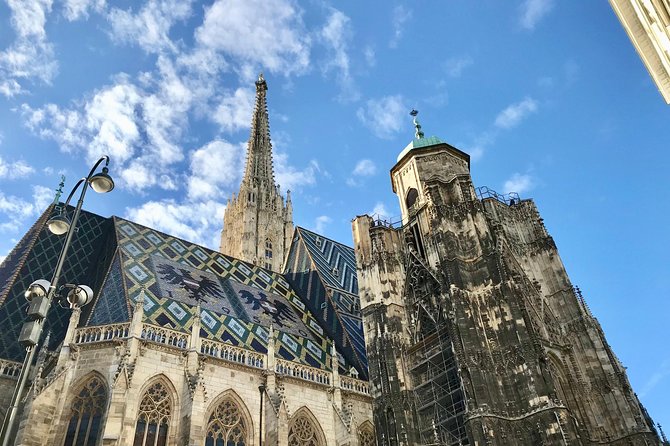
Freyung is one of the oldest squares in central Vienna. Its smaller scale and picturesque feel contrast with the wide Ringstrasse and formal Heroes Square. It is a good place to notice how quickly the city changes character from imperial avenue to older urban square.
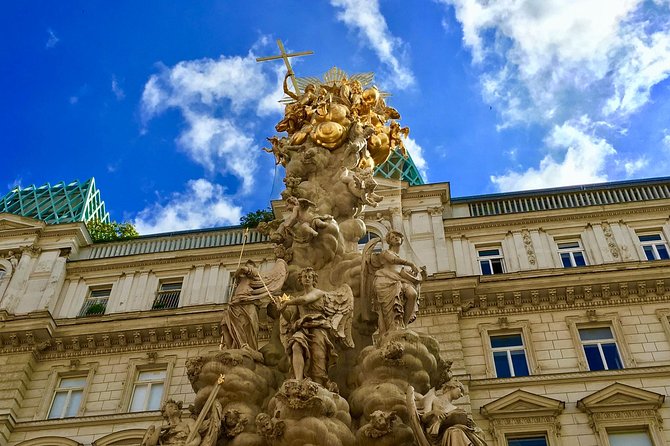
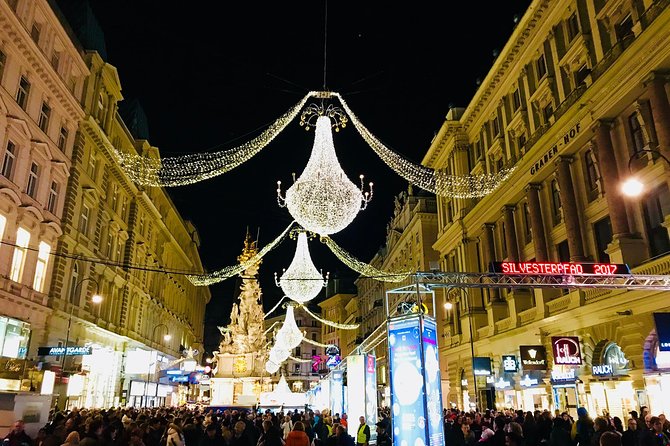
The route then moves toward Graben and Kohlmarkt, among Vienna’s most elegant pedestrian streets. These streets are useful both for orientation and for practical planning. You can return here later for shopping, people-watching, or a polished coffee stop, though prices in central Vienna can be high.
One of the most useful local suggestions concerns coffee. A coffee break at Café Demel was a highlight for one person on the tour, but it is not presented as a guaranteed stop on every departure. The guides’ café and restaurant tips are more reliable as advice than as fixed itinerary items.
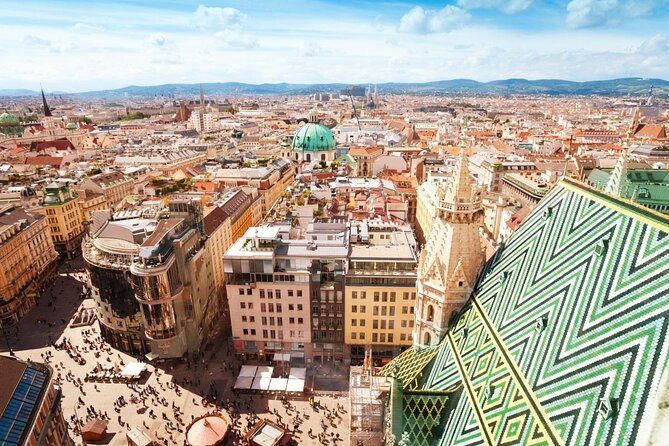
The final approach reaches Stephansplatz, the central square at the heart of the old city. This is where the walk’s many themes come together: medieval Vienna, Habsburg power, religious life, commerce, and modern city movement.
St. Stephen’s Cathedral and what happens after the tour
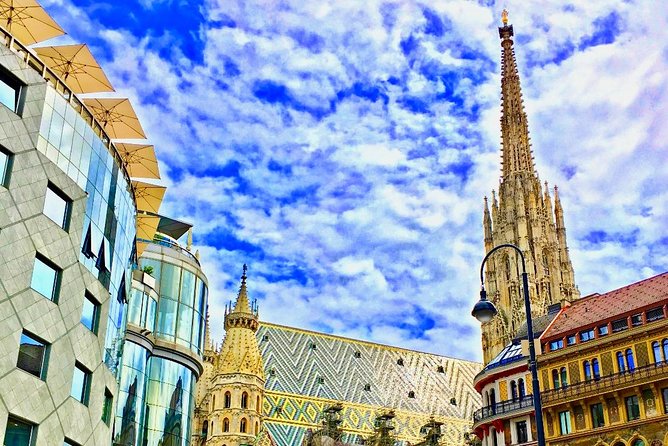
St. Stephen’s Cathedral is Vienna’s best-known landmark and the official end point. The cathedral’s exterior alone gives you plenty to examine, from its scale to its position at the center of the city.
The tour does not promise an interior visit, and admission to attractions is not included. That is the most important limitation to understand. If you want the cathedral interior, the Imperial Apartments, the Spanish Riding School, the National Library, or a major museum, plan and pay for those separately.
The ending is still practical. You can explore Stephansplatz on your own, return inside if access is available, or walk into the surrounding streets for food and shopping. The guide’s recommendations can help you use the rest of the day with less guesswork.
Pace, group size, and physical demands
Two and a half hours sounds moderate, but this is not a gentle stroll with long café pauses. You cover many districts and stop often for short explanations. One account recorded about 14,000 steps, so comfortable shoes are essential.
The route is not recommended for people with walking disorders, and you should have moderate physical fitness. Weather also matters. The experience can be canceled in poor weather, and the operator offers another date or a full refund in that case.
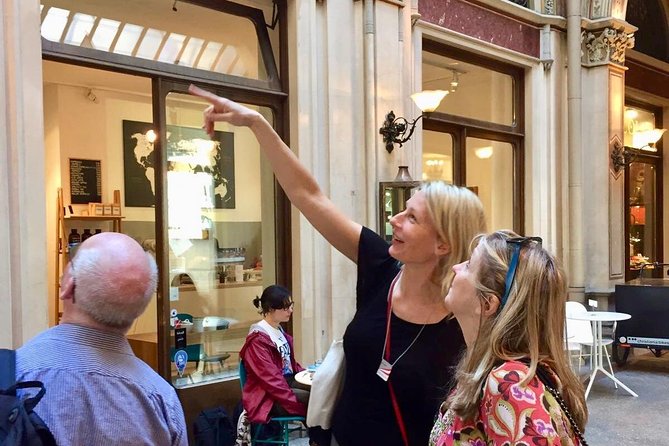
The group limit of 15 is a real benefit. Vienna’s busiest streets can swallow a large group, while a smaller group is easier to keep together. Audio devices are supplied so you can hear the guide without standing shoulder to shoulder.
Guides named in the feedback include Dace, Giselle, Gabriela, Beatrice, and Annelie. The strongest pattern is clear presentation mixed with humor and personal stories. Dace is praised for a dry sense of humor and useful behind-the-door context. Giselle is noted for warmth, history, and restaurant suggestions. Gabriela is praised for keeping people comfortable during cold weather.
The exact guide varies by departure, so book for the route and format rather than expecting one particular person.
Who should book this Vienna walk?
I would choose this tour if you are visiting Vienna for the first time, have only a few days, or want the city’s basic structure explained before visiting museums. It also suits people who enjoy history told through buildings, monuments, and short anecdotes.
It is a good fit for solo visitors, couples, and families with older children who can manage several hours on foot. The small group and audio equipment make it easier to ask questions without losing the thread of the talk.
I would choose something else if your main goal is interior access. A museum-focused tour or a palace visit will give you more time inside important sites. I would also think twice if you dislike lecture-style guiding. The experience is informative and story-led, but it is not built around hands-on activities.
At $72.56, the value depends on what you want included. You are paying for the route, guide, historical interpretation, small group, listening equipment, and local suggestions. You are not paying for museum tickets, a meal, or a performance.
Should you book it?
Book this Vienna Historic Center walk if you want a strong orientation, a small group, and a guide who can connect imperial buildings with music, science, politics, and daily life. Start it early in your stay, then use the final stop at St. Stephen’s Cathedral as a launch point for your own exploring.
Skip it if you want to spend the afternoon inside museums or dislike substantial walking. For everyone else, it offers a brisk and useful first look at Vienna, with enough context to make the rest of your visit more rewarding.
FAQ
How long does the Vienna Historic Center walking tour last?
The tour lasts approximately 2 hours and 30 minutes.
Where does the tour begin?
It begins at Maria-Theresien-Platz in central Vienna.
Where does the tour end?
The tour ends at Stephansplatz, beside St. Stephen’s Cathedral.
How many people can join the tour?
The group has a maximum of 15 people.
Is the tour offered in English?
Yes. The tour is offered in English.
Are museum and attraction admissions included?
No. The tour does not visit the inside of any museum, and attraction admission is not included. Depending on the weekday, there may be brief indoor visits to places such as churches, palaces, a university, or a café.
Can I cancel for a full refund?
Yes. You can cancel at least 24 hours before the local start time for a full refund. Cancellations or changes made less than 24 hours before the start are not refunded.
Just added around Vienna
- Vienna: UNESCO Schönbrunn Palace Guided Tour with Entry★ 4.5 · 94 reviews
- World War II History Vienna Old Town Private Walking Tour★ 4.8 · 9 reviews
- Vienna: Winery and Wine Tasting Tour with a Wine Expert★ 5.0 · 5 reviews
- Vienna: Wine Tasting E-Bike Tour★ 4.9 · 46 reviews
- Vienna: Wine Tasting at Schönbrunn Palace★ 4.3 · 71 reviews
- Vienna: Wine Tasting Tour★ 4.8 · 61 reviews
- Vienna: Wachau Valley Private Kayak and Wine Tour★ 5.0 · 3 reviews
- Vienna: Wiener Schnitzel and Strudel Cooking Class★ 4.9 · 126 reviews
Historical Tours, compared.
Skip-the-Line Schonbrunn Palace Guided Tour and Vienna Historical City Tour
Read our review →
Vienna Mozart Concert in Historical Costumes at the Musikverein
Read our review →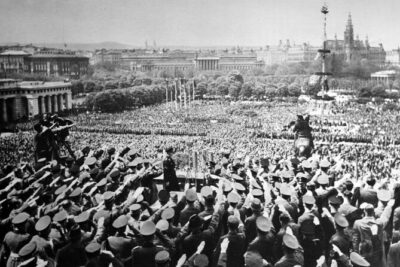
Browse the lists this tour appears in